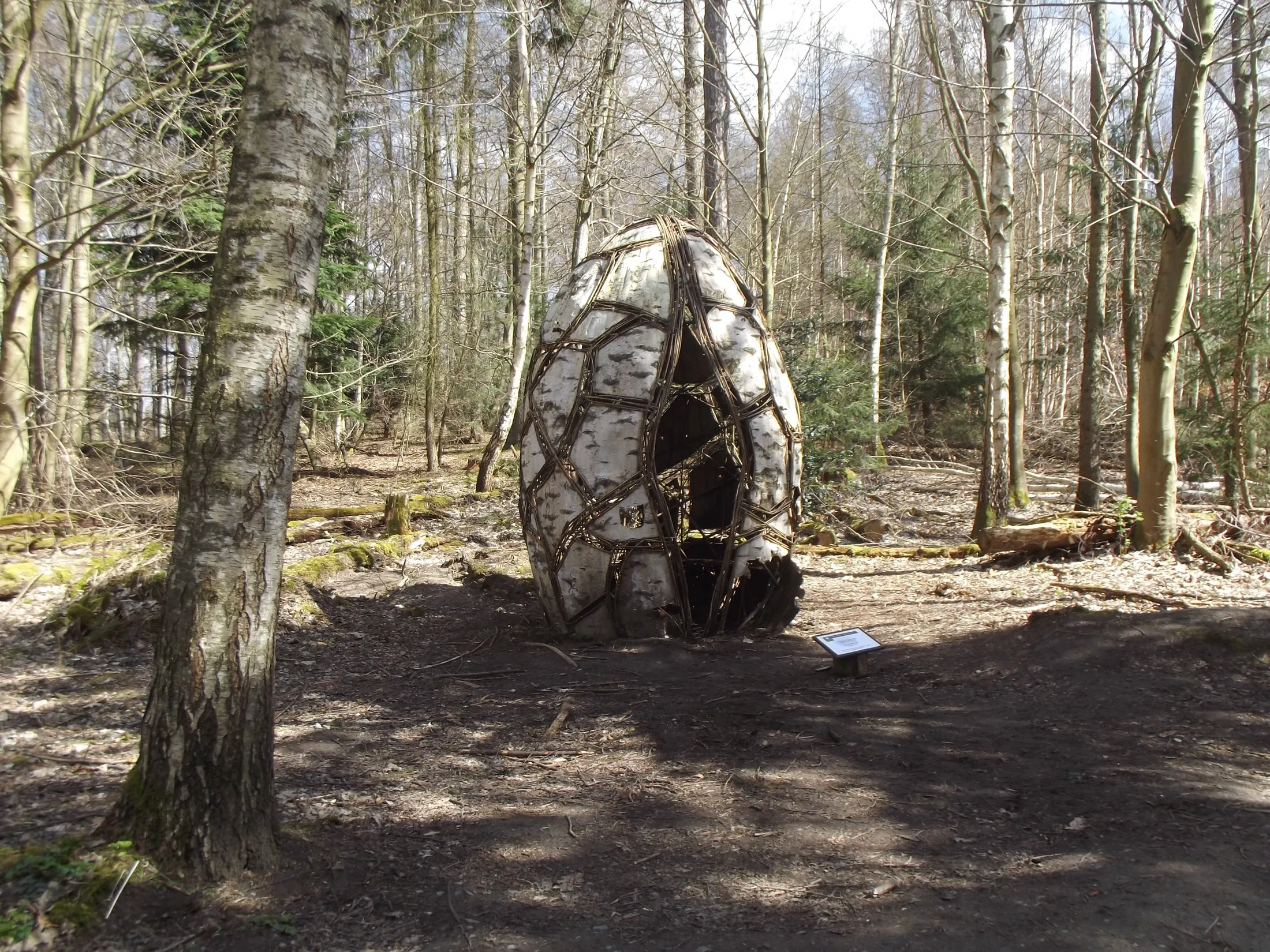
A work on the Internationaler Waldkunstpfad, Darmstadt, photographed in April 2015. Photo by Erkaha, via Wikimedia Commons — CC BY-SA 4.0.

There is no door, no desk and no rope. The gallery is 3.3 kilometres of Darmstadt forest, from the Böllenfalltor up to the Ludwigshöhe, and the works are simply standing in it.
The Verein für Internationale Waldkunst has staged the Internationaler Waldkunstpfad every two years since 2002, each edition under a different theme — Expeditionen, Laboratorium, Freiheit und Wildnis, Kunst Ökologie, and this year the thirteenth, Demokratischer Wald. The route runs past the Goethefelsen, the Goetheteich and the Ludwigshöhturm, and the organisers describe it as a Walderlebnispfad: a path designed so that finding the work is part of the work. Some pieces announce themselves. Others resolve out of the undergrowth about four seconds after you have already walked past them.
The making is the part most sculpture parks cannot offer. For three weeks each cycle the artists are in the forest building, and anyone can walk up and watch — children included, which is the stated intention. Since 2006 each cohort has been accompanied by scientists, so the wall text is not the only place the thinking happens.
The correction worth making is about time. It is easy to read the Waldkunstpfad as a permanent installation you can drop in on. It is not: this is a biennial, and the exhibition proper runs about six weeks. The thirteenth edition opened on 22 August 2026 and closes on 4 October, so as of this writing it is open right now, and this is the good half of the two-year cycle to be in Hesse.
What makes it worth the walk in the wrong year is what nobody takes down. Works are left in place after the exhibition closes, and they keep accumulating and weathering: a birch-bark shelter from an edition a decade ago, still standing with its placard beside it; Joan Backes’s Forest House, built of stacked branches for the 2010 trail and photographed intact seven years later. Moss arrives. Roofs sag. The forest is slowly editing the collection, which is more interesting than a gallery keeping it pristine. Between editions the trail is a treasure hunt through survivors rather than an exhibition, and the organisers are honest that this is what you are getting.
If you want the indoor version, the Internationales Waldkunst Zentrum sits at Ludwigshöhstraße 137 and keeps an open-air ground of works from past years; it opens Monday to Thursday 9–15 and Friday 9–14. Guided tours of the trail run during the exhibition and can be booked for groups outside it. Everything else is free, unstaffed and open whenever the forest is, which is always.