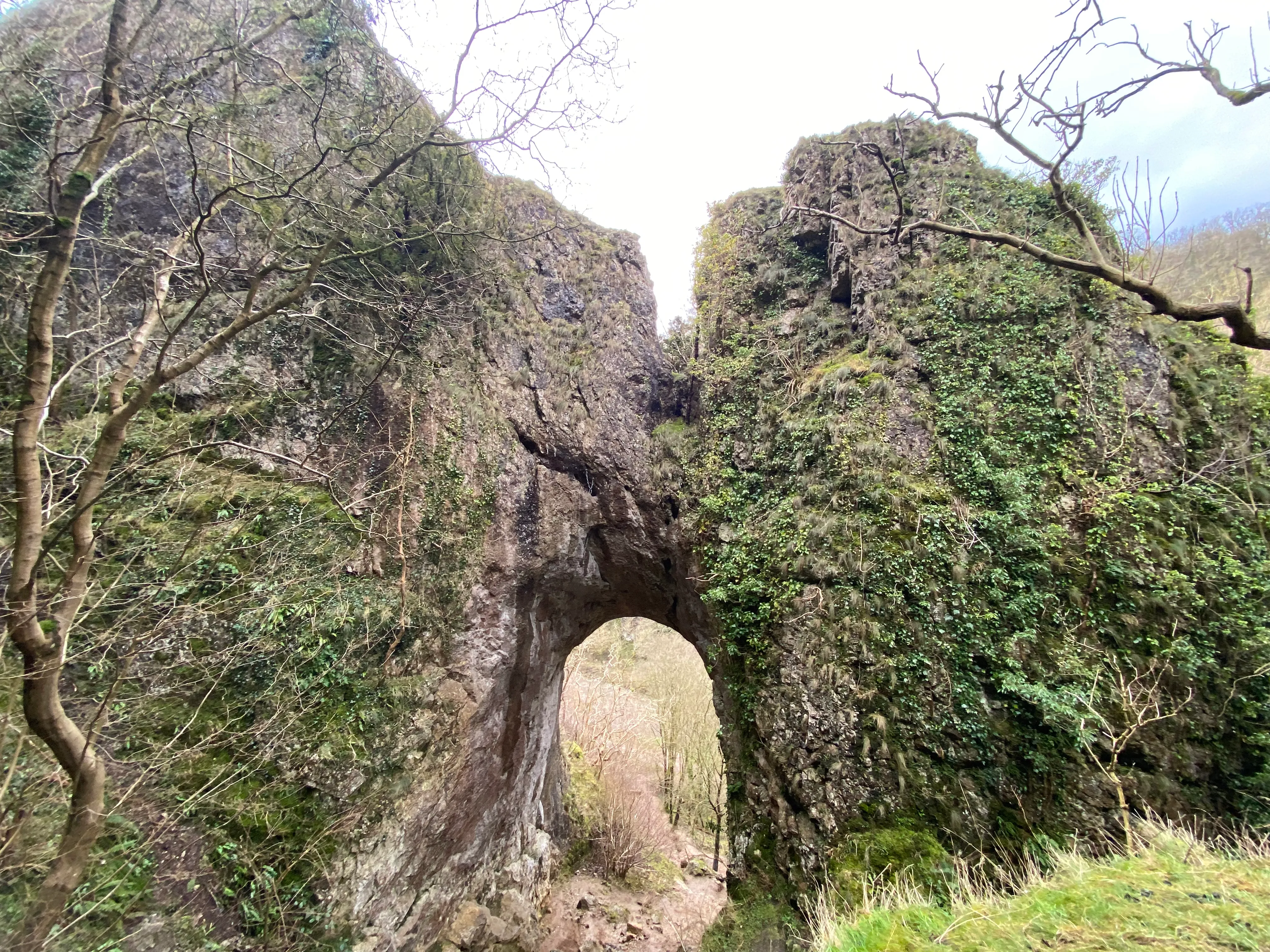
A natural arch in a Derbyshire gorge, a cave behind it, and — in the smaller cave you have to climb past the arch to reach — twenty-two coins that had no business being there.
The arch is what you come for. It stands in a section of limestone above Dovedale, wide enough to walk under and tall enough that photographs of it never quite convey the scale, and the combination of arch and cave behind it is one of the Peak District’s more distinctive pieces of rock. Excavations in the late 1950s established the obvious use: temporary shelter, on and off, through the Neolithic, the Roman period and the Middle Ages. Coins, pottery, fragments. The kind of record that says people passed through here and some of them stopped.
The find that surfaced this was built on the wrong cave, and the correction is the whole reason to make the trip. There are two caves here. Reynard’s Cave is the big one behind the arch. Reynard’s Kitchen is a separate, much smaller opening set high on the gorge wall, which you reach by climbing a steep incline and passing beneath that same arch — and it is the Kitchen, not the Cave, that produced the archaeology worth travelling for.
In 2014, archaeologists from the University of Leicester Archaeological Services excavated it alongside the National Trust and the Defence Archaeology Group’s Operation Nightingale, the programme that puts wounded and serving military personnel on digs. They recovered twenty-two coins in gold, silver and base metal — Iron Age and Roman together — plus a counterfeit thirteenth-century coin that arrived by some entirely separate accident. Two Roman brooches. A Bronze Age flint arrowhead. Two human teeth. Projectile ammunition spanning several centuries, because people have been shooting at things in this gorge for a very long time.
Two details make it genuinely strange rather than merely old. Coin hoards are extremely rare in caves at all, and the mixture of Iron Age and Roman Republican issues points at deliberate deposition — a ritual site in the first century AD rather than someone’s emergency savings. And the Iron Age coins are Corieltavi, a tribe whose territory sat well to the east of Derbyshire. Nobody has explained what their money was doing in a hole above Dovedale.
One honest caveat, because the sources disagree. The excavation also turned up bear jaw fragments and teeth; the ULAS account calls them cave bear, while a separate report of a tooth recovered from the base of the calcite layer argues the size indicates a brown bear instead. Either way the animal is not the point, and nobody can say how it got there. The coins went to Buxton Museum. The arch stays where it is, free, and takes about twenty minutes to walk up to.