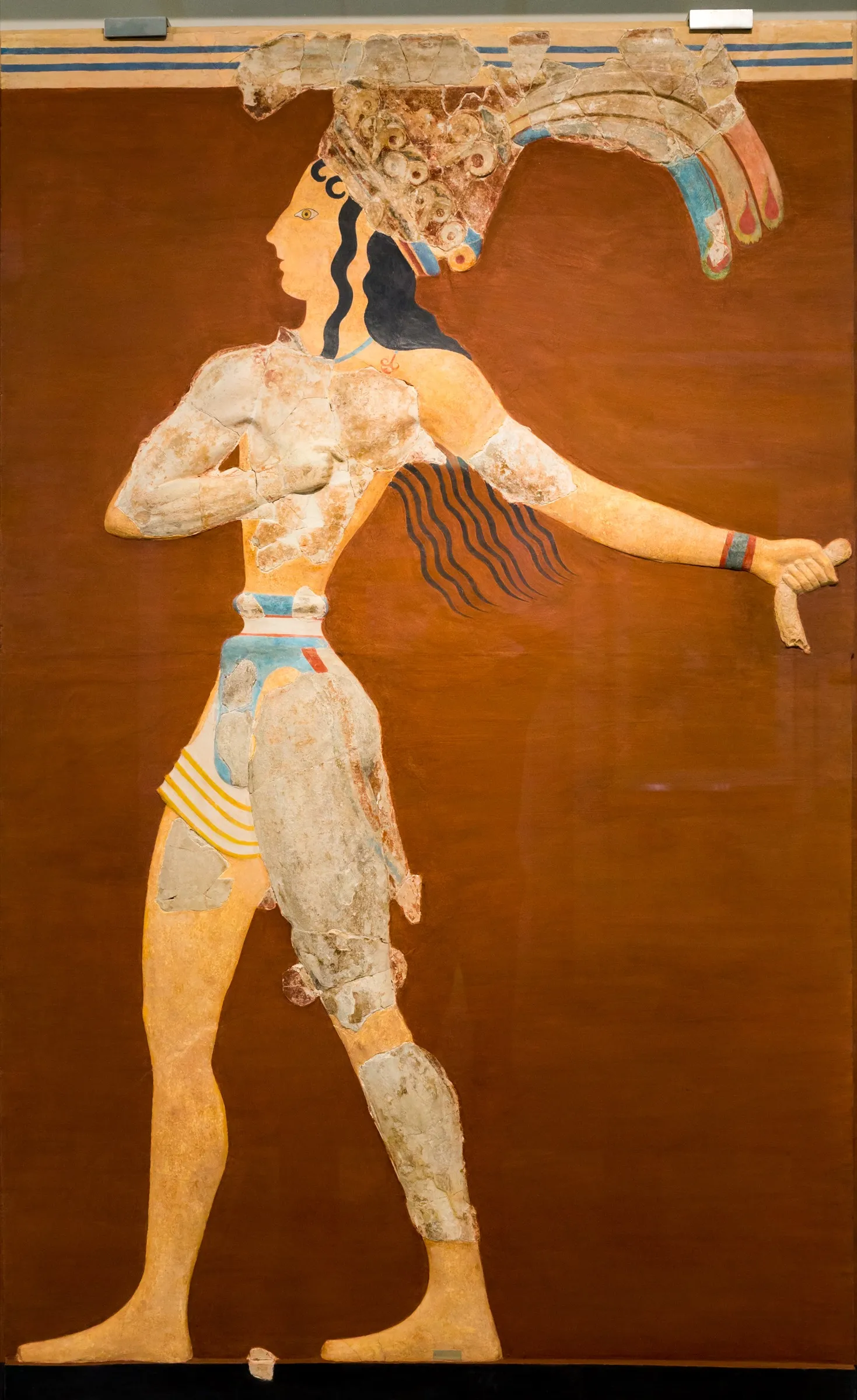
The panel as displayed in the Heraklion Archaeological Museum, 2019. The pale crazed patches are the ancient plaster; everything else is restoration. Photo by ArchaiOptix, via Wikimedia Commons — CC BY-SA 4.0.

The striding prince in the lily crown is on postcards, book covers and museum posters worldwide. The ancient material in the panel he comes from is three non-joining pieces, and no face was ever found.
The museum does not hide the seams, and they are the best thing in the case. The panel is 230 by 145 centimetres. The chalky, crazed, colour-drained islands in it are Minoan painted stucco relief from Knossos — plaster built up into low relief and then painted, sometime between 1600 and 1450 BC. They group into three pieces that do not join each other: a torso with the right fist folded to the chest, some of a leg, and a cluster of waz-lilies trailing a sweep of plumes. The profile face, the black hair, the outstretched left arm, the calves, the feet and the whole deep red ground are plaster and paint applied after 1901.
The pieces did not come out of the ground together, or even at the same depth. Duncan Mackenzie’s daybook puts them in a basement on the east side of the North–South Corridor, coming up between 11 and 16 May 1901, spread through at least 1.20 metres of soil and debris with no floor layer anywhere in the deposit. His own conclusion: “the whole space is substructure into which the fresco had fallen from the main upper floor.” They were in fill, not in place. In his first report Arthur Evans read them as the remains of no less than three figures, and wrote of the torso that “the attitude and clenched hand may suggest a boxer.” Within four years he had talked himself out of both ideas.
The men who executed the change also ran a gift business. Émile Gilliéron père (1850–1924) and his son (1885–1939) were Evans’s restorers at Knossos for more than thirty years. The father assembled the figure in 1905; the son reworked it, his final version dating to 1926. The same workshop sold reproductions of what it restored: the Metropolitan Museum alone bought close to 700 pieces from the firm between 1906 and 1933. Evelyn Waugh, in Labels (1930), named the problem without alleging fraud: “It is impossible to disregard the suspicion that their painters have tempered their zeal for accurate reconstruction with a somewhat inappropriate predilection for covers of Vogue.”
The first thing to come loose was the crown. Scholars noticed early that in Minoan art the plumed lily crown is worn by sphinxes and by women, not by striding men. In 1979 Jean Coulomb argued from the modelling of the left pectoral that the arm had been raised, not lowered, and reassigned the torso to a right-facing boxer — leaving the crown to a priestess or a sphinx and the legs to somebody else. Wolf-Dietrich Niemeier (1987–88) kept the reversal but made the figure a god, left arm extended in command. Both readings were widely accepted; both dissolved Evans’s prince.
Then it turned back. Maria Shaw went to Heraklion in 2004 and examined the plaster itself, including two joining fragments added in the 1926 restoration that neither Coulomb nor Niemeier had used — both had argued from a photograph Evans published in 1901. Shaw found long hair hanging down the left side of the body, and solid red with no hair above the right shoulder, exactly where hair had to be if the man faced right. In 2024, in the Annual of the British School at Athens, Ute Günkel-Maschek added the collar: the waz-lilies hang the way contemporary Minoan necklaces are drawn only if their wearer faces left. She proposes retiring the prince and calling him the Man with the waz-Lily Necklace.
So the tidy debunking is not quite the story either. Evans was wrong about the unity — the crown almost certainly is not this man’s, and the museum’s own catalogue record quietly drops his belief that the relief belonged to the Procession Fresco. But on the pose he abandoned his first instinct to draw, facing left with the fist on the chest, the current reading is that he was right. One correction to the version that sent us here: there is no female boxer in the literature. Coulomb’s boxers are men, Niemeier’s is a god, Shaw’s a male athlete. The female possibility attaches to the crown — a priestess, or the sphinx that is the “possibly not human at all” — and to the torso’s own sex, unanswerable now that the red-for-men, white-for-women convention has faded off the surface.
He is in Gallery XIII, case 137, catalogued as Τ7. A fuller copy with a meadow of lilies painted in behind him hangs on the restored corridor wall at Knossos, where he is photographed daily as the real thing.