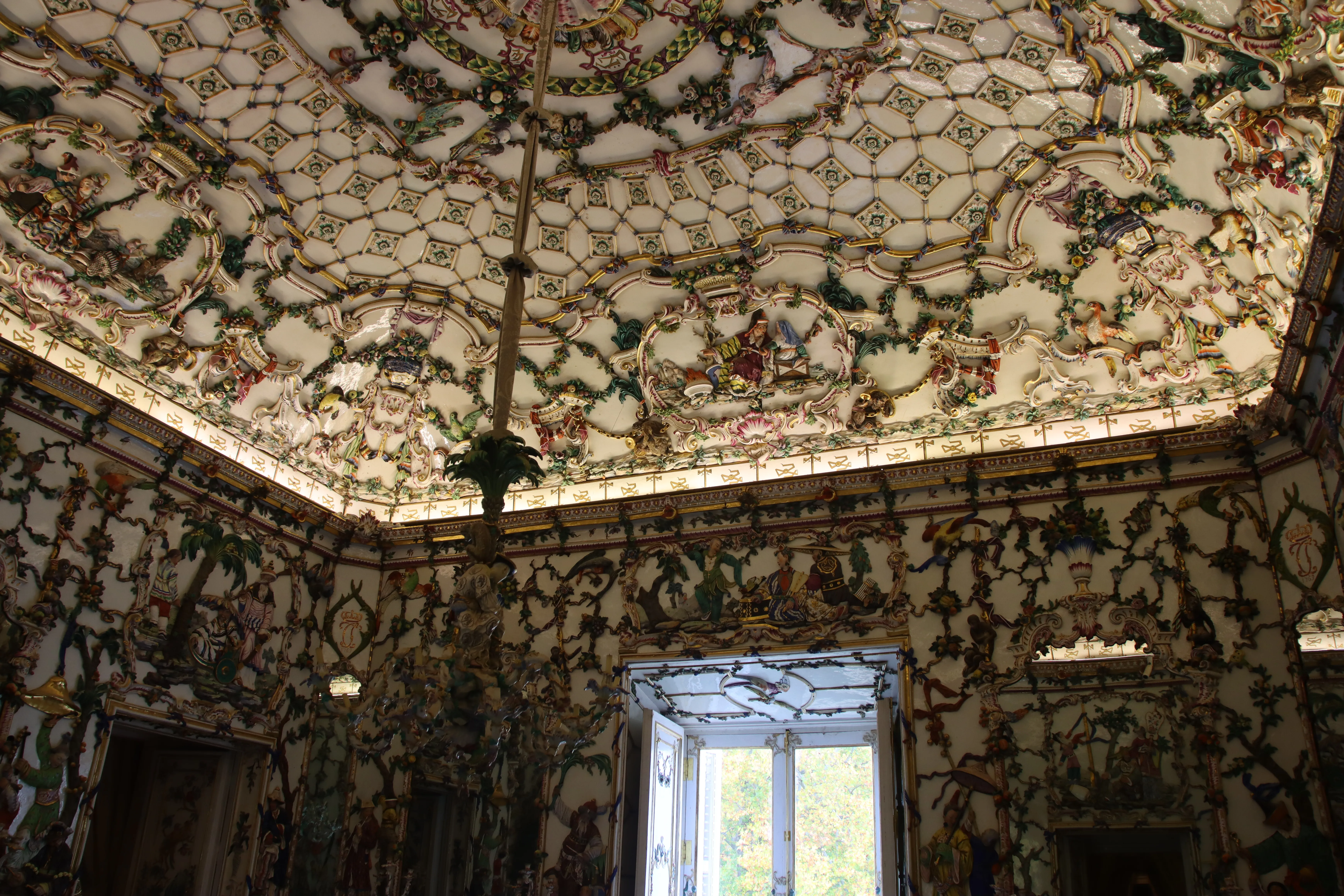
A corner of the ceiling and the palm-tree chandelier, Gabinete de Porcelana. Photo by Draceane, via Wikimedia Commons — CC BY-SA 4.0.
.jpg)
A small chamber inside the Royal Palace of Aranjuez is porcelain from floor to ceiling — walls, mirror frames, moldings, even the chandelier — thousands of interlocking plaques screwed, not glued, to a hidden wooden frame, on a system built so the whole room could in theory be taken apart and moved.
Charles III commissioned it starting in 1760 from the Real Fábrica del Buen Retiro, the royal porcelain works he’d just founded, and put the factory’s chief modeler, Italian sculptor Giuseppe Gricci, in charge. Gricci signed the baseboard “Joseph Gricci delineavit et sculpsit 1763” and stamped the year 1765 four times into the vault when the work was finished — a Rococo fever dream of Chinese mandarins, monkeys, dragons, parrots and flowering vines covering every surface of a room barely seven meters to a side, with mirrors multiplying it into a kind of porcelain infinity. It was the factory’s first major commission, and it cost 571,555 reales — a fortune, and rather the point: this was a king showing off exactly what his new factory could do.
That factory had a head start, and the screws are the proof. Before Charles inherited the Spanish throne in 1759, Gricci had modeled an earlier porcelain room in Naples for Charles’s wife, Maria Amalia, at the palace of Portici — about 3,000 pieces screwed to a wooden armature, the same removable construction later used at Aranjuez. When Charles left for Spain that year, he brought the entire Capodimonte operation with him: kilns, molds, some 40 key workers including Gricci, and nearly five tons of porcelain paste. The Naples room stayed behind, and in 1866, when the Bourbons lost the property to the new Kingdom of Italy, it actually was unscrewed and hauled off to Naples’s Capodimonte museum, where it’s on display today. The screws at Aranjuez, in other words, weren’t a decorative flourish — they were an inherited manufacturing habit, built around the idea that a porcelain room, however fixed to a wall, was still furniture.
The factory itself didn’t outlast its showpiece rooms by much. In 1812, during the Peninsular War, French troops fortified the factory building inside Madrid’s Retiro park; when Wellington’s army pushed them out of the city, he had it burned rather than leave a fortified position behind for a counterattack. It could have ended there. Instead, in 1817, Ferdinand VII rehired the surviving workforce and rebuilt the operation across town as the Royal Factory of La Moncloa, which kept making porcelain until 1849 — an unusually clean second act for a business anyone would have written off as lost to the war.
The single strangest object in the room hangs from the center of that ceiling: a porcelain chandelier shaped like a palm tree, its trunk ringed with branches for candles, a Chinese figure with a hand fan climbing the trunk while a monkey scrambles up right behind him. It’s easy to lose in a room already crowded with several hundred other porcelain creatures. Less well known is that Aranjuez’s cabinet isn’t unique — Gricci’s workshop, with Genaro Boltri and Juan Bautista de la Torre, built a second porcelain room at the Royal Palace in Madrid between 1765 and 1770, its floor designed by Matías Gasparini, and it’s part of the standard tour there too, a few rooms past the Gasparini Chamber. Most visitors see one or the other; almost nobody realizes both survive.
The room is genuinely open, and it isn’t an add-on ticket — it’s inside standard palace admission (around €12), on the normal circuit alongside the Throne Room. Aranjuez is an easy Madrid day trip: the C-3 Cercanías train leaves Atocha roughly every 20 minutes, takes about 45 minutes, and costs under €7 round trip, with the palace a 20-minute walk (or a €5 taxi) from the station. Budget 90 minutes for the full interior. The one thing to manage is scale: it’s a single room, not a wing, and photographs flatten how disorienting the mirrored corners actually are — you have to stand in the corner to feel the trick work.