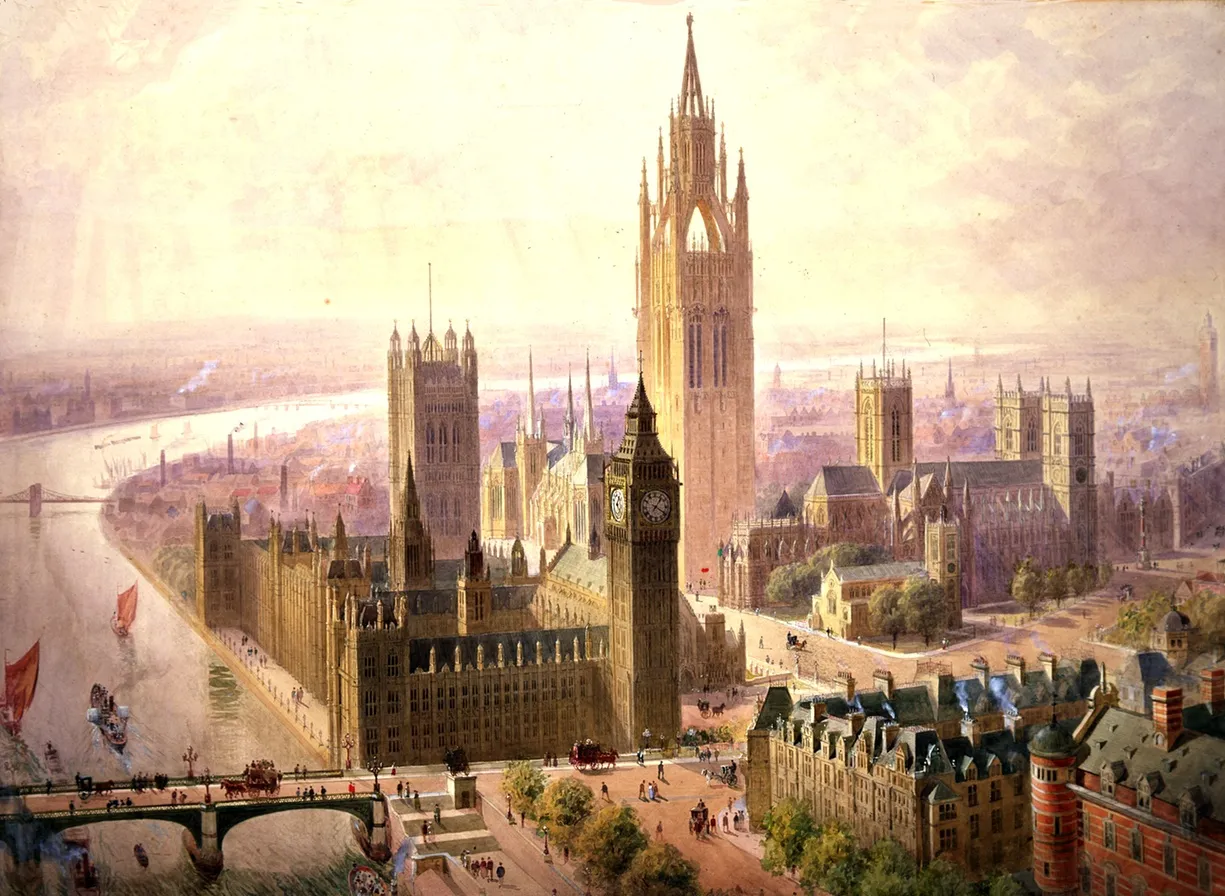
Lamb and Seddon’s 1904 design for an Imperial Monumental Hall and Tower, 167 metres, behind Big Ben. RIBA Collections, via Wikimedia Commons. Public domain.

The architect Christopher James Botham wants to know why people keep trying to leave the ground. He answers one picture at a time: nearly 300 posts on towers nobody built, flying machines that mostly didn’t fly, and the mountains in between.
Start at the Archive page, not the home feed. It sorts the posts onto shelves, and each post is usually one period drawing and a few hundred words of close reading by someone who designs buildings for a living.
The unbuilt architecture is the best shelf. Lamb and Seddon’s 1904 tower above would have stood behind Big Ben and housed the overflow of monuments from Westminster Abbey. They pitched it as “a worthy centre to the metropolis of the Empire”. Botham’s point is that it would have turned Big Ben and the Victoria Tower into its supporting cast. In c. 1900 someone proposed a “Colossal Hotel” to fill the open space under the Eiffel Tower, with four blocks, one on each side, and bridges up to the first deck. Botham calls it a jumble built to undermine the tower’s simple elegance. Robert Mills gets a triptych: his 1814 column for Baltimore, the c. 1845 winning design that ringed the Washington obelisk with a colonnaded temple, and the bare shaft that was finally built.
The flight shelf, 67 posts, is a chronology of people jumping off things. Past the myths, it runs from Abbas ibn Firnas leaping from a tower in 875 and Eilmer of Malmesbury, the monk who tried in 1010, through the Marquis de Bacqueville’s 1742 leap from a Paris roof. After that come an 1845 satirical balloon towed by a tame vulture and an 1889 patent for a bird suit, and it ends with the Wright Flyer and a 1908 multiplane that never left the ground. Read in order, it is a thousand years of hope, most of it wrong.
Behind the pictures is a thesis. A twelve-part “Theory of Verticality”, written in 2020, argues that the urge is evolutionary: tree-dwelling ancestors, then upright bodies, then gravity pulling along the axis mundi. It is earnest and long. The pictures carry the site.
A correction to our find: the flying machines are not an 1880s set but a run from the ninth century to 1908. The Eiffel drawing is a single “Colossal Hotel” that reads as four buildings, not four hotels. It is free with no account, but mostly finished: nearly all the posts date from 2020 to 2022, and apart from a quote in June 2026, nothing new has appeared since October 2024. The Eiffel post doesn’t name its architect (Google Arts & Culture credits Constant Bernard), and image sources are rarely cited.