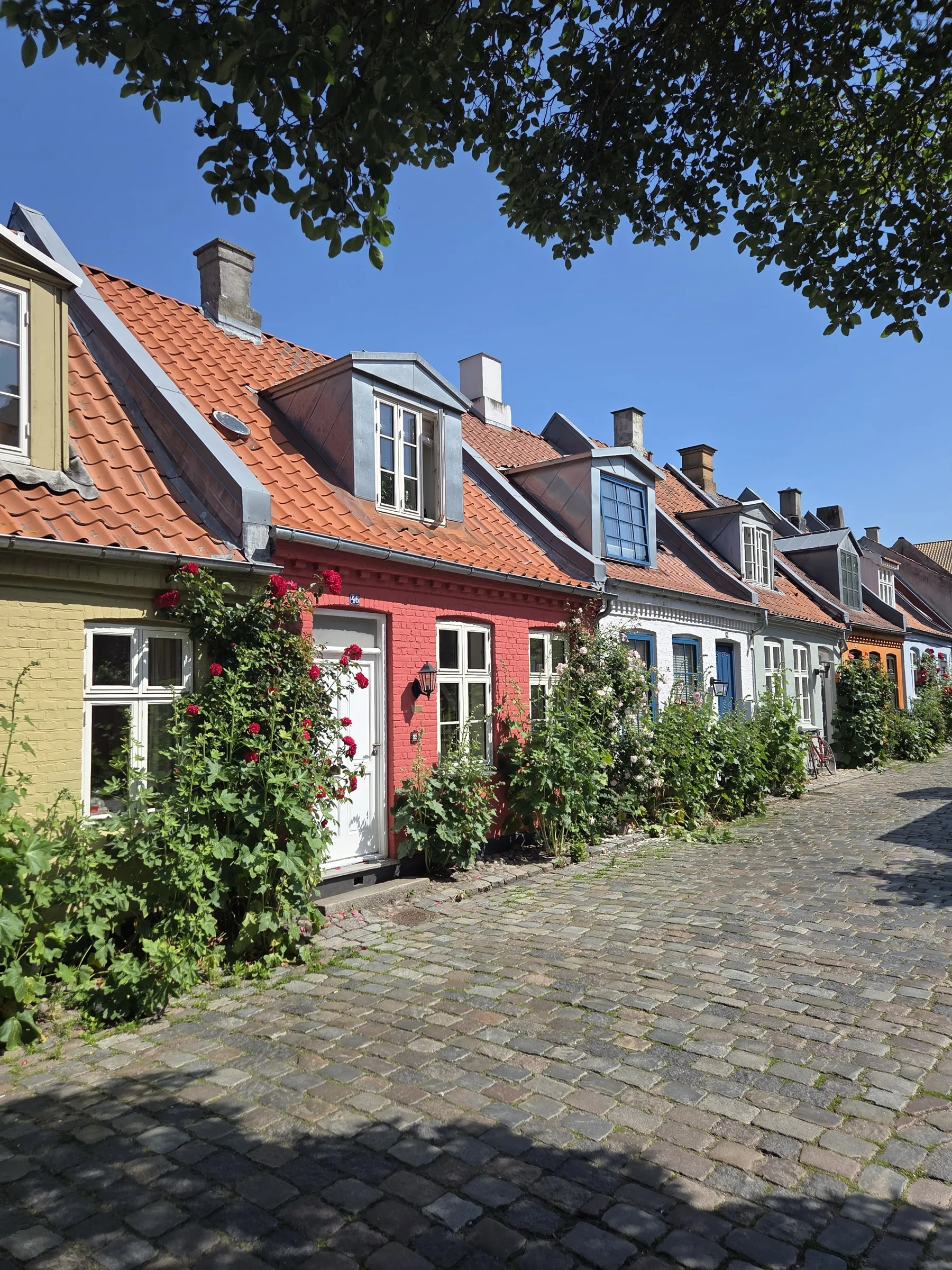
Twenty-eight small cottages washed in yellow, coral, white and pale green, a hundred metres of cobblestones, hollyhocks against every wall. It looks like something that survived. Most of what you are looking at was arranged in the 1950s.
The lane is genuinely old. Møllestien has been here since before 1300, may follow the line of a path laid in the Viking age, and has carried the name since the fifteenth century. The cottages themselves are more recent — mostly eighteenth and nineteenth century — and for almost all of that time this was not a beautiful address. It sat at the edge of the city, which is where Aarhus put its workers, its small craftsmen, and the people it had no other use for.
The record of what that meant is unusually specific. In 1686 three women from this lane were tried for witchcraft, accused of having caused the death of the city bailiff. One died in prison, reportedly under harsh interrogation. One was banished. The third was sentenced to be burned alive, and the sentence was commuted only on condition that she submit to Church discipline, after which she disappears from the street’s records entirely. At the western end, where a small park now sits, there was a burial ground for criminals, paupers and unidentified bodies; when the ground was redeveloped centuries later, thirty-eight skeletons came out of it.
So the thing worth knowing about Møllestien is that its charm is an intervention, not a survival. In the late 1950s artists and actors began moving in, renovating the cottages, painting them, and planting the hollyhocks that now climb the walls in every photograph of the street. The colours are a choice made within living memory. The flowers were put there on purpose. What reads as a lane that time forgot is a lane that a specific group of people decided to make lovely, about seventy years ago, and it worked so completely that it now looks accidental.
That is not a debunking, and it should not be read as one. It is the better story. A street can be pretty because nothing ever happened to it, or pretty because a great deal happened to it and somebody afterwards decided it should be pretty anyway. Møllestien is the second kind, which is rarer and considerably harder, and knowing it makes the hollyhocks look less like scenery and more like an argument.
Go in summer, when the hollyhocks are up. It is a hundred metres long and takes four minutes to walk, and it is a functioning residential street, so the correct behaviour is to look and keep moving.