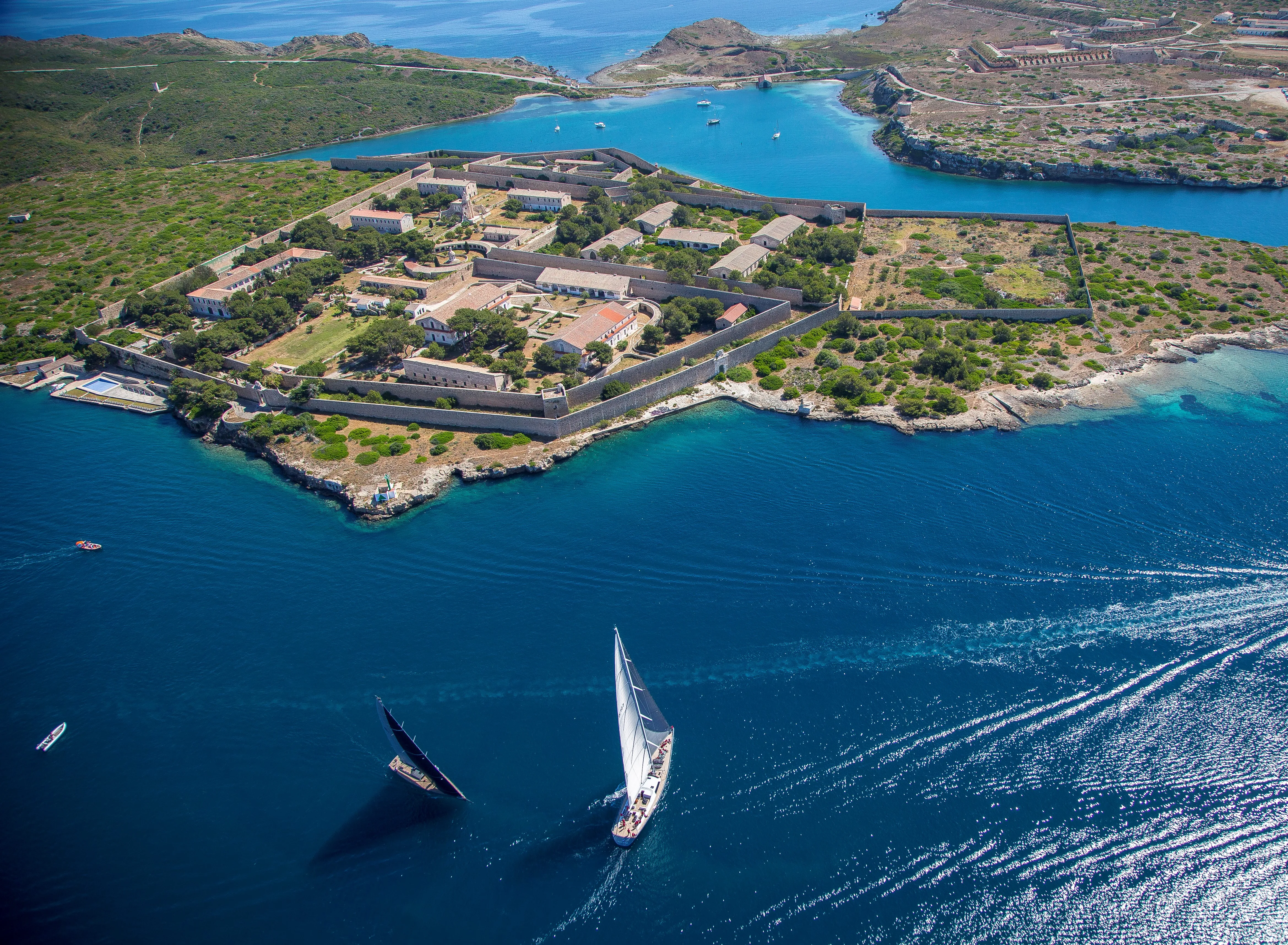
A whole island in Mahón Harbour, walled into three sealed zones so that plague, cholera and yellow fever could arrive in Europe and go no further. It worked for a century, and it is still standing.
The commission came from the Count of Floridablanca, prime minister to Charles III, in 1787. Building started in 1793 with stone recycled from a ruined fortress, stopped for the third British occupation of the island, resumed, and finished in 1807. The Lazareto opened in 1817 and ran until 1917 — an even hundred years, during which 13,864 ships, 111,184 passengers and 276,693 crew passed through it.
The architecture is a single rule made physical. A stone wall seven metres high rings the island, and inside it the complex is cut into three separate zones that never connect: one for the crews of ships with an epidemic aboard, one for sailors carrying something non-infectious, and one for ships that arrived with a single sick person on them. Each zone has its own hospital, chapel, garden, warehouse and quarters, because each zone had to be a complete world for forty days — the quaranta giorni the word itself comes from.
That triage is the part worth standing still for. Somebody had to decide, at the harbour mouth and with no test available, which of three boxes a ship belonged in, and the buildings were then arranged so that a wrong guess about one vessel could not contaminate the other two. It is risk management poured in stone by people who had no germ theory and were nevertheless completely right about what to do.
How to actually see it, because this is the part the secondhand write-ups leave out. It is an island, so there is no walking in. Boats run from Cales Fonts in Es Castell between May and October only, and the visit is a guided tour of roughly two and a half hours rather than a wander. Outside that window the site is closed to casual visitors; since the 1960s it has otherwise been used for courses and cultural events.
One correction to the version of this story that circulates: it is routinely described as nineteenth-century. The nineteenth century is when it opened. The decision, the design and the construction are all Enlightenment-era — a Bourbon prime minister’s public-health project, three decades in the building, finished a full ten years before the first ship was held there.