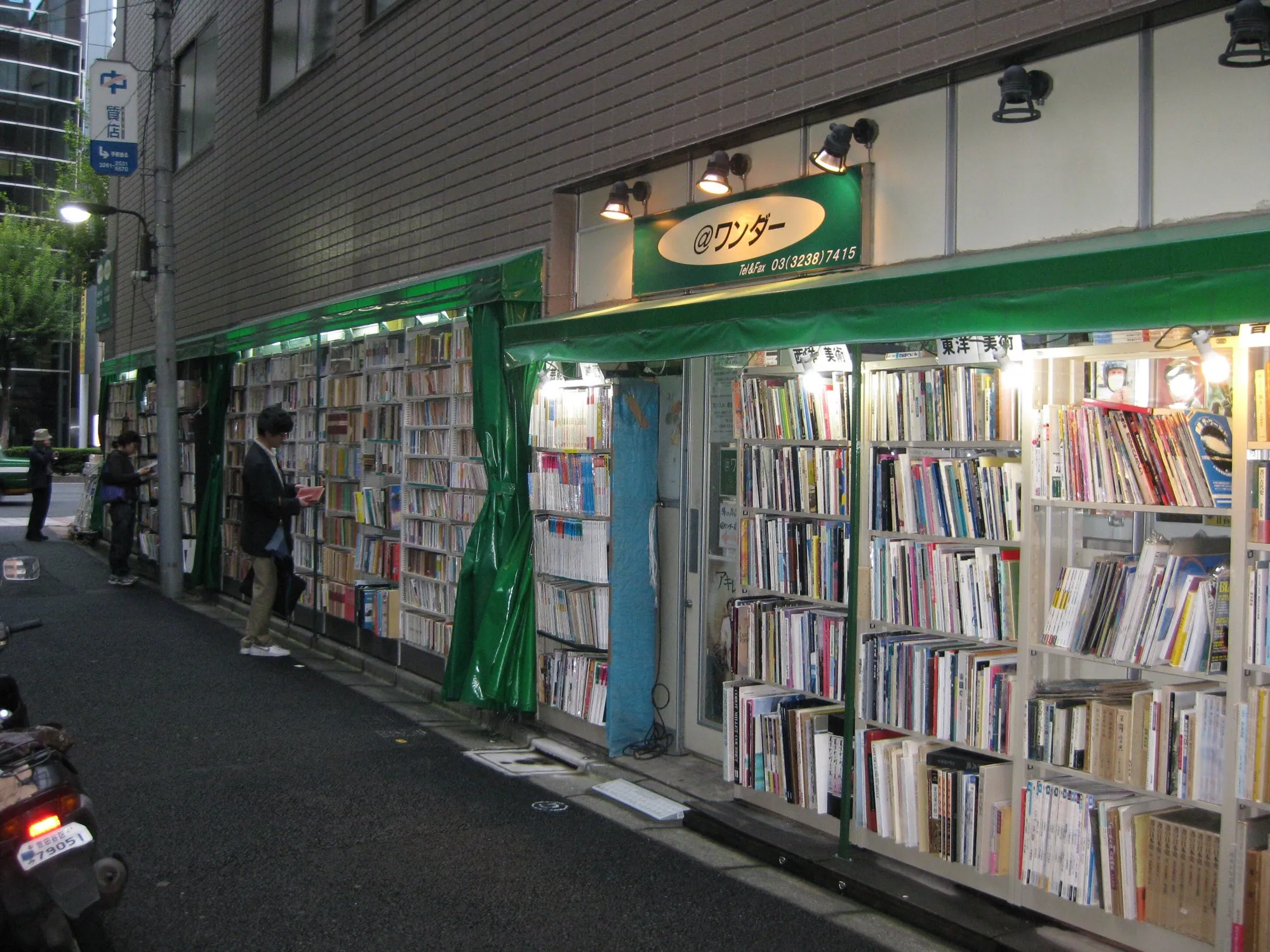
Secondhand books lining a walkway in Kanda-Jimbōchō, October 2008. Photo by Nick-D, via Wikimedia Commons — CC BY-SA 3.0.

A few blocks of Tokyo hold more used bookstores than most towns hold buildings. Jason Kottke walked into 20 or 30 of them in an afternoon and still only got through four favorites.
Jimbōchō sits a short walk from Ochanomizu and Jimbōchō stations, and it is Tokyo’s book district the way SoHo is New York’s gallery district — dense, walkable, and organized by nobody in particular. Kottke put the count at “more than 100”; the Kanda Bookstore Federation’s own tally, in 2021, was 176, or roughly a third of every secondhand bookstore in Japan.
Four shops earned repeat visits. Kitazawa Bookstore, an English-language shop the Kitazawa family has run since 1902, turned up a leather-bound Pride and Prejudice and a 1940s For Whom the Bell Tolls, shelved beneath hand-lettered notes asking customers to hold each book with both hands. Komiyama Shoten’s design floor held a cache of 1990s Raygun magazines and a Kids (1995) poster signed by Larry Clark. Ohya Shobu deals only in Edo- and Meiji-period volumes, woodblock prints, and maps — a huge one of old Edo fills its window. At Sawaguchi Book Store, a staircase wallpapered in posters climbs to a reading nook with two vending machines, where a Princess Mononoke poster was going for ¥50,000.
The density traces back further than any one shop. Foreign-studies schools that grew into the University of Tokyo opened nearby in the late 1800s, and bookstores followed the students. A fire tore through the district in 1913; a former teacher named Shigeo Iwanami opened a bookstore in the aftermath that grew into Iwanami Shoten, still one of Japan’s major publishers. Cheap “one-yen” paperbacks fed the secondhand trade through the 1930s, and by the 1950s the shops had specialized — maps and prints in one window, art and design books in the next, whatever a professor down the street needed in between.
Every autumn the street turns itself inside out for the Kanda Used Book Festival, in its 66th year and running October 23 to November 1 in 2026, when dealers line Yasukuni-dōri with an estimated million volumes. The rest of the year needs no ticket — just Jimbōchō Station (Tokyo Metro Hanzōmon, Toei Mita and Shinjuku lines) or Ochanomizu on the JR lines, and patience for shelves that don’t sort alphabetically in a language you read.