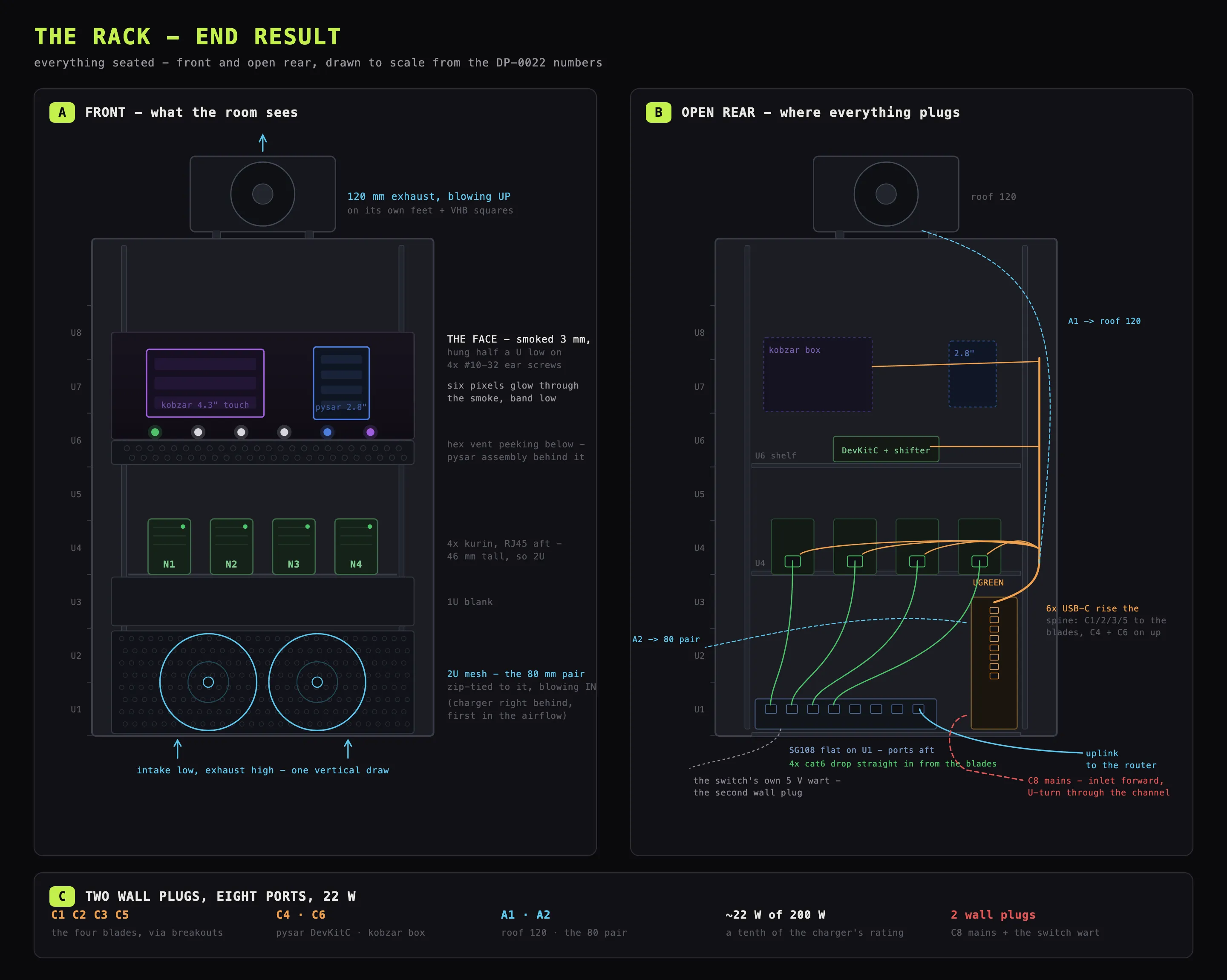
A personal website served from a shelf in a London flat by six ESP32-S3 boards costing about £12 each. No cloud, no CDN, not even a Raspberry Pi — and when you kill whichever board is currently serving, another takes over the same MAC address, IP and TLS certificate in under four seconds.
One correction to the first pass, because it changes what the project is: only four of the six boards run the election. Those four are the serving blades. The other two drive the faces on the front of the rack — a 2.8-inch screen called pysar and a 4.3-inch touch panel called kobzar — and take no part in deciding who is in charge.
The election itself is the good idea, and its cleverness is in what it refuses to be. There is no consensus protocol here. The rule is arithmetic and preemptive: the lowest-numbered healthy, serving blade leads, re-evaluated at 1 Hz. Crucially the vote runs over encrypted ESP-NOW radio rather than over the wired network the site is served on, so a dead switch or a pulled cable cannot produce two blades that each believe they are the leader. The failure domain of the election and the failure domain of the traffic are deliberately different.
Health is checked from both directions, which is the detail that separates this from a weekend project. Every blade opens a TCP connection to its own public port every seven seconds and stands down from the election when that fails — so a blade that is unreachable from the outside world removes itself, even if it feels fine internally. Independently, the splicer benches backends based on bytes actually returned rather than on a port being open.
The performance numbers are published rather than glossed, and they are small on purpose. TLS 1.3 terminates on the serving blade, where a P-256 handshake is, in the author’s phrase, 99% of the toll: about 2.9 to 3.0 fresh TLS connections per second. Warm keep-alive requests land in 40 to 60 ms at roughly 40 to 50 requests per second fleet-wide, and past about 100 req/s the splicer’s own network interface becomes the ceiling. The whole rack draws around 22 W.
It needs a static public IP and a router you can port-forward on, so it is not a recipe everyone can follow. It is MIT-licensed, thoroughly documented, and the site is up — which is the only benchmark that finally matters.