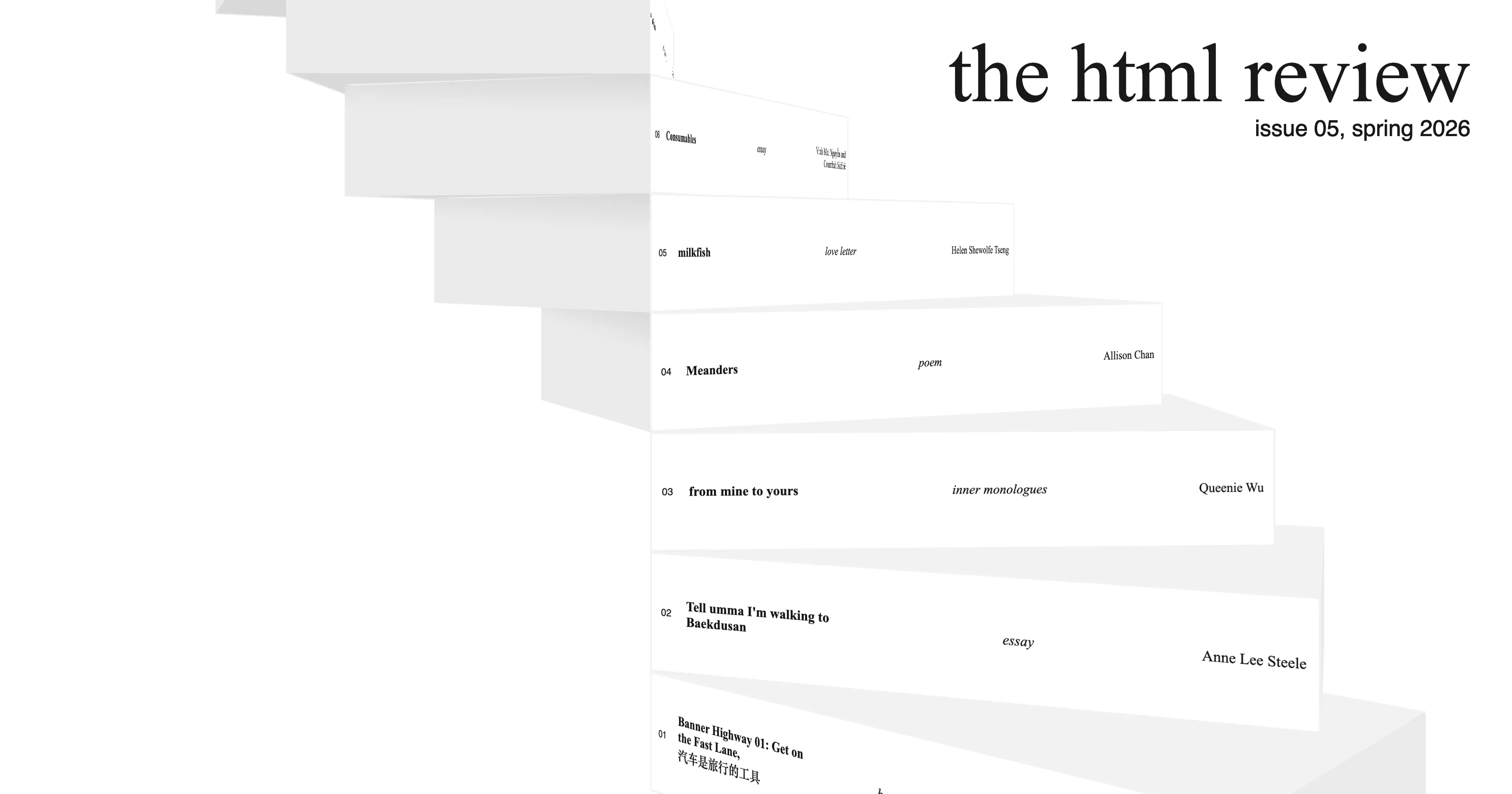
The HTML Review is a free annual journal of “literature made to exist on the web” — not writing that happens to be published online, but writing where the page is the medium. Issue 05 (Spring 2026) is fifteen pieces long, and most of them stop making sense the moment you try to print them.
Edited by Shelby Wilson and Maxwell Neely-Cohen, the journal publishes one issue a year, on the first day of Spring, and has done since Issue 01 in 2022. It is free to read, with no account and no paywall; submissions open for a single month each year (November 1 to December 1), contributors are paid $500 per piece, and they keep their work in perpetuity — the review only archives a copy of the code. That last detail is the tell. This is a journal whose editorial process covers “text, design, and code,” because for most of what it prints the three are the same object.
The distinction it’s drawing is narrower than “digital literature” and worth stating precisely. A PDF poem, a Substack essay, a Kindle novel — all of those are print that arrived by wire. What the HTML Review wants is work that could not have been made anywhere else: the cursor, the scroll, the hyperlink, the stylesheet, the fact that other people are on the page with you right now. It isn’t a new idea, but it is an unusually well-edited one, and the results have landed in places that don’t normally read literary magazines — pieces from past issues have taken the New Media Writing Prize and been shown at Rhizome, Pioneer Works, and the de Young.
Three from this issue give the shape of it. “Intersymmetric: Connect” by James Bradbury, Rian Treanor, and Mark Fell is a multiplayer music system: a browser instrument where your inputs are broadcast to everyone else currently on the page (the system shares pattern data, not audio streams), so the thing you are playing is also being played by strangers. Its text frames that as the social survey curdling into surveillance — the minutiae of a life, “recorded, mapped, controlled.” “carecore” by Raphaël Bastide, which the issue files under the genre “CSS botany,” is a persistent shared garden: plant one seed a day, feed other people’s plants, treat them against parasites, compost the dead ones for nutrients. It is dedicated “to all caregivers, whether by choice or circumstance,” and Bastide built it in explicit reaction to AI-generated interfaces — his argument being that you cannot care for a black box. And “Banner Highway 01” by Richard Lewei Huang and Yufeng Zhao rebuilds the old Burma-Shave roadside sign poems out of salvaged late-90s banner ads, scrolled through like a highway; click any banner and it confesses its original metadata. Elsewhere in the issue: a CSS webtoon (“les aventures de mr mister in the land of lines” by zeste le reste), an Itsẹkiri folktale (“Kp’ọjọ kp’ọjọ” by Omayeli Arenyeka), and a page that is simply a place to sit next to someone (“Cursor Park” by Christopher Shank).
The honest limits: this is an annual, so the entire body of work is five issues — 74 pieces since 2022, and you can read the good half of any one of them in an evening. The hit rate is what you’d expect from an art form with no settled grammar; some pieces are genuinely moving, some are a clever mechanic in search of a text, and a few want a landscape screen and an unmuted device before they’ll work at all. It is also art, not utility — nothing here saves you time or solves a problem. What it does is make a case, once a year and for free, that the web is a place you can write in rather than to, and Issue 05 is the strongest argument the journal has made yet.