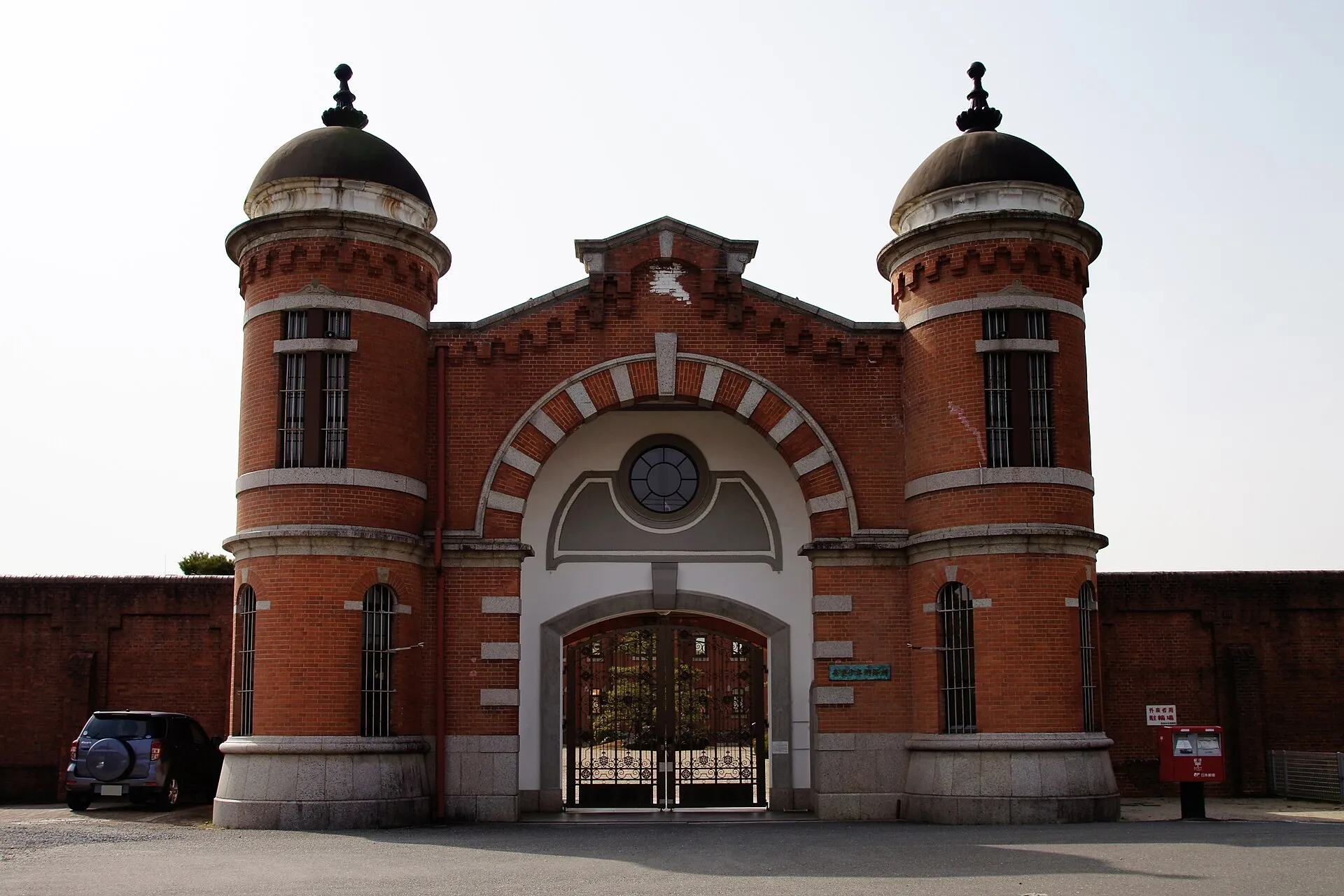
The 1908 gatehouse, unchanged. Photo: 663highland, 2013, CC BY 2.5, via Wikimedia Commons.
The gate, the five radial wings and the barred arched windows are all still there. What changed is who sleeps inside, and for how much.
Japan built five great prisons in the Meiji era, and it built them to be looked at. The government of the 1890s wanted the unequal treaties with the Western powers revised, and one of the arguments it could make was a modern, humane penal system in the European style — so the prisons were designed as a diplomatic exhibit, red brick and Romanesque arches, with radial cell wings fanning out from a central hall. Nara’s was completed in 1908 by the Ministry of Justice architect Yamashita Keijirō. Of the five, it is the only one that survives intact, and it is the one that kept working the longest.
It did not stop being a prison until 2017. From 1946 it was the Nara Juvenile Prison, where sixteen vocational programmes — the hotel’s own history singles out the Wakakusa Barbershop, which was open to the public and cut the hair of over eighteen thousand townspeople — were meant to walk young men back into society. When the last inmates left, the complex was designated an Important Cultural Property, and a public-private partnership spent seven years working out how to keep a listed prison standing by finding it a use. The answer opened on 25 June 2026 as a Hoshinoya, the luxury tier of Hoshino Resorts.
The conversion is the interesting part, because the constraints of a listed building are exactly what keep it from being a themed hotel. The cells were too small to be rooms, so each of the 48 suites is a run of nine, ten or eleven adjoining cells knocked through along a wing — bedroom, dining and living area in sequence, with the original brick and the high, arched windows left as they were. Hoshinoya says the living and dining areas were deliberately left without blinds so the shadows those windows throw can cross the brick during the day. The joinery is European cherry, chosen as a nod to the Meiji builders learning Western construction; the cups are Arita porcelain. A lot of the hotel’s own copy is about that light.
The prison is not hidden, either. The Nara Prison Museum sits inside the complex, free and open to guests, and Wallpaper*’s report says the preserved Cell Block D is reached after hours through a private side door. The activity list is Meiji-themed rather than prison-themed — a gramophone evening, perfume blending, a rickshaw tour of the city, morning exercise with wooden dumbbells, and a staff-led walk through the buildings called The Promenade of Time.
Honest notes. It is a hotel for one or two people per suite, from around ¥147,000 a night per Wallpaper*, and the official site’s room pages did not resolve for us — the numbers above come from Hoshinoya’s own story pages and Wallpaper*’s reporting. It sits at 18 Hannyaji-chō, a couple of kilometres north of Tōdai-ji and the deer park. If you are not staying, the gate photographed above is on a public street, and the museum’s opening arrangements for non-guests are worth checking with the hotel before you plan a visit around it.