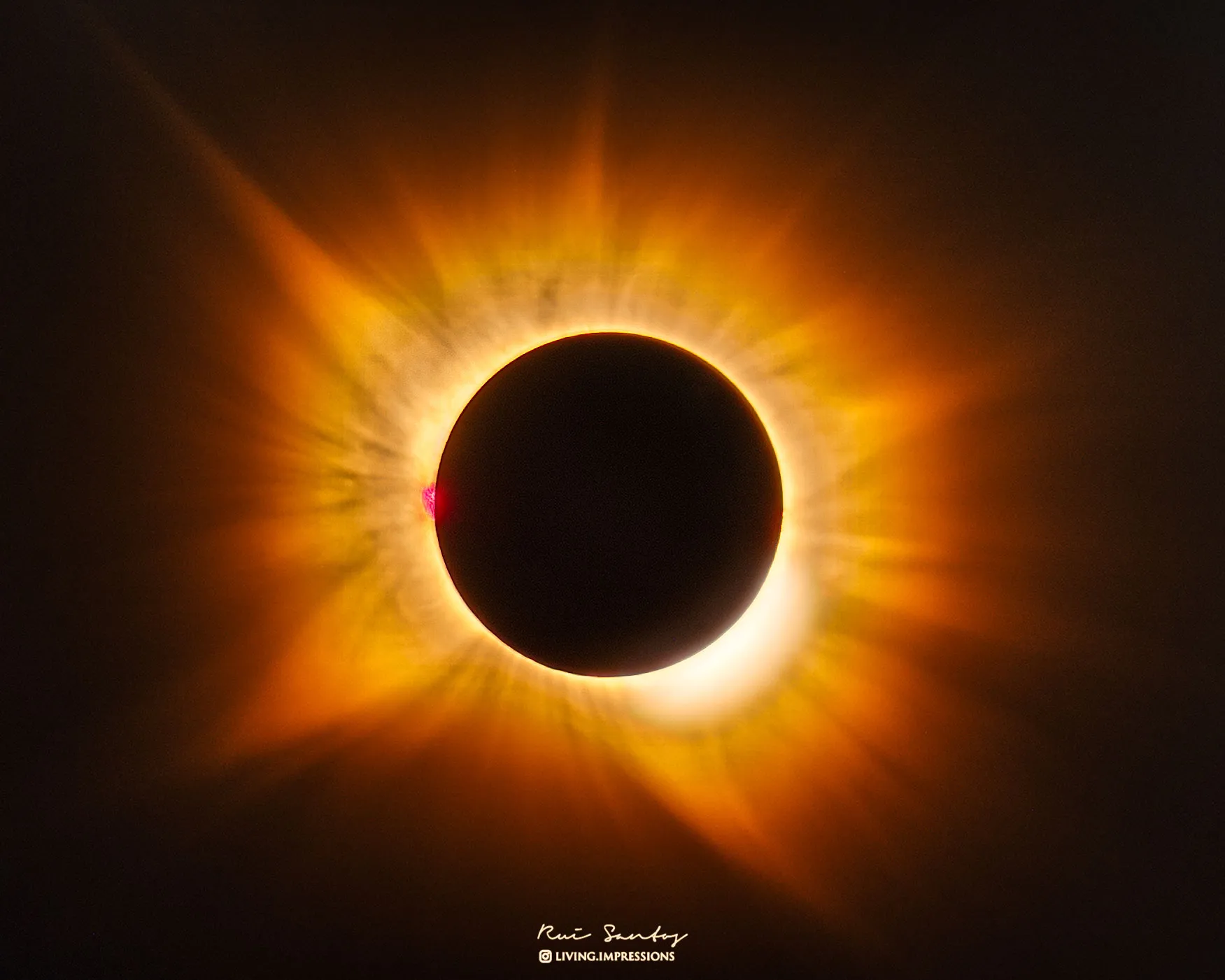
The corona of a total eclipse is white. On 12 August, from one town in Spain, it came out gold — and not because the corona had changed.
Spain sat at the tail end of this eclipse’s path, which is the whole reason for the colour. At Benavente the sun was nine degrees above the horizon at maximum and totality ran eighty-three seconds. Nine degrees means the corona’s light had to cross an enormous slab of atmosphere to reach the lens, and a long path through air scatters blue out of whatever travels along it — the identical mechanism that reddens every sunset anyone has ever watched.
The second filter was smoke. Spain’s August wildfires had put an unusual quantity of it into the air, and it did to the light exactly what the air had already done: took out more of the blue that survived the first pass, and deepened a frame that was already gold-dominated.
Which is the correction worth making, because it is the opposite of how the picture reads. The gold was not a property of the eclipse. Observers of the same totality, standing elsewhere, reported the ordinary pearl-white corona. The colour is a fact about where you stood and what happened to be between you and the sun — an observing-conditions story rather than an astronomical one, and a better story for it.
Then there is the thing the two filters could not touch. Off the left edge of the black disc sits a small, unmistakable flare of pink: a solar prominence, hydrogen glowing at its own narrow wavelength rather than reflecting broadband light. Everything continuous in the frame went gold. The one emission line did not, and it is the only thing in the photograph that tells you what colour the rest was supposed to be.
Rui Santos shot it as an HDR composite of multiple exposures, which is the only way to hold both the searing inner corona and the faint outer streamers in a single image — their brightnesses differ by orders of magnitude, and any one exposure gives you one or the other. Astronomy Picture of the Day ran it on 17 August, with an explanation by a professional astronomer attached, as it has done daily since 1995.
This was Spain’s first total solar eclipse in over a century, and it is the first of three. Another total crosses Andalusia on 2 August 2027, and an annular follows on 26 January 2028. The corona will be white next time, unless the air is bad again.