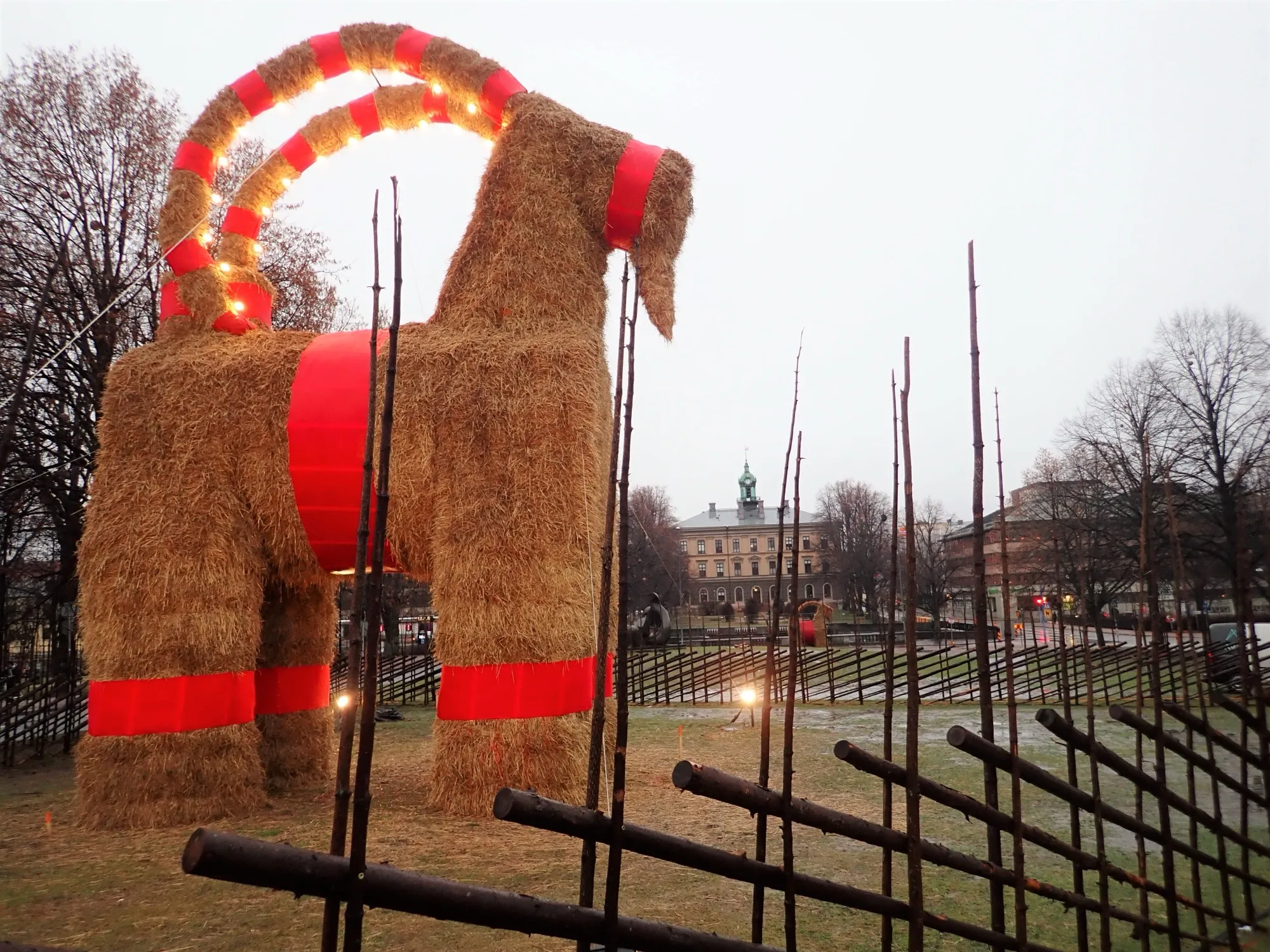
The goat standing in Slottstorget, 2019. Photo by Sinikka Halme, via Wikimedia Commons — CC BY-SA 4.0.

Every December since 1966, Gävle, Sweden has erected a 43-foot straw goat in its main square — and in 43 of the 60 years since, something has taken it down again before New Year.
The Gävle Goat — Gävlebocken — was the idea of an advertising consultant named Stig Gavlén, who wanted to pull Christmas shoppers toward the south side of town. He handed the design to his brother, Jörgen Gavlén, who happened to be the town’s fire chief. On 1 December 1966 the two of them raised a 13-metre (43-foot) tall, 7-metre-long straw goat weighing about three tonnes in Slottstorget, the city’s castle square, where a version of it has gone up every Advent since. The first one didn’t make it through the season: it burned to the ground at midnight on New Year’s Eve, less than a month old. The arsonist was caught and convicted of vandalism; the goat had been insured from day one, so the man who financed it got his money back regardless.
That set the template. As of the goat raised in December 2025, 43 of the 60 goats built since 1966 have been destroyed or seriously damaged before they could come down — leaving exactly 17 Christmases where Gävle’s goat simply survived. Most losses are arson, but not all: in 2023, flocks of jackdaws spent weeks picking the straw apart hunting for seed, and in 2025 the goat went down for the first time to nobody’s malice at all, blown flat by Storm Johannes on 27 December.
The arson years read like a highlight reel. A 40-year-old man was sentenced to six months in prison for burning the 2021 goat in the small hours of December 17. In 2001, an American visitor from Cleveland torched it, spent eighteen days in a Swedish jail, and was ordered to pay about SEK 100,000 in damages. In 2005, two people dressed as Santa Claus and a gingerbread man shot it with a flaming arrow. Twice — in 1976, and again in 2016 on a replacement goat put up after that year’s first had already burned — someone simply drove a car into its legs.
The detail that gets embellished in the retelling is the helicopter. In 2010, two men offered a security guard 50,000 kronor to walk away from his post so they could allegedly lift the goat out by helicopter and set it down in a square in Stockholm. The guard said no. No helicopter ever showed up. It was a foiled bribe, not an attempted heist — though the heist is the version that travels.
Gävle has watched all of this happen, on purpose. A webcam has monitored the goat since 1996; today it livestreams on YouTube to more than 14,000 subscribers watching, mostly, a large motionless pile of straw. British bookmakers started taking odds on whether it would survive in 1988, and betting on the goat’s fate is still a real, standing market most Decembers, Swedish and international bookmakers alike.
The town’s countermeasures have grown every year without ever quite working: a double perimeter fence, hired guards, police patrols, volunteer watch groups, and straw sprayed with flame retardant that mostly just changes how long the fire takes. None of it has talked Gävle out of building the next one. The first goat’s design was drawn up by a fire chief in 1966, and sixty years later that still reads less like an oversight than a mission statement.