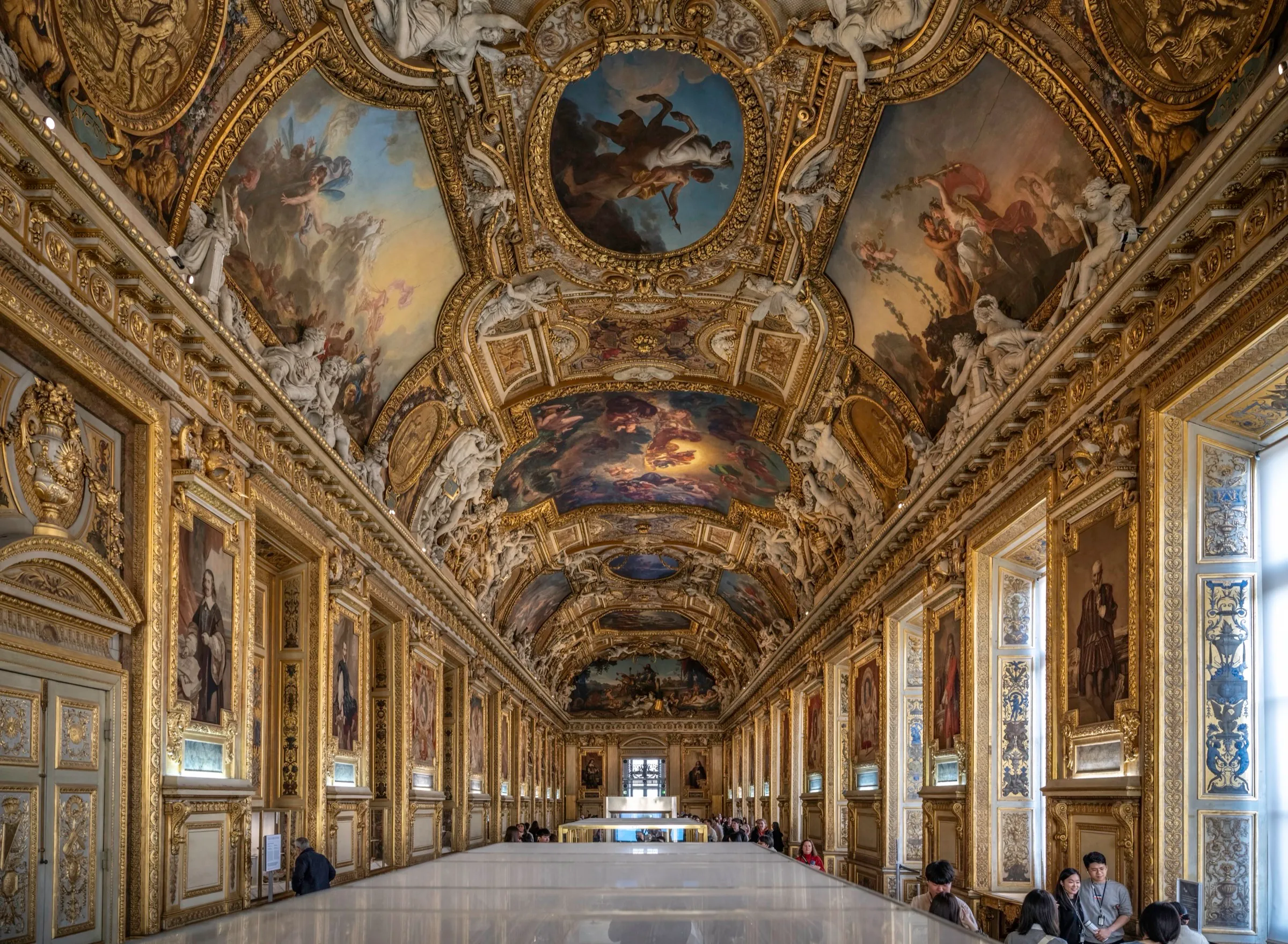
The gallery’s barrel vault, photographed in January 2024 — before the theft, and before the cases were cleared. Photo by Wilfredor, via Wikimedia Commons — CC0.

The Louvre’s Galerie d’Apollon reopened nine months after thieves stripped its cases — and the museum responded by emptying it further, vaulting even the crown jewels the theft never touched.
The room predates the theft by over three centuries. A fire gutted the Petite Galerie in February 1661, and Louis XIV had it rebuilt as a ceremonial hall: Louis Le Vau handled the architecture, Charles Le Brun the decoration, and Le Brun filled the vault with Apollo and the sun in a program meant to flatter the Sun King by association. It was still unfinished when Louis XIV died in 1715, and it sat in disrepair for a century after. Architect Félix Duban restored it in the 1850s and commissioned Eugène Delacroix to paint the central ceiling panel, Apollo Slaying the Python — installed in 1851. Le Brun later reused the same formula, at far greater scale, for the Hall of Mirrors at Versailles; this gallery was the prototype.
Since 1887 it has held the French Crown Jewels, including the 140-carat Regent diamond. A 2020 renovation, funded by Cartier, reunited 23 pieces in cases at the center of the room. That was the version four thieves broke into on 19 October 2025, using a truck-mounted lift to reach a window and disc cutters to open the cases — the whole job took under eight minutes. They got away with nine pieces; Empress Eugénie’s diamond-and-emerald crown was dropped in the escape and recovered nearby, badly mangled — a hoop snapped, a gold eagle missing, four of its eight palmettes broken off, ten of its 1,354 diamonds lost (all 65 emeralds survived). The Louvre is restoring it. The other eight pieces, including sapphire jewelry worn by Queens Marie-Amélie and Hortense and an emerald set from Empress Marie-Louise, are still missing. Several suspects have been charged; the jewels haven’t surfaced. Paris prosecutor Laure Beccuau put the loss at roughly €88 million — a figure she was careful to call replacement value only, “nothing comparable to the historical damage.”
Here is where the gallery’s story gets more interesting than the theft. The stolen pieces were only ever part of the collection — the Regent diamond and the rest of the historic jewels weren’t touched. The Louvre could have simply restocked the empty cases with what survived. Instead, director Christophe Leribault moved all of it, spared jewels included, into a windowless vault elsewhere in the museum, and reopened the gallery on 22 July 2026 with no jewels in it at all. Twenty-eight Gobelins tapestry portraits now hang against the paneling in their place. What’s left to look at is the room itself: Le Brun’s gilded stucco, Duban’s restoration, Delacroix’s ceiling — the setting, finally undistracted by what it used to hold.
It’s included in general admission, no separate ticket, though the Louvre currently requires a timed-entry reservation for the museum as a whole. Three hundred and sixty-five years, a revolution, and a heist later, the room is still standing on its own merits.