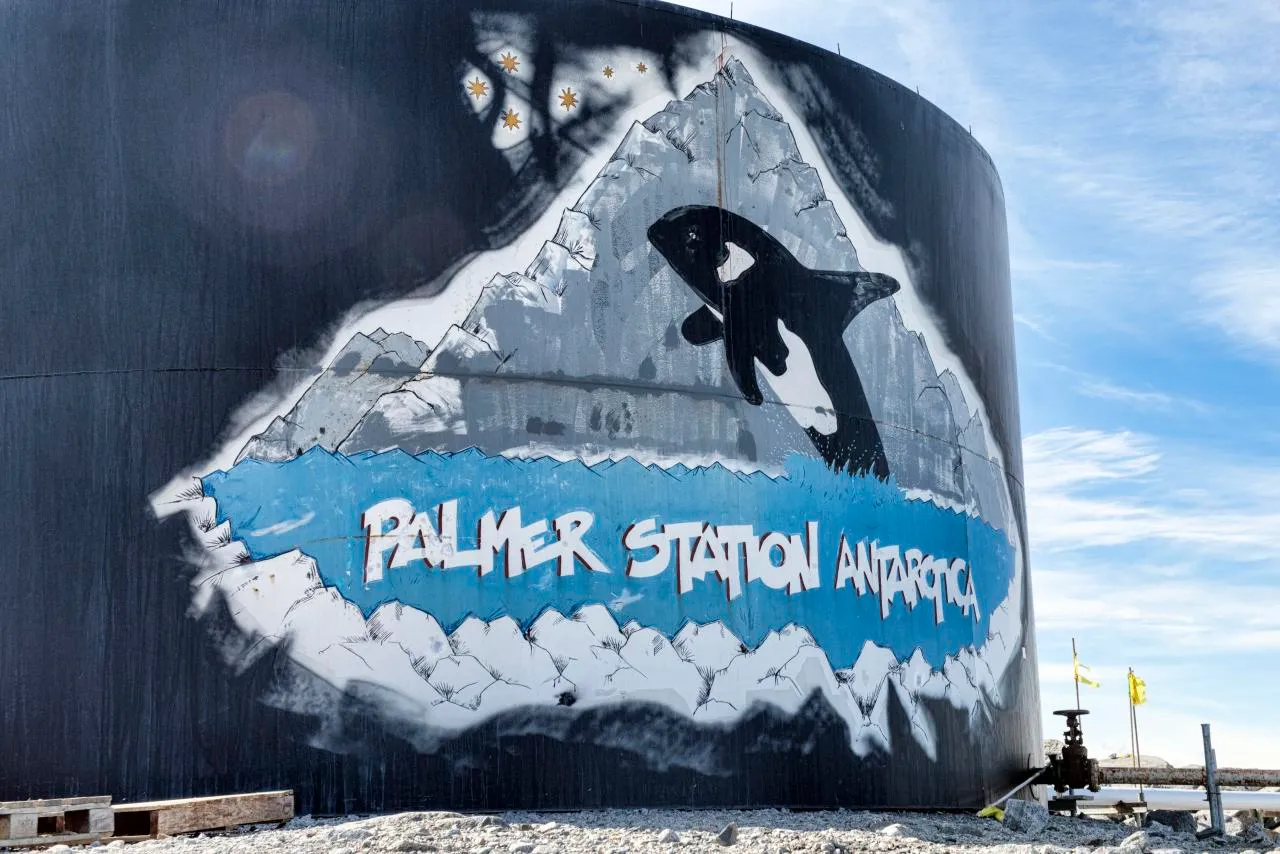
A leaping orca, painted black and white across the biggest fuel tank at Palmer Station, is the first landmark arriving ships see rounding the point into Arthur Harbour — the closest thing Antarctica’s smallest year-round U.S. base has to a skyline.
Palmer sits on a rocky outcrop of Anvers Island, off the west side of the Antarctic Peninsula, and it’s the only U.S. Antarctic station north of the Antarctic Circle — closer to Tierra del Fuego than to the South Pole. Run by the National Science Foundation’s U.S. Antarctic Program, it holds up to about 46 people through the austral summer research season and as few as 10 through the winter, working mostly on marine biology: seabirds, plankton, the effects of a fast-warming peninsula on what lives under the ice. There’s no airstrip. The only way in is by ship, several days across the Drake Passage from Punta Arenas, Chile.
Among the cluster of buildings and storage tanks on the point, one tank got the treatment: an orca banked against a jagged white peak, riding a blue band lettered “PALMER STATION ANTARCTICA,” a scatter of gold stars in the black sky above. It reads from the water before any of the station’s actual buildings do — a fuel tank isn’t scenery, and somebody decided this one should be.
Nobody has put a name or date on it. What is on the record: the volunteer-run palmerstation.com archive, which has tracked the station for decades, notes that the orca was already on the tank, unchanged, when a multi-season fuel-residue cleaning project wrapped up in December 2012 — so the paint job predates at least that work — and that a whale-tagging science team passing through in February 2013 flagged it, for the record, as anatomically incorrect. Beyond that: no muralist, no year, on the station’s own site or anywhere else searchable.
Seeing it firsthand means getting a ship there, and Palmer isn’t a tourist stop — it’s a working research base that happens to also receive a small, arranged number of visiting vessels each season. One account from a 2016 all-women STEM expedition put that season’s total at nine ships, staff coming aboard to welcome each one and guides walking visitors around the grounds once ashore. For everyone else, the mural is a landmark documented almost entirely by people who already had a reason to be there.