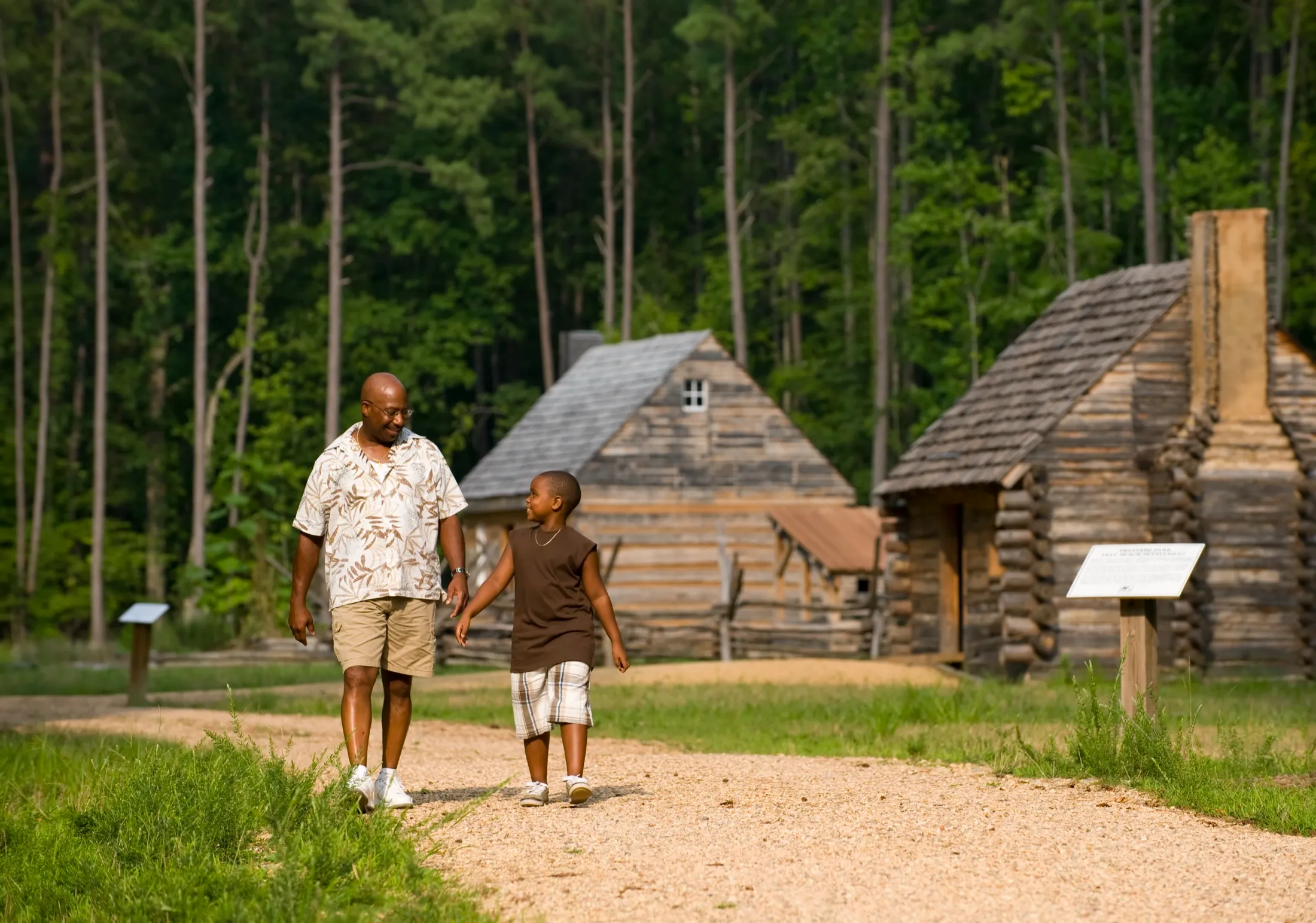
A county park with a botanical garden, twenty miles of singletrack and free parking. The reason to come is a hundred yards off the path.
Six miles from Colonial Williamsburg, where history is delivered by people in costume, James City County runs a 600-acre park that mostly reads as ordinary municipal recreation: picnic tables, a mile of paved ADA trail, the Williamsburg Botanical Garden, and more than twenty miles of mountain bike singletrack through pine woods and creek bottoms. Open daily 7 a.m. to sunset. No admission.
A short walk from all that stand three cabins, and the settlement they belong to is the point. When the plantation owner William Ludwell Lee died in 1802, his will freed the people he had enslaved and left them tracts of his land. From 1803 to 1850 the families who took that land farmed it, built churches and raised children there, and what they made is now recognised as one of the earliest documented free Black settlements in the United States. The three cabins are reconstructions, built to period and furnished differently from one another — each one interpreted around a particular family’s trade, so that they read as households rather than as a single generic exhibit.
What makes the site work is the refusal to separate the two things. There is no gate between the recreation and the history, no ticket, no reenactor. The Interpretive Center (10 a.m. to 5 p.m.) holds archaeological fragments and material on the park’s ecology; free ranger-led tours of the settlement run 20 to 40 minutes; a Virginia historical marker sits near the entrance. Everything else is a trail you were going to ride anyway, which happens to pass three doorways.
The 600 acres hold more than the settlement. There is an 18th-century cemetery, the archaeological remains of a 17th-century domicile occupied roughly 1680 to 1730, and the site of the Revolutionary War Battle of Spencer’s Ordinary, fought here in 1781 — three centuries of the same ground, none of it fenced off from the picnic tables.
One honest note on the dates, because the sources disagree. The Atlas Obscura entry that surfaced this place runs the settlement to 1860; James City County’s own page ends it at 1850. We have taken the county’s figure — it is the custodian of the site and the sponsor of the archaeology — but a decade is a real difference and somebody should say so out loud rather than pick the rounder number.
Go on a weekday, walk the paved loop, and give the cabins the twenty minutes. The virtue of the place is that it asks for nothing else.