Most total eclipses give you two or three minutes. On 2 August 2027, in the Nile Valley, the shadow sits for six minutes and twenty-three seconds. Nothing longer falls on easily reachable land until 2114.
The number is the entire reason to care. The celebrated North American eclipse of 2024 managed four and a half minutes at its absolute best; the 2027 maximum is 6 minutes 23.2 seconds, and the next comparable one on accessible ground is 3 June 2114 — eighty-seven years, which for most people reading this means this one or none.
One precision the coverage keeps blurring, and it’s worth having right. This is not the longest eclipse of the century. The 22 July 2009 eclipse ran 6 minutes 39.5 seconds, but it made landfall mostly over Asia and then spent its best minutes over open Pacific. The 2027 claim is the narrower and more useful one: the longest totality this century on land you can straightforwardly get to. The 6m23s maximum itself falls in the north-east of Egypt’s New Valley Governorate, just south-east of Luxor; Luxor sits near enough to the centre line to get essentially all of it.
Then the weather, which is what actually decides whether you saw an eclipse or a cloud. Luxor in August runs roughly an 80% chance of clear sky — close to the best odds available anywhere on any eclipse path. Greatest eclipse is at 10:07:50 UTC, about ten past one in the afternoon locally, with the sun some 82 degrees up: almost directly overhead, no horizon to worry about.
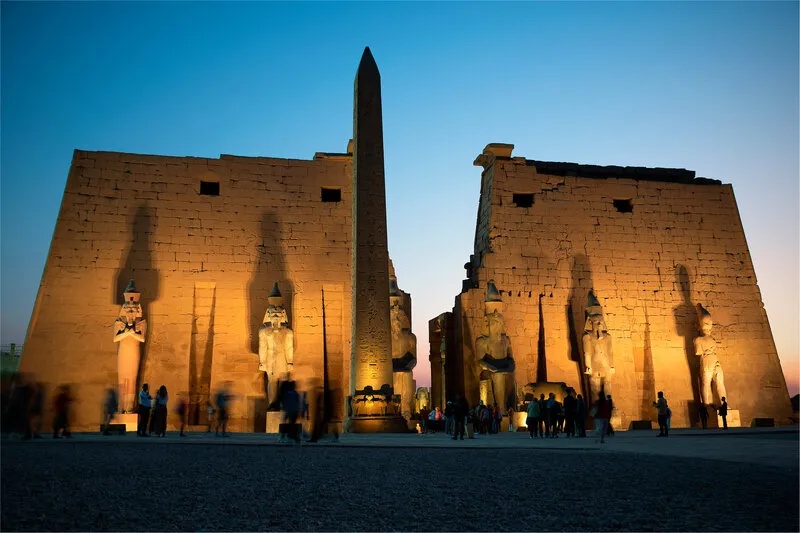
The path crosses ten countries — Spain, Morocco, Algeria, Tunisia, Libya, Egypt, Saudi Arabia, Yemen, Somalia and the British Indian Ocean Territory — and runs about 258 kilometres wide at its broadest. Of the realistic destinations along it, Luxor has the airport, the hotels and the infrastructure for crowds, and it puts the shadow over the densest concentration of monuments built by a civilisation that organised its entire cosmology around the sun leaving and coming back.
The single most common planning error, stated plainly: Cairo is not in the path. You can stand in Cairo on 2 August 2027 and see a partial eclipse, which is to totality roughly what a photograph of a meal is to dinner. Aswan gets four to five minutes. Luxor gets the full six.
The practical caveat is not astronomical. Hotels along the path have been selling out for a year already, and “the eclipse of the century” has been the working name for this since 2024. Whatever you are going to book, the eighty-seven-year gap is doing the arguing.