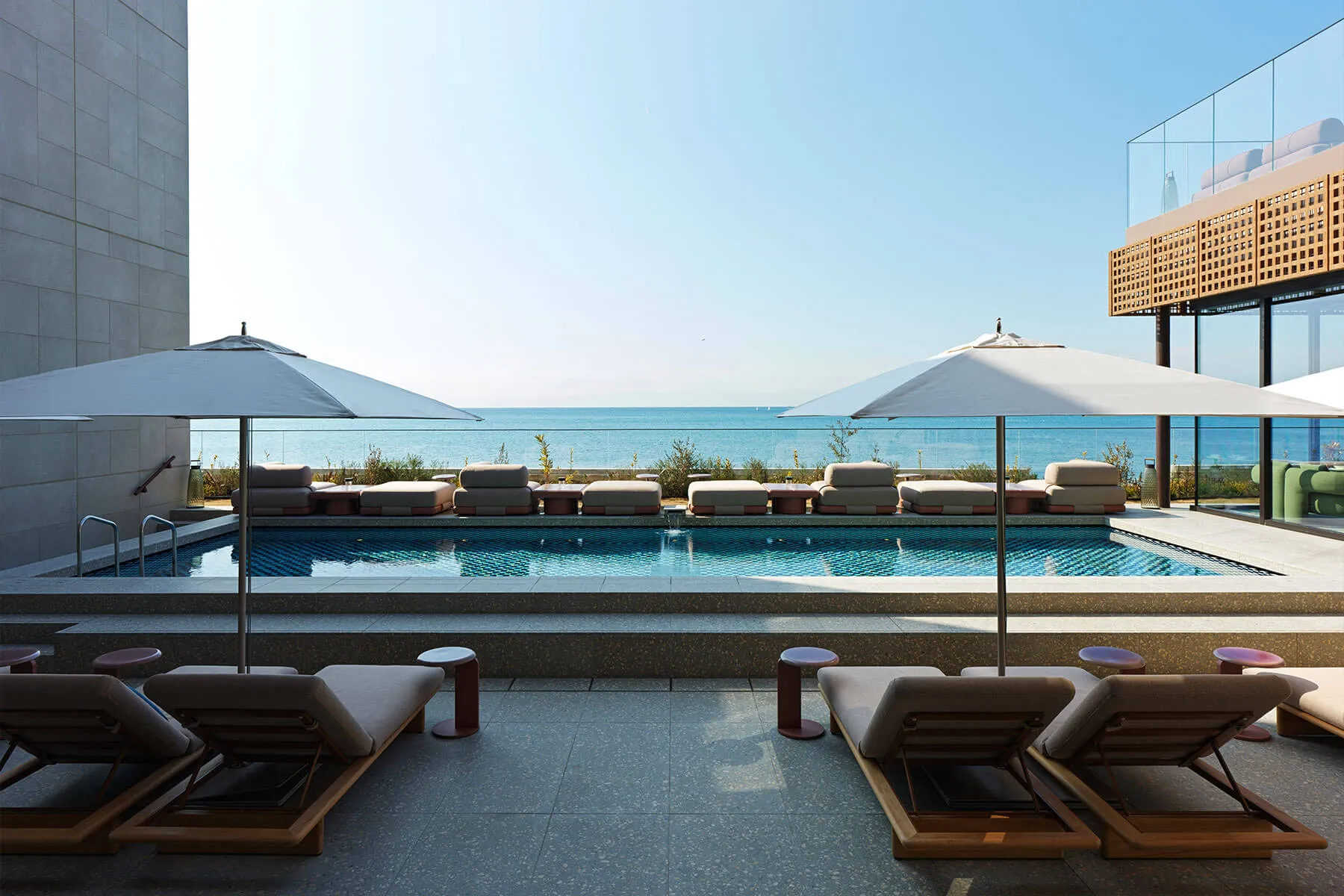
The pool deck, with the facade’s woven panels at right. Photo: Casa Caban Hayama.
A knitwear company asked a designer for a hotel, and she took the brief literally: the facade, the lounge ceiling, the window louvres and the pool floor are each a different material doing the same thing — over, under, over.
Tomorrowland started in 1978 making knitted clothes, and its relationship with Patricia Urquiola goes back to 1993, when she designed one of its Shibuya stores while still largely unknown. The hotel began with a phone call: in July 2017 Urquiola, tired from a work trip in Japan, rang Tomorrowland’s founder Hiroyuki Sasaki for dinner, met him at Morito Beach in Hayama, and saw Mount Fuji across Sagami Bay. Casa Caban Hayama opened on that stretch of shore on 26 March 2026. By the hotel’s account it is the first project where Urquiola did everything herself — planning, architecture, interiors, furniture.
The concept she gave it is weaving, and the pleasure is in how many ways she finds to say it. The facade carries lattice panels of 100% recycled material; Wallpaper* reports them as recycled polyethene, handwoven in Indonesia. They read as knitwear from outside and work as privacy screens from inside. Kyoto artisans plaited the lounge ceiling in bamboo. The louvres in rooms and corridors add vertical slats to the usual horizontal ones, so the sun throws a woven grid across the floor. And the pool is floored in a blue-and-white check that Wallpaper* likens to a tenugui, the traditional Japanese cotton towel.
The other recurring hand is suminagashi, the old Japanese technique of floating ink on water and lifting the pattern off with paper. Wallpaper* found it on ceramic cladding around the lounge columns and on a wall of roof-tile shapes in the entrance hall that look like fired clay and turn out to be lightweight resin. Most of the chairs, sofas, tables and bed frames are Urquiola designs, made to order in Cassina’s workshop outside Milan, and the tapestries on the walls are hers too.
It is small. There are fourteen rooms, four of them suites, and every one has a terrace facing the sea and Fuji. They range from 56 m² Deluxe rooms to the 173 m² Caban Suite, of which 86 m² is terrace. The pool and rooftop terrace are for overnight guests only, but both restaurants, an Italian-leaning main dining room and the Japanese restaurant Ashitaba, are open to everyone.
Honest notes. It is not cheap: the hotel doesn’t publish rates, but Wallpaper* puts them from ¥177,100 a night with dinner and breakfast. Getting there is easy until the end: Wallpaper* puts it an hour from central Tokyo, and the hotel’s directions finish with a ten-to-twelve-minute bus from Zushi and a short walk through a residential neighbourhood whose lanes narrow to 2.85 metres, which is why it asks guests not to drive. Michelin gave it a Key in September, six months after opening.