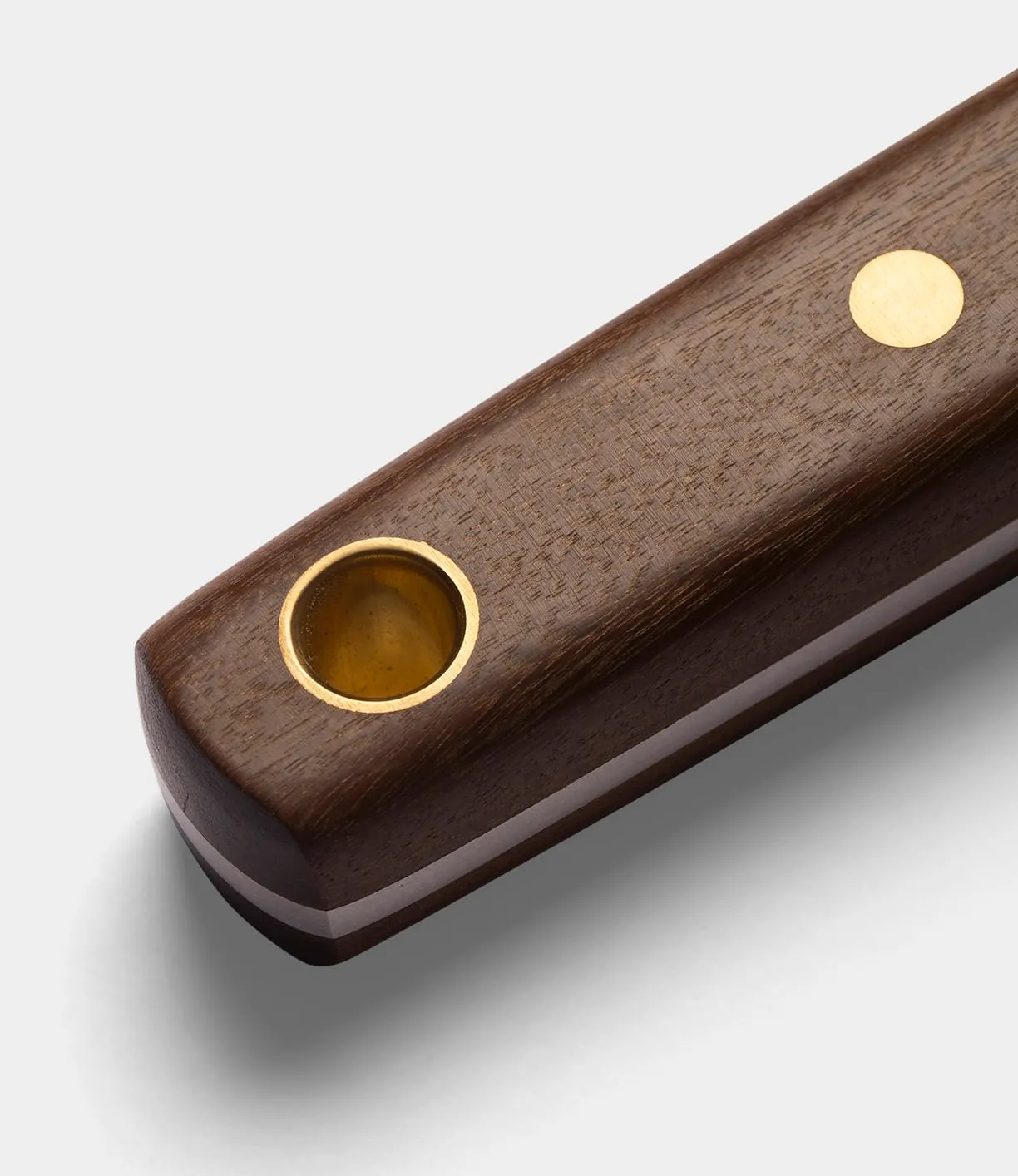
The Cumarú end grain — dense from a century underwater. This is the part of the knife with the story; the blade is brand new.
The story here is the handle, not the blade: Best Made’s Sailor’s Knife pairs a handle cut from Cumarú timber that spent roughly a century at the bottom of the Panama Canal with a blade of brand-new German steel.
Worth untangling up front, since earlier coverage got the parts swapped: it’s the handle that’s the salvaged, century-old material, not the blade. When the Chagres River was dammed in 1913 to form Gatún Lake — the reservoir the Panama Canal’s locks run on — 164 square miles of rainforest went under, old-growth trees included. Best Made’s product page says salvage crews raised its Cumarú logs “a century later,” preserved by the same mechanism that keeps any wood intact underwater — no oxygen, so no rot fungi and no insects. That much holds up independent of Best Made’s own copy: divers have been legally salvaging submerged hardwood from Gatún Lake since at least 2010 (Vancouver’s Coast Eco Timber is the best-documented operation), and submerged tropical logs need no more kiln-drying than wood cut on land. What doesn’t hold up to the same precision is the “113 years” figure attached to this knife — Best Made’s own language stays vaguer (“a century,” “a hundred years”), with no recovery date given, so treat 113 as arithmetic (2026 minus 1913), not a verified count.
The blade, despite the mixup, has its own real story: 1.4197.02, a niobium-alloyed refinement of Niolox steel developed for a 2003 German Navy tender for a working sea knife, made by Robert Herder — the Solingen workshop that’s stamped its windmill mark on knives since 1872. Niobium carbides keep the grain fine, meaning an edge that resists chipping without turning brittle — useful for cutting wet rope and salt-crusted line. Herder mills it with a convex grind: a rounded bevel with no flat facet, thicker behind the edge than a standard V-grind, built for hard repeated use rather than clean slicing.
It’s a fixed blade, not a folder: 5.5-inch drop-point edge, 9.5 inches overall, full tang, brass rivets, an oversized lanyard hole, cowhide sheath included.
At $320 you’re paying for the wood’s story more than the steel — a plain-handled Herder knife in the same steel costs a fraction of that. And right now you can’t buy it: Best Made lists it sold out, taking email signups for the next run, which tracks with a company still finding its footing since founder Peter Buchanan-Smith bought it back from Duluth Trading in late 2023. If a piece of the Panama Canal in a sheath is worth $320 to you, wait for the restock. If it’s just a knife you’re after, this isn’t the efficient way to get one.