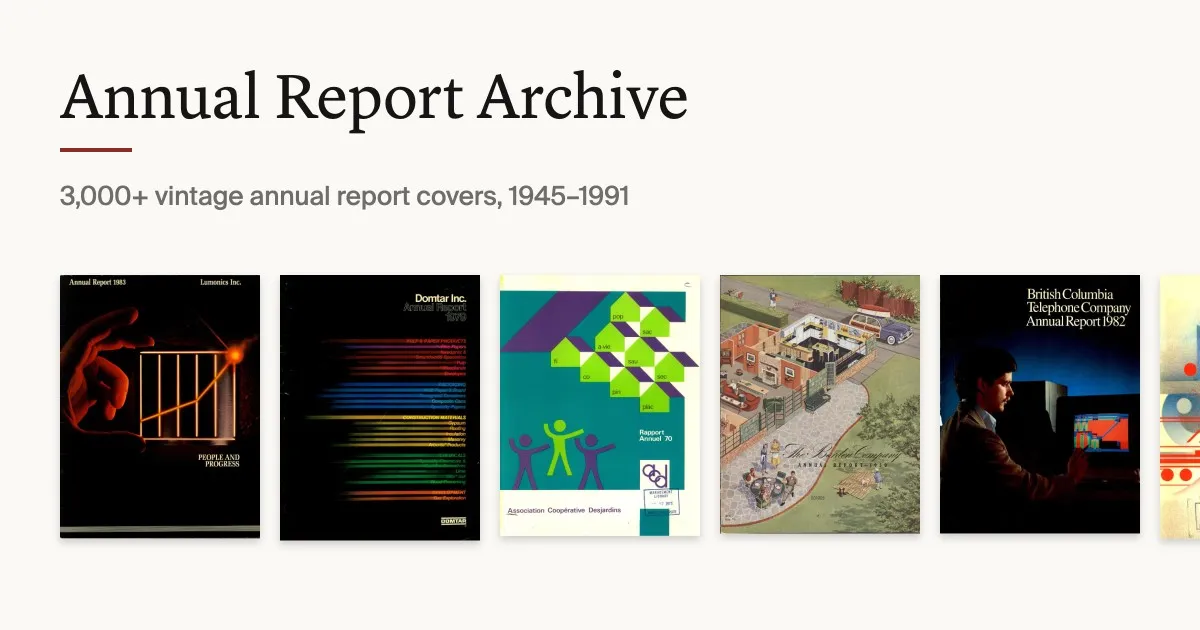
For most of the twentieth century a company’s annual report was a design commission. Three thousand of the covers are here, and the search is by colour and by what’s in the picture.
The premise is that between roughly 1945 and 1991, if you wanted a document to look like anything at all, you hired someone. Photography was expensive, illustration was expensive, typesetting was expensive — so a company spending the money on a report cover was making a real decision about how it wanted to be seen, once a year, in front of its shareholders. The archive is 3,002 of those decisions, scanned.
The search is what turns it from a pile into an argument. Filter by decade or by industry, which you’d expect. Then filter by dominant colour, and watch the palette of American corporate self-image move — the browns and golds of the mid-seventies against the black-and-magenta of 1985. Then search by what is physically pictured: playful mascot, photographic sky, gold on black, harvest, quiet type. Ask it for harvest and you get four decades of agribusiness deciding whether to show you a field or a factory.
The scans are not the site’s own. They come from eight collections — the Internet Archive, McGill’s Canadian Corporate Reports holdings, bitsavers, the University of Washington, the University of North Texas, the Paul Rand Archive, the School of Visual Arts, the AIGA Design Archives — plus the investor-relations pages of IBM, Boeing and Lockheed Martin, which have quietly kept their own back catalogues online. Phil Hedayatnia’s work was pulling them into one index and giving them facets, which is the unglamorous half of every good archive.
One detail is genuinely of its moment: the archive publishes itself as an MCP server, so you can attach it to Cursor or Claude and ask an agent to go looking through it. A collection of documents from before the web, addressable by the thing that came after it.
The honest limitation is that this is covers only. You cannot read the reports, and the site does not pretend you can — it is a picture library of one very specific object, and the object stopped being made around 1991, when the design budget went to the website instead.