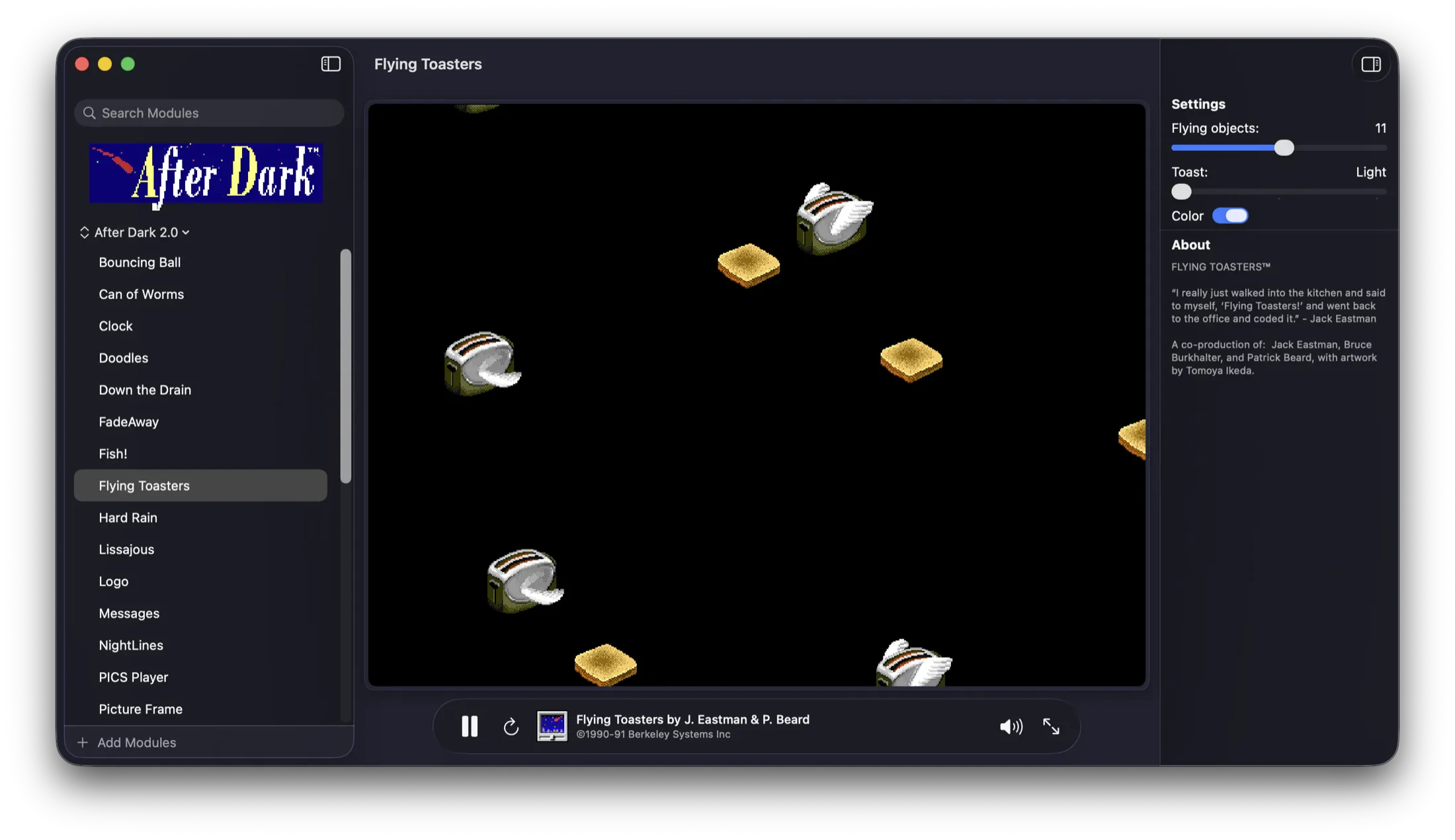
Everyone who has tried to see Flying Toasters again has ended up installing an emulator, hunting a ROM, or buying a beige Mac. Afterglow is the first thing that just plays the module.
The distinction that matters is in the first paragraph of its own page and is easy to skim past: Afterglow is not a remake. It runs the original 68k module code, the actual binaries Berkeley Systems shipped between 1989 and 1994, on a Musashi 68k CPU emulator with just enough of the Macintosh Toolbox reimplemented around it to keep them happy. No Apple ROM and no classic Mac OS installation is required — which is the sentence that separates this from every previous route to the same thing.
That route was genuinely bad. Running After Dark meant Mini vMac or SheepShaver, a system disk, a ROM of contested legality, and then the discovery that no single emulator gets the timing right for every module: some animate too fast, some crawl. An emulator built for one job can be tuned for that job, and this one was.
Getting modules in is the part that could have been a chore and isn’t. Drop in a module file, a disk image or a compressed archive and it extracts and imports whatever it finds. It will also browse and install software releases from the Internet Archive without leaving the app, which is the difference between “you’ll need to find the files” and “here they are”. Nothing is bundled — the app ships empty, for the obvious reason.
Then it hands the result back to macOS as a real screen saver, so anything you have imported can be the thing that comes up when you walk away. The extras read like someone enjoying themselves: a randomiser, a multimodule mode, a CRT shader, 3D box art, a resource inspector, and an editor for DrawMorph.
The honest notes are three. Version 1.0 requires macOS 15 or later, so an older Mac — the machine most likely to be sitting under a desk waiting for exactly this — is out. The project is explicitly non-commercial and explicitly not affiliated with or endorsed by Berkeley Systems or the current rights holders, which is a preservationist’s position rather than a licence. And the page itself names no author; Daring Fireball, which surfaced it, credits Jeff Halter, who previously brought back After Dark’s Lunatic Fringe under the name Lunacy.
Set Flying Toasters to eleven objects and the toast to light. It is exactly as you remember, which is the entire and sufficient point.