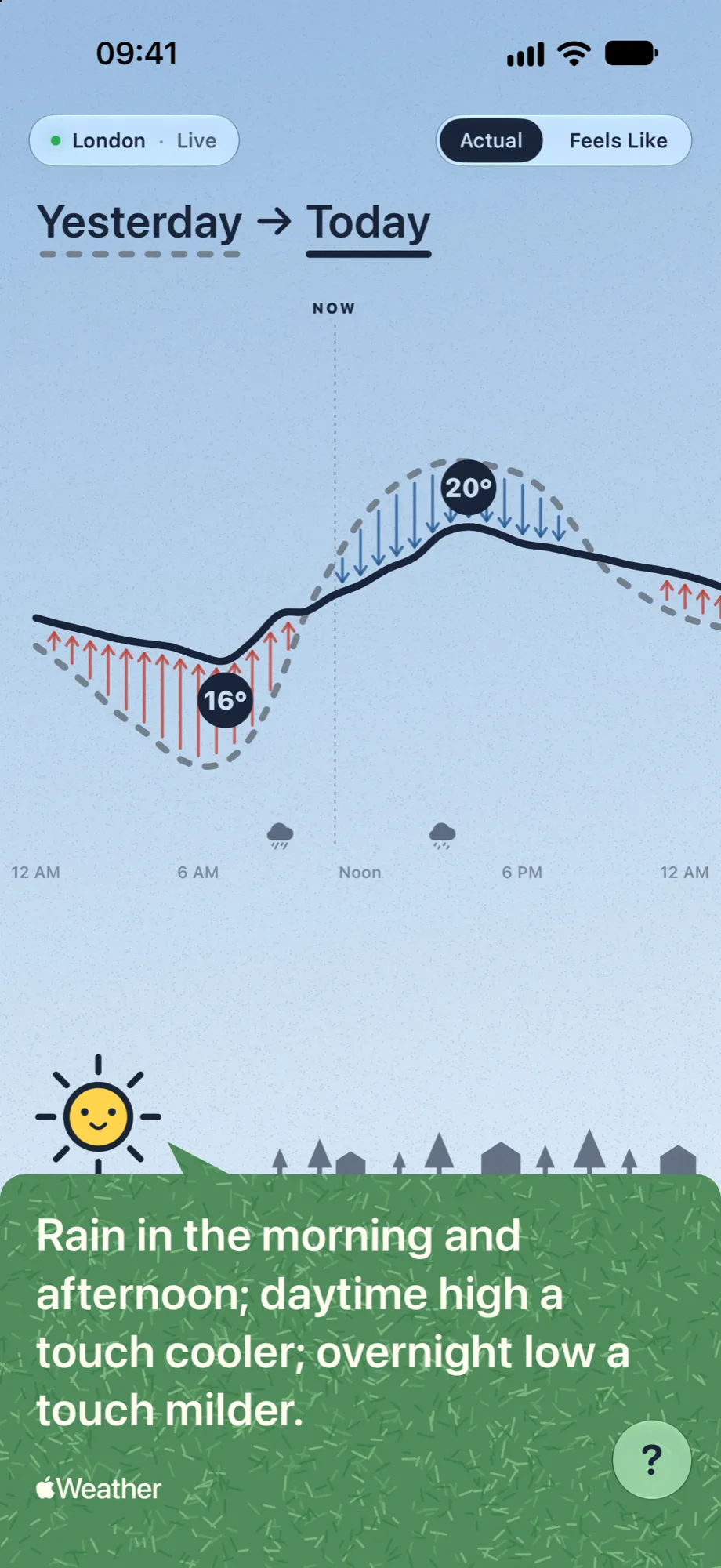
The London sample from the App Store listing. Image: Yesterday, via apps.apple.com.
A weather app that skips the forecast number and answers a question you can act on: is today warmer or cooler than yesterday, and when? Today is a solid line, yesterday a dashed one, and arrows fill the gap.
Matt Webb built it because a temperature on its own is abstract, while what you wore yesterday is easy to remember. So the chart is the argument. Red arrows point up where today runs warmer, blue ones point down where it runs cooler, and a dotted “now” line marks the hour. Under the hill at the bottom sits a plain sentence, such as “Rain in the morning and afternoon; daytime high a touch cooler; overnight low a touch milder.” It is generated by Apple’s built-in language model, and it is the whole forecast most people need.
The restraint is deliberate. Webb’s launch post says the app has no icons beyond small rain glyphs, shown only when the chance of precipitation is 30 percent or more. An Actual / Feels Like toggle switches the curve between measured and apparent temperature. Tap the sun and it becomes a moon in dark mode, showing the real phase for your date and latitude. A home screen widget carries the same sentence.
Weather data comes from Apple’s WeatherKit. The App Store listing says the app collects no data, has no in-app purchases, and costs nothing. It weighs 1.5 MB.
The limits are plain. It needs iOS 26 or later. It launched without Fahrenheit, which a tester flagged; version 1.2 added it. It answers one question, plus a late-day look at how tomorrow compares; there is no radar and no week ahead. The listing has only a couple of ratings so far, and Webb wrote that he doubts many people will download it; its two daily users are his household, and the friends he showed it to mostly said they had built their own weather apps. The summary sentence comes from a language model, so it is a convenience, not a source; the chart beside it is the evidence.
For a free app that does one thing, the idea carries it. You glance, see red arrows, and leave the jacket.