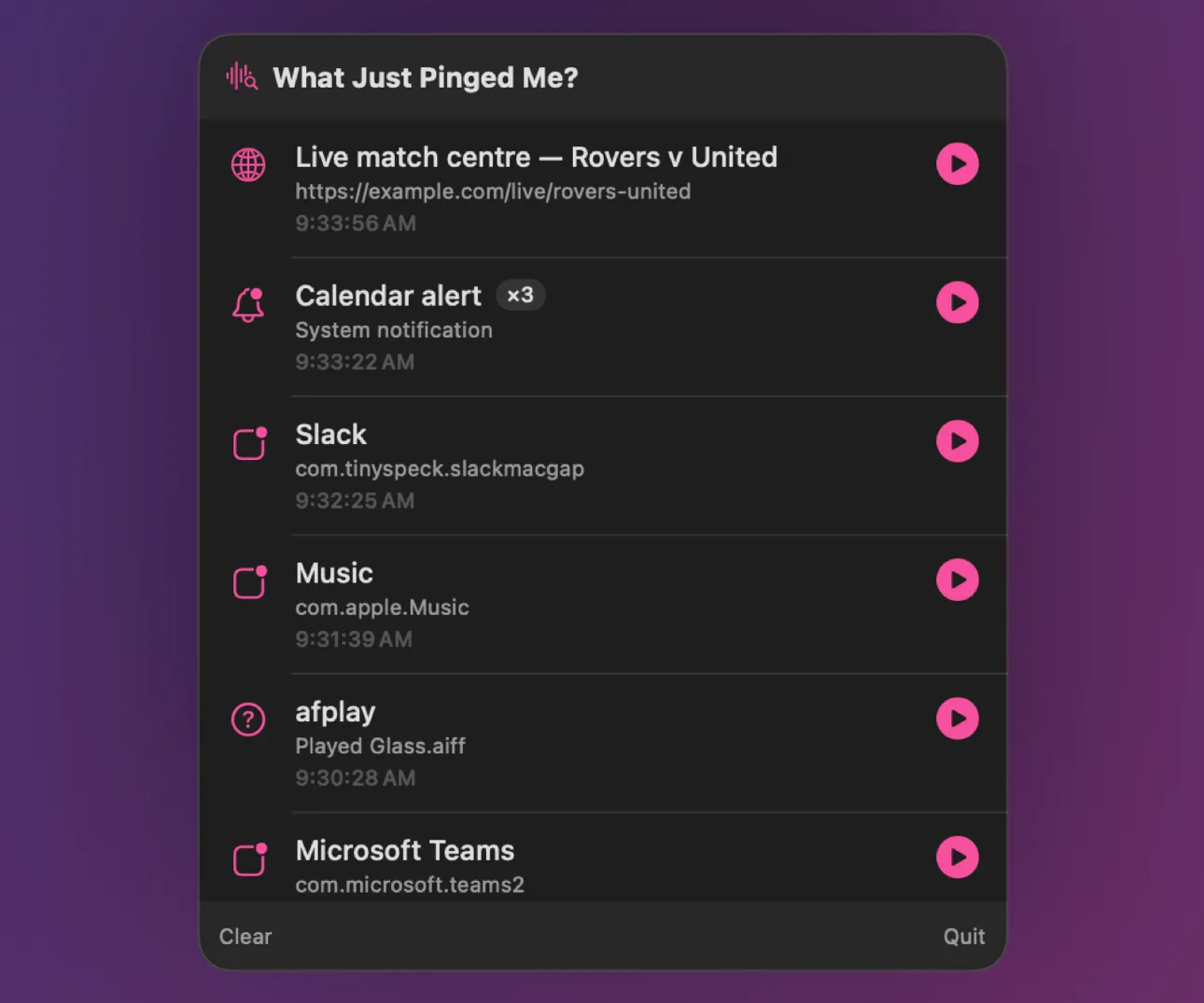
The list: a tab named by title and address, a calendar alert folded into one row, and a command-line tool caught playing Glass.aiff.
Your Mac makes a noise; by the time you look up, whatever made it has moved on. This app was already listening, and will name the culprit and play it back.
It lives in the menu bar with no Dock icon and listens from the moment it launches. When something plays, it keeps a few seconds of what came out of the speakers and writes down the source — not “Safari” but the title and address of the tab, the app behind a helper process you have never heard of, a Notification Center ping credited to the app that posted it, or a command-line tool down to the file it played (“Played Glass.aiff”). Repeats fold into one row with a count, so a chatty app cannot bury the rest, and every row has a play button.
The version notes read like a casebook. Version 1.4 gave each sound a case file: the seconds around it — what you were using, who else was audible and how loudly. When several things are audible at once, each is measured through its own tap and the suspects ranked by their share of the loudness. The matcher listens to pitch as well as volume, searches every sound on the Mac — the built-in alerts, the screenshot shutter, sounds shipped inside apps — and blames a match only on an app that was running. When nothing matches, it says how many sounds it checked; unidentified ones are remembered between launches, so a row can at least say “the same sound as 25 earlier times, usually from the same app”.
The limit is on the support page: browsers do not tell other apps which tab is making noise, so the app names the tab in front — “right nearly all the time but not always”. The newest App Store notes answer it with an optional browser extension that reports the tab actually playing; Safari’s ships inside the app, Chrome and its cousins set up from a window. It only knows about sounds after it started, discards clips too quiet to hear, records system output and never the microphone, and needs macOS 15 and the audio-recording permission.
Nothing leaves the machine: no account, no analytics, no crash reporting, “no network connections at all”; recordings sit in the sandbox cache behind a Clear button, and the list is in memory and gone when you quit. Free, 1.1MB, on the App Store or as a notarized DMG from GitHub — thirteen direct-download releases between August 20 and 31. The maker is Kelly Dornhaus Games LLC, whose other App Store titles are word and sliding-tile puzzles, which may be why a utility this small reads like a whodunnit.