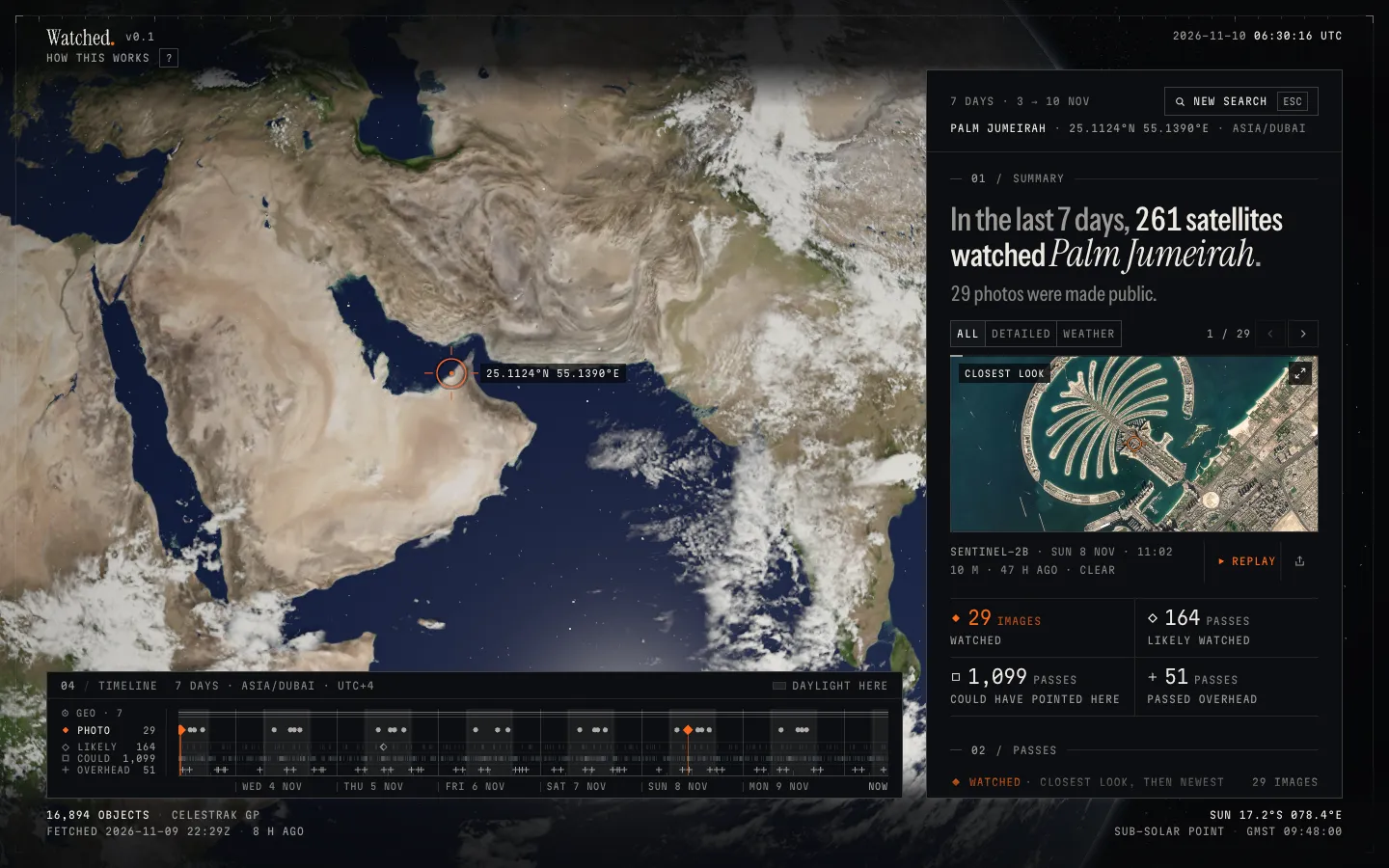
Palm Jumeirah, Dubai, on 10 November 2026. Image: watched.earth, screenshot by us.
Type any place and Watched replays the past week of orbits over it, then shows the real photos those satellites took.
The search box takes a city, a landmark or coordinates. While the globe flies there, your browser replays seven days of orbits for roughly 400 imaging, weather, radar and crewed satellites and notes each time one’s field of view crossed your spot. In parallel it searches the Sentinel-2 and Landsat archives (through Microsoft’s Planetary Computer) and NASA’s GIBS weather imagery, matches each photo to the pass that took it, and checks whether your spot was under cloud.
Then you can replay a pass. The satellite flies its real track, the strip its camera sees sweeps across the place, and the photo develops line by line in the direction of flight. Matching is fiddly: a Sentinel-2 scene’s timestamp marks the start of its strip, which can be minutes before the satellite reaches your spot, so Watched predicts the crossing and shows that time.
The find was loose with “passes.” The globe does draw about 17,000 objects (16,894 in the CelesTrak catalogue it loaded on 9 November), each one solved on the GPU every frame. But only the imaging, weather, radar and crewed satellites are searched for passes, and the headline count includes every satellite with a pass, photographed or not. Each pass carries one of four labels, and only the first, watched, means a photo exists. Palm Jumeirah that week: 29 photos, 164 likely, 1,099 that could have pointed there.
The limits are stated plainly. The best public pixel is about 10 m, bigger than a car, and often coarser. Archives lag capture by hours to days, so the newest passes may have no photo yet. Military and intelligence satellites mostly aren’t in public catalogues. Commercial cameras that see down to about 30 cm are listed as “could have pointed here”, with no photos.
It’s free, with no sign-up, and needs WebGL. It logs a search only as a roughly 10 km cell and a shared link as a point rounded to about 1 km, and deletes raw events after 90 days. Armaan Gupta built it over a weekend and published the code under the MIT licence.
Try Giza, Uluru, or your own street.