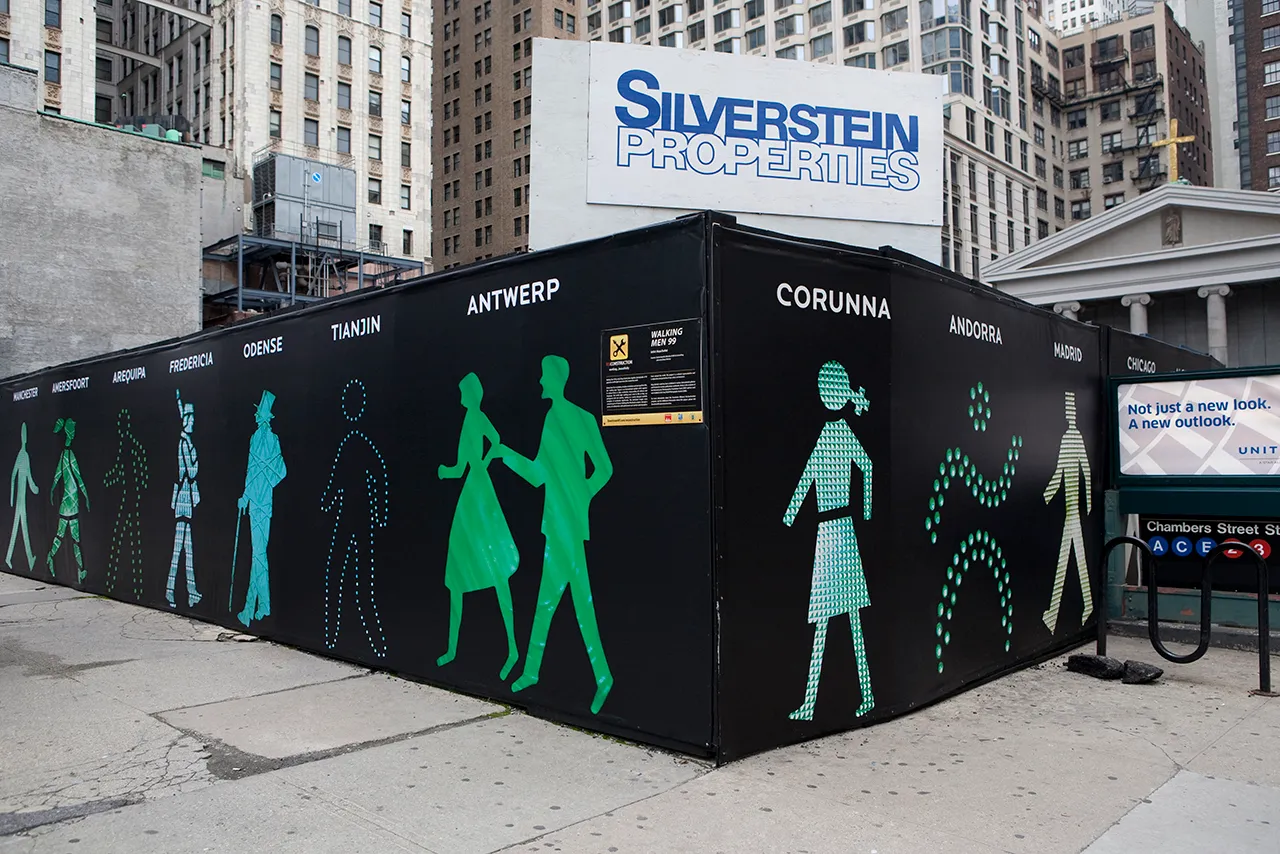
Walking Men 99 at Church Street and Park Place, Manhattan.
Maya Barkai asked strangers to photograph their local pedestrian signal, then printed the collection at life size along five hundred feet of construction hoarding in lower Manhattan. The canvas is the point: this is art that only exists where a building is going up.
The submission mechanism is as plain as the work: you email a photograph of your own crossing signal to the project. Hundreds have — the credits page runs to over 170 entries, from Arequipa to Tianjin — and what comes back is a taxonomy nobody set out to make. Odense’s man wears a top hat and carries a cane. Antwerp’s is two people walking arm in arm. Tianjin’s is assembled entirely from dots, Andorra’s from a looser scatter of them. Corunna’s is unmistakably a woman. Set side by side and labelled, the sameness you assumed collapses: every city solved the identical two-second problem and no two solved it the same way.
Walking Men 99 went up in January 2010 on the Alliance for Downtown New York’s Re:Construction programme, wrapping a plywood wall across Church Street, Park Place and Barclay Street with 99 figures. It stayed nearly four years and gained 25 more icons in a second edition in 2012. The Times filed it under “Bringing Some Whimsy to Construction Sites,” which is the whole commission in six words.
It travelled from there. Seventy-seven icons over four hundred feet in Perm, Russia, in September 2010. Nearly 150 figures along a thousand feet of parapet at World Trade Center Tower 4 in September 2011, a piece that made the Americans for the Arts Public Art Network’s 2013 Year in Review. Over six hundred street banners across eight Sydney streets in autumn 2013. Buenos Aires in 2015. The largest ran a full year in Taipei from March 2018: more than 140 icons around a four-hundred-metre hoarding — with 28 of them redrawn as living green-wall planting — enclosing the site where Renzo Piano’s Fubon Contemporary Art Museum was going up.
The honest part is what has happened since. Taipei came down in March 2019 and nothing has replaced it; the newsroom clippings stop in 2018, and the site’s last substantive edit was in 2022. Nothing is on display anywhere right now. What remains for sale is four items — two hand-pulled screen prints at $600, editions of 150, printed by Donald M. Sheridan, who printed for Warhol and Rauschenberg, and two $40 posters.
So it is an archive rather than a going concern, and worth the visit as one. A hoarding is the ugliest surface a city produces and the most temporary, and for nine years the best use anyone found for it was to stand the world’s walking men in a row and let you notice they were never the same man.