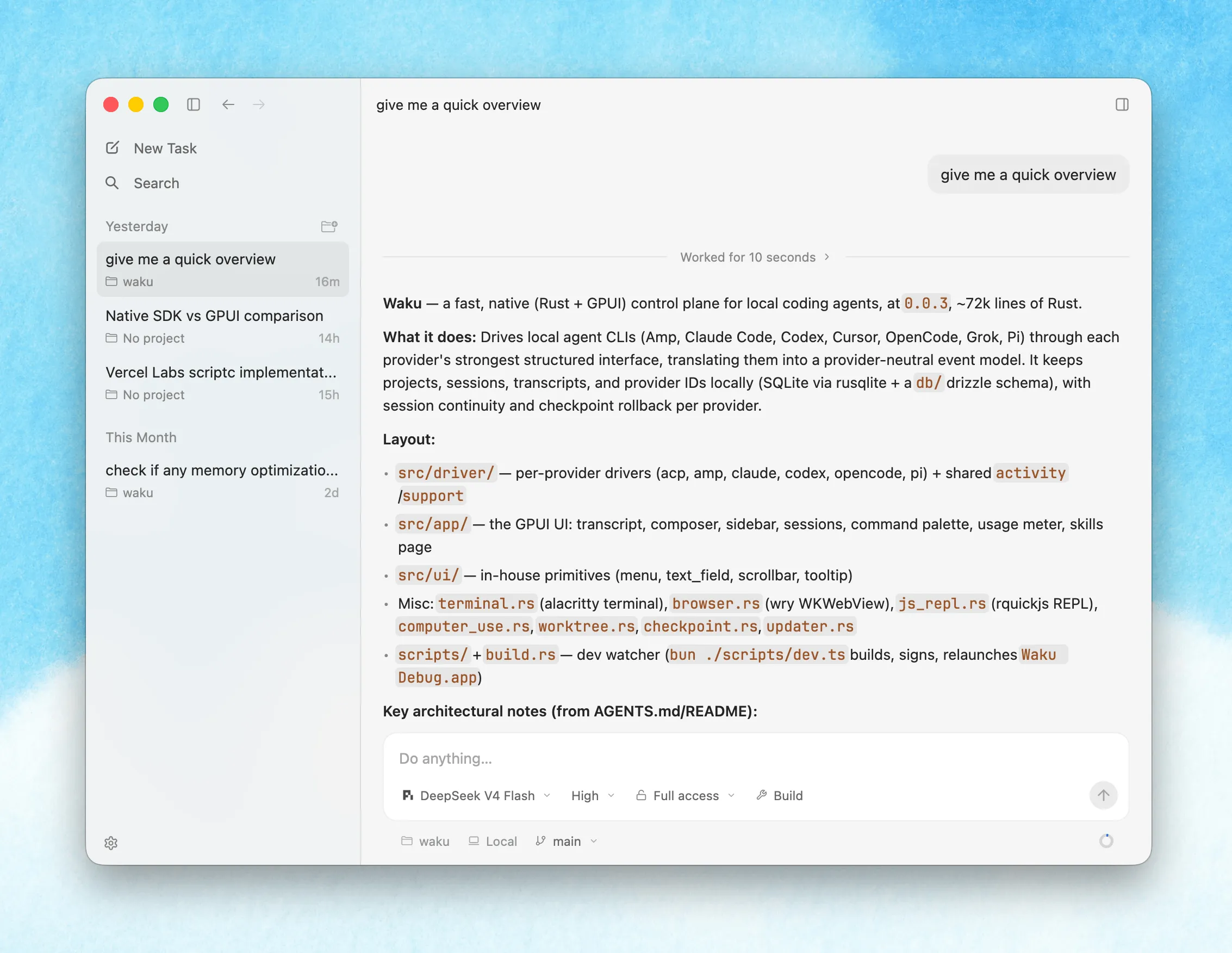
Undo in a chat window rolls back the chat. Waku checkpoints your working tree on every prompt, so rewinding takes the files back with it.
The problem it solves is small and extremely annoying. You let an agent work, it goes somewhere you did not want, and you rewind the conversation — at which point the transcript agrees with you and the directory does not. Waku writes a checkpoint of your working tree under a hidden git ref every time you send a prompt, so rolling back a turn rolls back the code and the provider conversation together. That is the entire pitch, and it is a good one.
Around it sits a control plane for the agent CLIs you already have installed. Waku does not ship its own model or ask for new keys; it drives Amp, Claude Code, Codex, Cursor, OpenCode, Grok and Pi over each one’s strongest structured interface — stream-json, JSON-RPC, live events — and normalises them into a single provider-neutral timeline. Projects, sessions, transcripts and provider IDs stay on your disk in SQLite. There is no account, no telemetry, and no Waku cloud sitting between you and the agents.
It is native in the way that matters for a window you leave open all day: Rust and GPUI, the GPU-accelerated framework behind Zed, rather than Electron. The keyboard map is complete enough to never reach for the mouse — ⌘N opens a session, Return queues a follow-up while the agent is still working, ⌘Return steers it mid-turn, Escape stops it. Updates arrive signed, notarised and delta-compressed through Sparkle.
The limitations are stated plainly and one of them is large. This is version 0.0.3, roughly seventy-two thousand lines of Rust, and the author describes it without ceremony as “basically an alternative GUI for Codex CLI and other CLIs” built because Electron apps frustrated him. Codex’s computer use is wired but not fully implemented. Windows and Linux are listed as an open question with no answer attached. And the banner reading “Not backed by Y Combinator” is a joke, not a funding note — worth saying, because the phrasing has already fooled at least one automated reader.