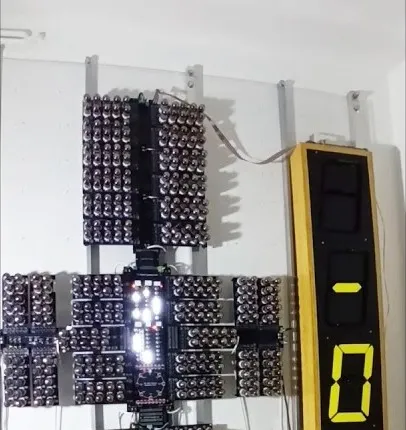
The array and its mechanical digit display. Frame from the builder’s own walkthrough video — the only photography the project publishes is small.
Nobody needs an eight-bit computer in 2026. This one is 920 glowing valves bolted to a brick wall, it takes ten minutes to warm up, and the best line about it is about how it smells.
The headline number is the builder’s own, and it corrects the version going around: “The Tube Computer integrates 920 thermionic triodes and 5 Backplane boards.” Those are dual-triode 6N3P envelopes sourced out of Eastern Europe, so 460 physical bottles, spread across a 190-by-130-centimetre panel weighing about twenty kilos and fixed to brickwork. High tension runs below 100 volts. It is Mike’s third such machine — the first ran on 28 May 2021 — and he and his wife Judy document the whole thing publicly, in a Technical section and a twelve-minute walkthrough.
Architecturally it is stricter than it needs to be, which is the point. Eight bits, Harvard layout with separate data, instruction and address buses, and every piece of logic in it is a NOR gate — no shortcuts to a faster adder, no borrowed silicon anywhere. Sixteen single-step instructions, among them LOADA, STOREB, JUMPØ, XNOR, CARRY and ADDC. That last one is the one worth knowing about: chaining carries through it gets you 16-, 32-, 64- or even 128-bit arithmetic, which the site notes will take long enough “for a nice cup of tea.”
Then there are the facts that only apply to a computer made of hot glass. It needs about ten minutes to reach thermal stability before it computes reliably. It heats the room it is in. And Kottke’s excerpt picked the right sentence: “The Tube Computer has a pleasant homely aroma from the hundreds of double triodes, all quietly burning off their dust.”
One thing is conspicuously absent and worth flagging rather than filling in: there is no stated clock speed anywhere. The site quotes the 6N3P as capable of “over 200Mhz”, but that is a component datasheet figure, not the rate this machine runs at, and nothing on the site claims the second from the first. For a build documented down to the backplane count, the omission reads less like an oversight than like a builder who declines to publish a number he has not measured.