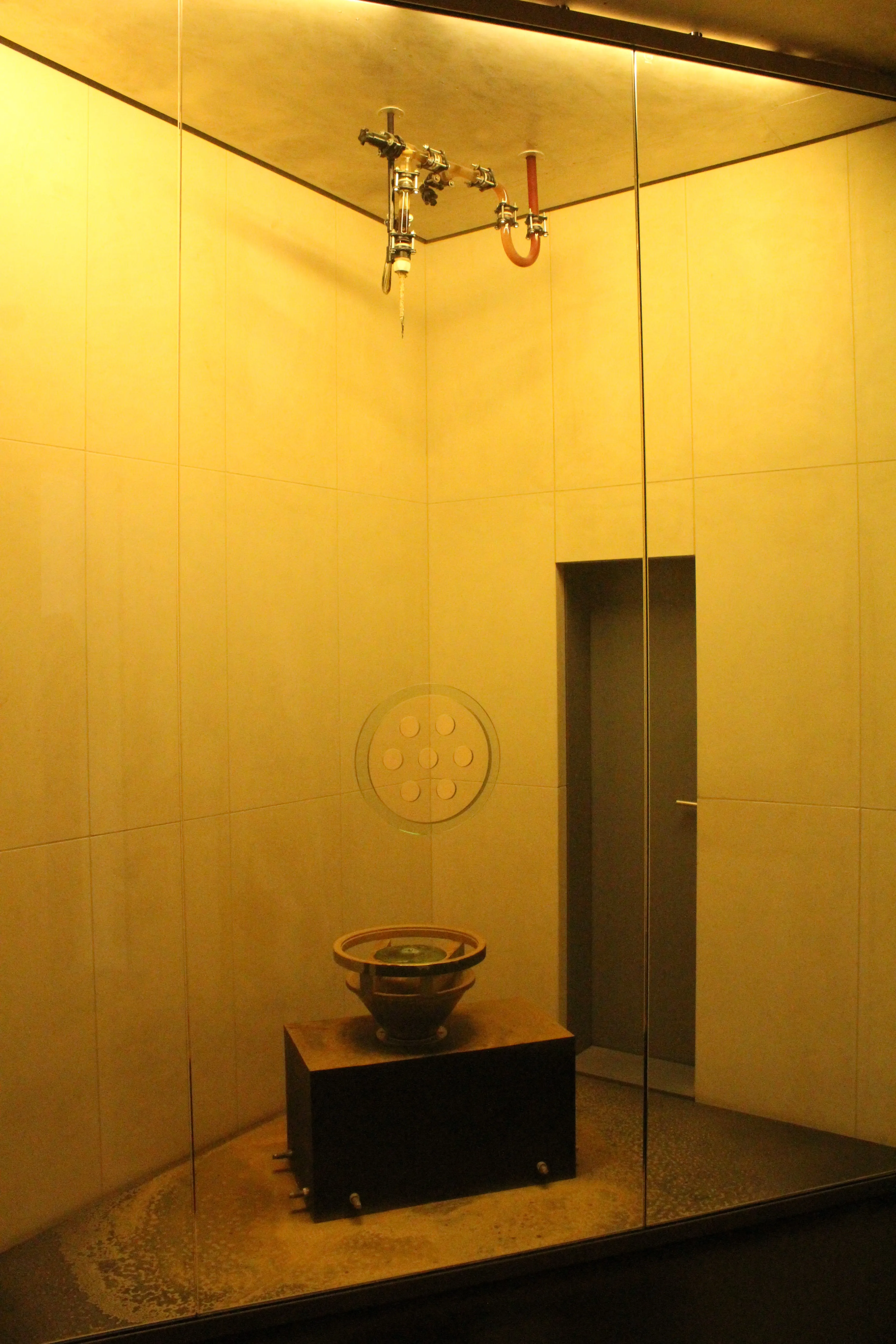
The drip point, one floor below Hamburg’s Kunsthalle. Photo by Hinnerk11, via Wikimedia Commons — CC BY-SA 4.0.

Beneath Hamburg’s Kunsthalle, a machine switched on in 1996 is still dripping rainwater onto a stone slab, one drop at a time, on a schedule that doesn’t finish until the year 2496.
On December 19, 1996, after more than ten years of development, artist Bogomir Ecker switched on a machine inside the museum’s newly built Galerie der Gegenwart and then, by design, mostly left it alone. Commissioned by the city’s cultural authority under Hamburg’s Kunst im öffentlichen Raum (art-in-public-space) program, the Tropfsteinmaschine occupies a room-within-a-room built on its own foundation, at the seam between the exhibition floors and the museum’s storage depot, sealed from visitors by a diagonal glass wall. The only instruction embedded in it — lead numerals set into the stone wall panels, reading 1996–2496 — is to keep running for five hundred years.
The plumbing is almost comically simple for something built to outlast every visitor who will ever see it. Rainwater collects on the museum roof and drops into a 1,500-liter reservoir — an unpublicized drought reserve — before being routed to a small, deliberately overgrown planter at the gallery’s entrance. From there it seeps through soil and a custom-built capillary system, picking up calcium and carbon dioxide along the way, until it reaches the drip point in the sealed room below. Each drop that lets go there evaporates slightly, upsetting the water-calcium-CO2 balance just enough to leave a trace of limestone behind — the same chemistry, and roughly the same 10-millimeters-per-century pace, by which real stalactites and stalagmites form in caves. No pump, no wiring: gravity and Hamburg’s weather run it.
What keeps it from reading as a stunt is the institutional scaffolding built around it. Eleven founding members signed the charter of Tropfstein e.V. — an association with no purpose but stewarding this one artwork — in May 1997; its own count has since grown to 26 members, a small standing bureaucracy assembled to outlive its founders. The room itself is tuned for the wait: it’s the only unheated space in the gallery, isolated from vibration on its own foundation, and built of materials resonant enough that a falling drop is audible, not just visible, in the quiet. By 2021, a quarter-century into its run, the calcium had built a shallow crater into the round catch stone below the drip point, and the stalactite above had thickened by several millimeters — on pace with Ecker’s own note from his 1987 design proposal: “Ten millimeters per century stand for these thoughts.”
The honest limitation is also the point: there’s nothing dramatic to see. Through the glass it’s a drip, a stained stone, maybe a faint mineral crust — a piece that pays out on a schedule no visitor, or Kunsthalle director, will live to see resolved. It isn’t the museum’s showpiece, though the Kunsthalle built an entire exhibition, FUTURA, around its 25th anniversary in 2022, because a quarter-century is about as close to a milestone as this piece will offer anyone alive today. Go anyway, on one of the Kunsthalle’s Tuesday-to-Sunday open days. It’s one of the few artworks anywhere designed on a timescale longer than the institution housing it, let alone the people looking at it — worth the two minutes it takes to stand at the glass and watch almost nothing happen, on purpose, for five hundred years.