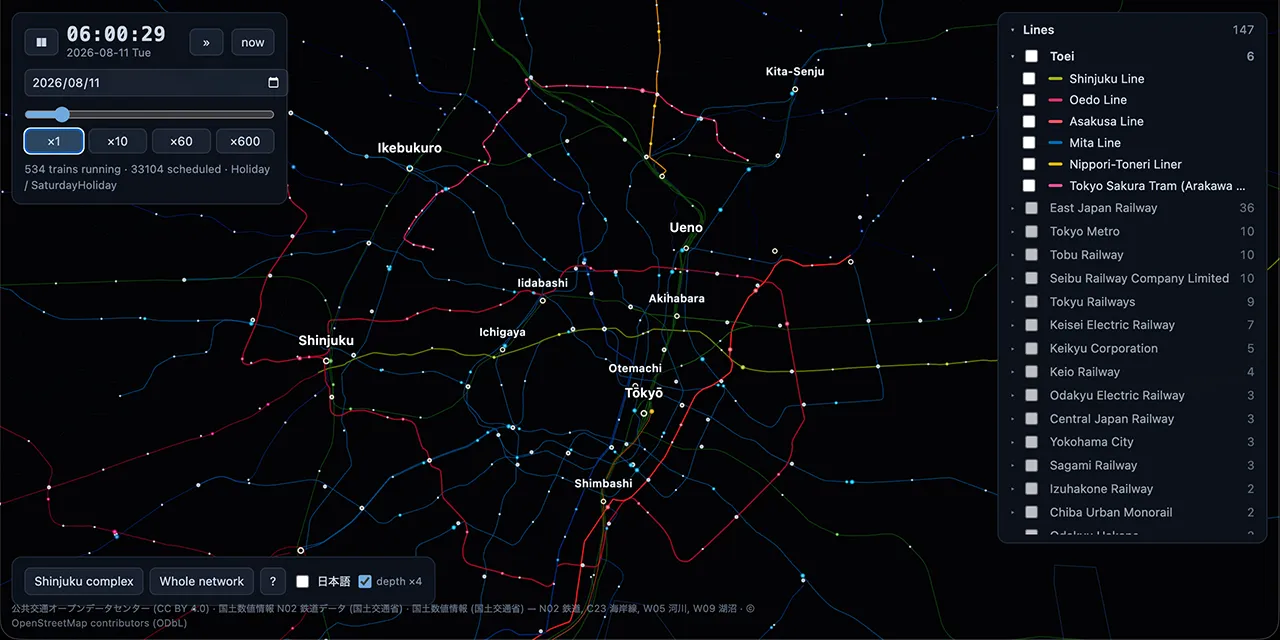
147 rail lines, roughly 1,900 trains moving at once, and a clock running at sixty times speed. Zoom into Shinjuku and the ground goes transparent.
Most transit visualisations settle for a map with dots on it. This one is built as a viewer for a physical thing — the rail network as an object with depth, drawn straight in WebGPU and WebGL2 with no rendering library in between. Across the Kanto region it carries 147 lines from every major operator, over a backdrop of the real coastline, rivers and lakes, with about 1,900 trains in motion on a weekday. The clock runs at ×60 by default, so one second of your time is one minute of Tokyo’s, and the network visibly breathes: the morning peak thickens, the last trains thin out. You can also set it to any date, or flip to real time.
The x-ray is the part that justifies the whole build. Zoom toward Shinjuku and the view cross-fades into the station complex itself, ten operators deep, from Seibu-Shinjuku at +9 metres above datum down to the Oedo line at −39 metres. Four more complexes are modelled the same way — Shibuya, Tokyo, Ikebukuro, and Akasaka-Mitsuke/Nagatachō. Anyone who has ever been lost changing lines at Shinjuku has been carrying a vague mental model of a building with floors in it; this replaces it with the real vertical arrangement, and the forty-eight-metre spread between the highest and lowest platforms explains why the walk takes so long.
The data is properly sourced and properly credited: ODPT for timetables and live positions, MLIT for rail geometry and the coastline, OpenStreetMap for station names and indoor structure, all CC BY 4.0. A legend filters by operator and flies the camera to any route you pick.
The honest limitation is stated by the author before anyone can catch him at it, which is the mark of the whole project. Only 6 of the 147 lines run published timetables, because ODPT serves Toei without an API key and nothing else. The other 141 run fabricated schedules — a plausible regular service, not real times — and they are drawn lighter and thinner, with the legend saying so outright. The data notes add that none of it should be used to plan travel.
Which leaves it exactly what it claims to be: not a departure board, but the closest thing to seeing Tokyo’s railway as a single moving object.