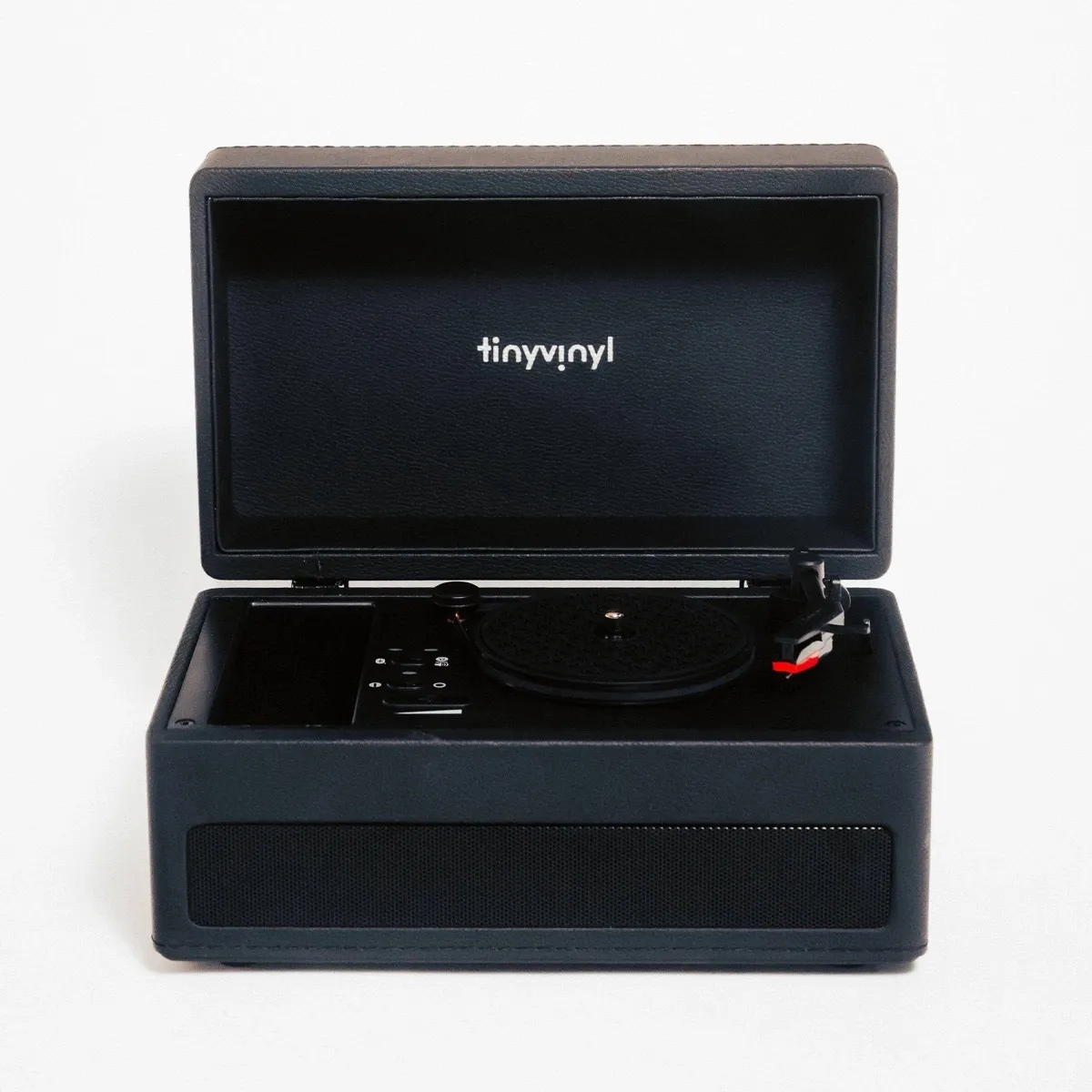
The deck open and empty — platter, storage slot, and speaker grille, all built for a format that already plays elsewhere.
A $50 turntable built exclusively for Tiny Vinyl’s 4-inch collectible records — records that already play on any full-size turntable at 33⅓ RPM. It exists anyway, for collectors who’d rather have a dedicated deck than dig the real one out from under a stack of LPs.
Tiny Vinyl makes 4-inch records: a third the size of a standard LP, two songs per side, pressed for artists from Olivia Rodrigo to BTS to Chappell Roan and sold as $14.99 collectibles at Target. Nothing about the format requires special hardware — the records are calibrated to 33⅓ RPM specifically so they’ll spin on the turntable a buyer probably already owns.
It’s a shoebox — 10 by 6 by 5 inches, clad in black faux leather, lid doubling as a dust cover. Open it and the mechanism is a real one: motor, platter, tone arm, and control panel built specifically for the format, though the cartridge and needle are off-the-shelf parts. A slot built into the platter deck stores five records upright, so the player doubles as a small library. There’s a built-in speaker for grab-and-play listening, Bluetooth for streaming to a real system or headphones, and a wired headphone jack plus A/C cord for when Bluetooth isn’t worth the lag.
Once five records isn’t enough, there’s the Crate ($20), a stackable base that holds 30 more underneath the player, and the Frame ($15), a wall-mounted case that displays four records at a time. The whole line is built to stack, so a serious habit grows upward rather than sideways.
None of that is a case for the sound. A built-in speaker on a shoebox deck is not where fidelity lives, and Bluetooth-out doesn’t change what the onboard playback sounds like — it just gives you an escape route to better speakers. It’s also a closed loop: player, Crate, Frame, and records are all Target-exclusive and cross-branded, and the debut black colorway was already showing as sold out online within a day of launch. None of that seems to be the point. The point is a whole miniature hi-fi stack built for a format that didn’t strictly need one — the kind of unnecessary specificity a real collection eventually asks for anyway.