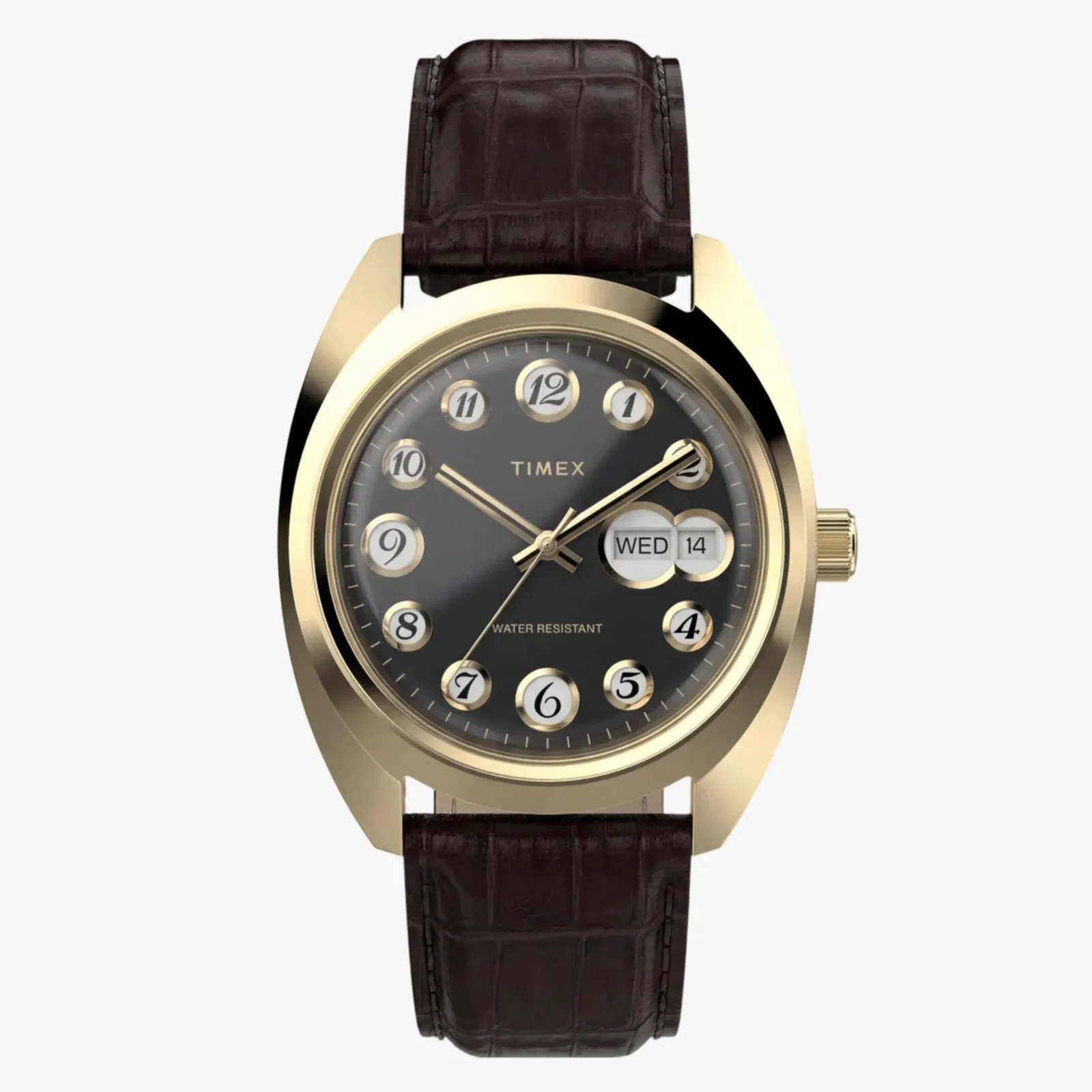
A rotary telephone had ten holes and you knew where every number was without looking. Timex made a watch out of that in 1976, and has just made it again.
The whole design is one decision. Instead of printing the numerals on the dial, each Arabic numeral gets its own polished gold-tone frame — a raised ring, set into a charcoal dial, with the numeral sitting at the bottom of it. Twelve small wells around the edge of a circle. Nobody has to tell you what it is referencing; your hand remembers before you do.
It commits, too, which is the difference between a reference and a costume. The day-and-date aperture at three o’clock is a twin porthole — two overlapping circles rather than a rectangle, so the complication joins the pattern instead of interrupting it. The case is a 37mm cushion in gold-tone stainless with a mix of brushed and polished surfaces, 43mm lug to lug and 12mm tall, which is small by current habit and correct for the decade it came from. Fifty-one grams.
The specification is 1976 in the places that matter and 2026 where it should be. The crystal is acrylic — it will scuff, and it will also survive a doorframe and polish out, which is why the originals are still around. Quartz movement, SR920SW cell, 50m water resistance. The strap is 20mm brown leather with a crocodile grain, sourced through the Leather Working Group, on quick-release spring bars so you can change it with a thumbnail and no tool.
One correction worth making, because the press coverage got it wrong and the photograph settles it. Write-ups describe the numerals sitting “against a white backdrop.” They do not: the dial is dark — charcoal to black — and it is the numeral discs that are pale. The contrast runs the other way, and it is better that way, because the twelve bright wells are what read as a dial from across a room.
$219, in stock, model TW2Y82100, one-year warranty. No Amazon listing exists for it, which for once is a small mercy.
A watch that tells you the time in the shape of a thing that no longer tells you anything.