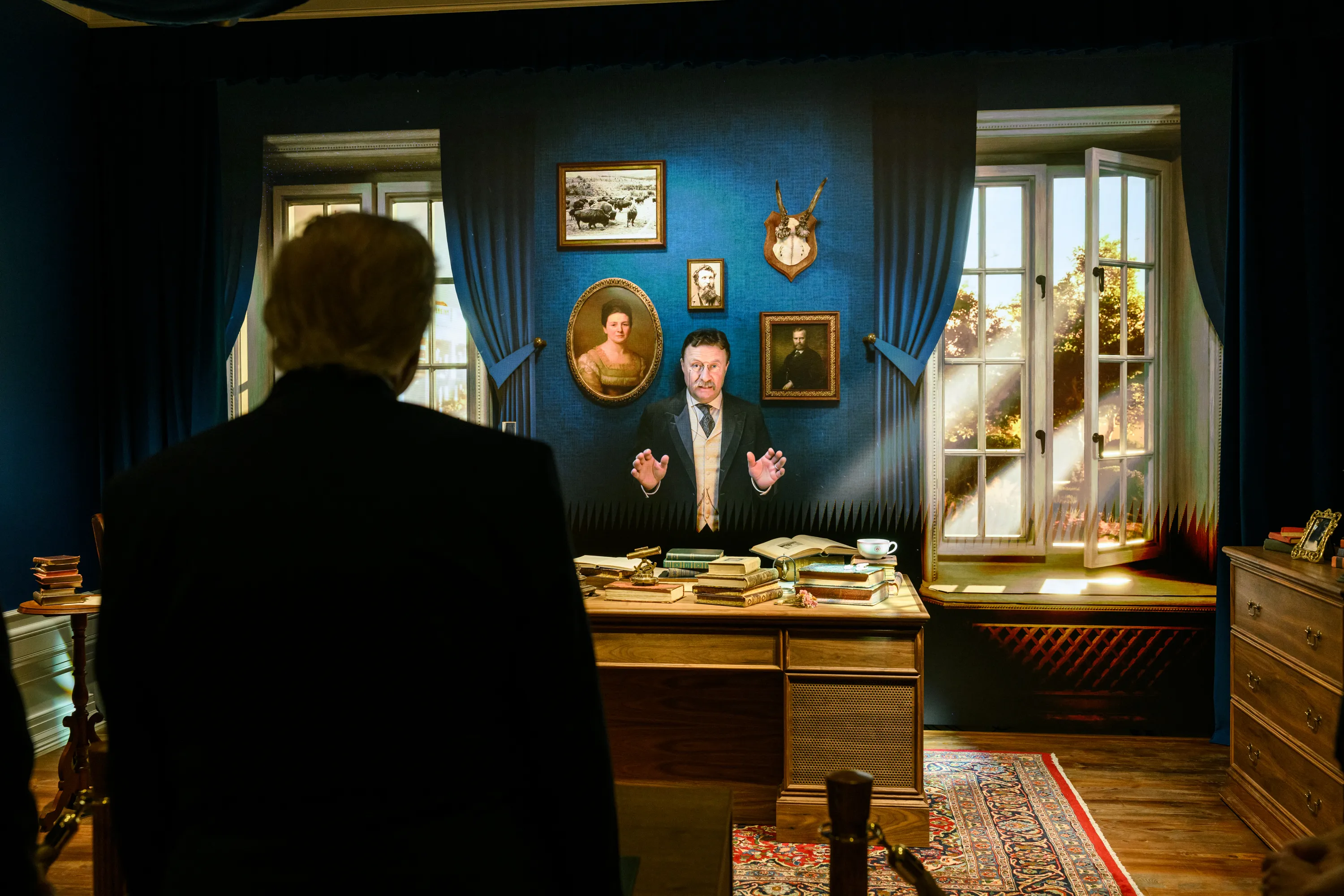
Inside “Talk with TR,” photographed days before the public opening. Photo by Daniel Torok, via Wikimedia Commons — public domain (U.S. government work).

A living roof of prairie grass over a Badlands bluff, an archive of Roosevelt’s own letters and speeches behind it, and inside, a life-size AI avatar of the man himself that visitors can question face to face.
The Theodore Roosevelt Presidential Library opened to the public on July 4, 2026, on a 93-acre site outside Medora, North Dakota, in the badland country Roosevelt ranched as a young man and later credited with remaking him after his wife and mother died in the same house on the same night in 1884. It sits beside the national park that bears his name, a fitting neighbor for a president whose defining legacy was setting land aside.
Snøhetta designed it — Design Architect, Landscape Architect, and Interior Designer, with JLG Architects as architect of record — around a premise the firm states plainly: “the library is the landscape.” The building’s roof, some 121,000 square feet of it, is planted with living prairie grass and walkable, so from a distance the 95,000-square-foot structure reads less as an object on the butte than as a fold in it. A boardwalk nearly a mile long threads the restored land around the building at shifting elevations. Inside, mass timber, reclaimed regional wood, low-carbon concrete, and rammed-earth walls sourced locally carry the same logic indoors; the project is among the more ambitious attempts anywhere to pursue full Living Building Challenge certification, the strictest environmental standard going.
The archive is the quieter half of the story and arguably the harder one. Roosevelt’s papers, letters, speeches, and photographs have long been scattered — the Library of Congress alone holds hundreds of thousands of pages, with more at Harvard’s Houghton Library and 16 other institutions. The Theodore Roosevelt Center at Dickinson State University, working with Microsoft’s AI for Good Lab, built a tool called Campfire to pull that scattered record into one searchable place, usable both in the galleries and online: ask it a question in plain language and it answers, cites its sources, and can build a lesson plan or a research thread on request.
The more startling installation is a separate one: Talk with TR, a life-size AI avatar of Roosevelt that visitors address directly, standing where a study or cabinet room has been reconstructed for the purpose. It is not a recording — LemonSlice, the lab that built it with Microsoft’s Azure conversational AI platform, renders Roosevelt’s face and voice live, frame by frame, in response to whatever’s actually asked, drawing on roughly 400,000 documents pulled from those same 18 institutions. Ask him something and the answer comes back in his own words, wherever the record supports one, with the source material cited so a visitor can go check it. The library is upfront that it’s AI rather than any kind of trick, and the honest limit is real: on questions that reach past the documented record — modern politics, abstract ideology, anything Roosevelt never actually wrote or said — the avatar is built to demur and redirect rather than improvise an opinion for a man who can’t hold one anymore.
None of this is cheap to see. A $450 million building charges $26 for adult admission ($16 for ages 3–12), open year-round with hours that shift by season and advance booking recommended for busy stretches — reasonable by presidential-library standards, but still a real ask for a site more than 30 miles from the nearest airport. What earns it is the pairing: an archive doing the patient, unglamorous work of making a scattered record legible, and a building willing to let a visitor stand in a lamplit room and just ask the ninth question that occurs to them, out loud, to something that answers back.