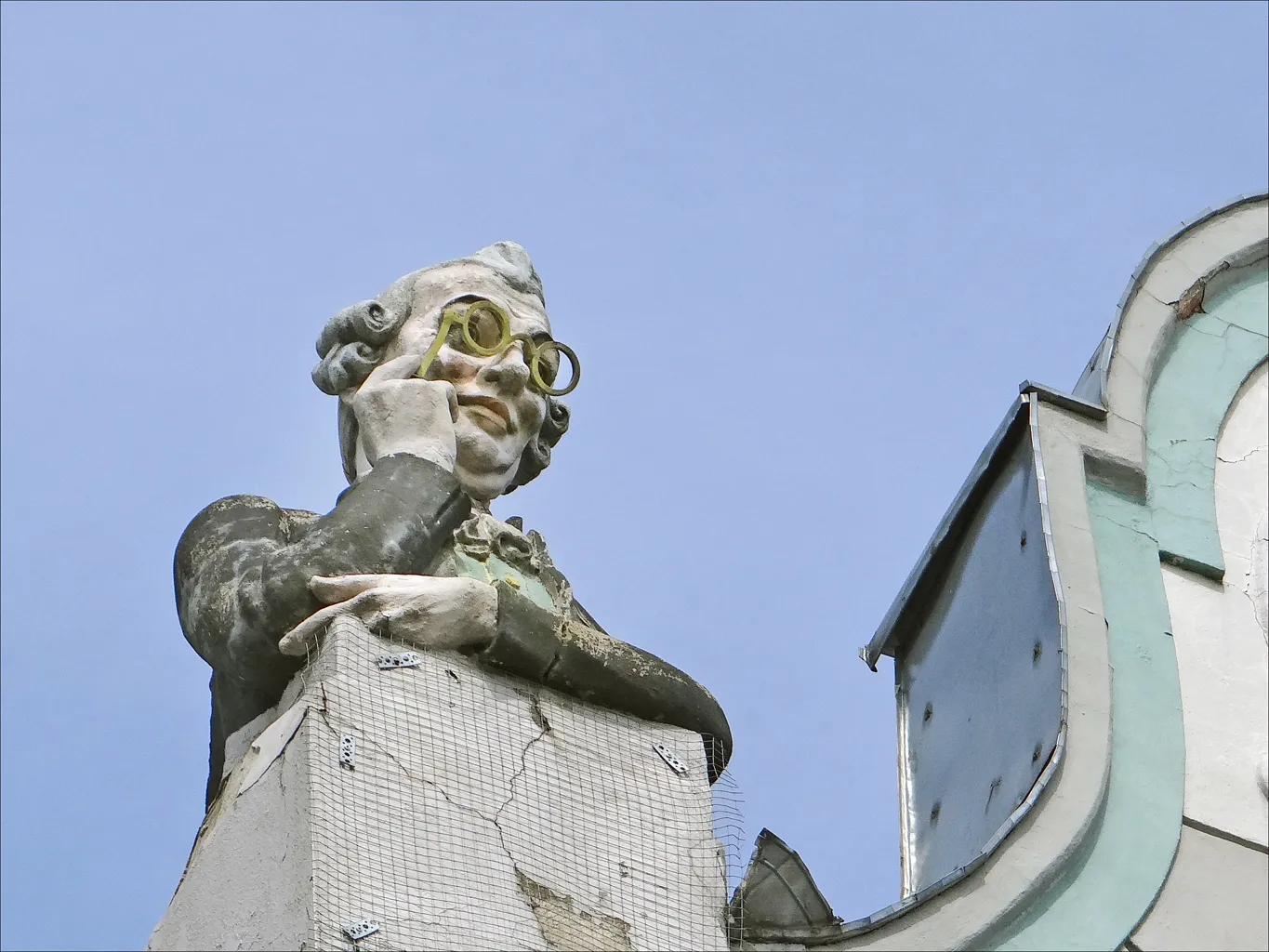
The lorgnette, the wig and the tailcoat, out on the shoulder of the Pikk-street gable. Photo: Jean-Pierre Dalbéra, CC BY 2.0, via Wikimedia Commons.
Every guide on Pikk Street tells you a merchant had him carved to shame a neighbour. The building’s own facade tells a different story, and that one is signed.
He is not a face on a wall. Out on the shoulder of the street gable of Reichmann’s House — Pikk 23/25, on the corner of Hobusepea in Tallinn’s Old Town — a man in a tailcoat and a curled eighteenth-century wig leans over the parapet on both elbows, three storeys up. What he holds is not a pair of spectacles but a lorgnette: two gilt lenses on a handle, the handle plainly visible running down to his fingers. He is aimed across the street.
The story is that he is a portrait. A merchant’s wife, undressing, found an old man opposite watching her through opera glasses; her husband declined to fight him and hired a sculptor instead, mounting the peeper’s own likeness on the roof so that the next time he raised his glasses, he met himself. It’s a good story, and it is not the only one. A second version has the owner putting up his own likeness to watch his young wife while he took his evening walks — and has the wife answering with the black cat that still crouches on the roofline nearby, to say she could leave whenever she pleased. A third has the figure mounted as a shrug: this is the love house, watch if you like. Nobody dates any of them, nobody sources them, and at least one guide page confidently calls the legend three hundred years old for a house finished in 1909.
What is documented sits at eye level in a cartouche that everybody walks past. BAUHERR R. REICHMANN — ING. ARCH. J. ROSENBAUM — INC. E. BOUSTEDT — BILDHAUER A. VOLZ — BAUUNTERNEHMER ALEX. BUSCH — 1908–1909. Reinhold Reichmann bought the plot in February 1908; Jacques Rosenbaum designed the house; the sculpture was ordered from August Volz, the Riga workshop that made that city’s Roland and the figures on its House of the Blackheads. The man on the gable was a line item on a contract.
The counter-explanation usually printed against the legend is a hedge — “a more sober theory holds” that he is only decoration — with nobody standing behind it, and we could find no art historian who has ever said so in print. The building argues it better by itself. Walk to the corner turret and look at the grotesque masks under its windows: two of the three are also wearing round eyeglasses, tassels and all. Eyewear is a running joke in Volz’s ornament here, not an accusation aimed at one window.
It costs nothing and it never closes. Stand on the Pikk pavement opposite the Canute Guild hall and look up at the left-hand gable — which is the last thing the legend has to survive. The window that figure has been staring into for a hundred and seventeen years belongs to a guild hall of German craft masters, with Saint Canute and Martin Luther standing on the front of it.