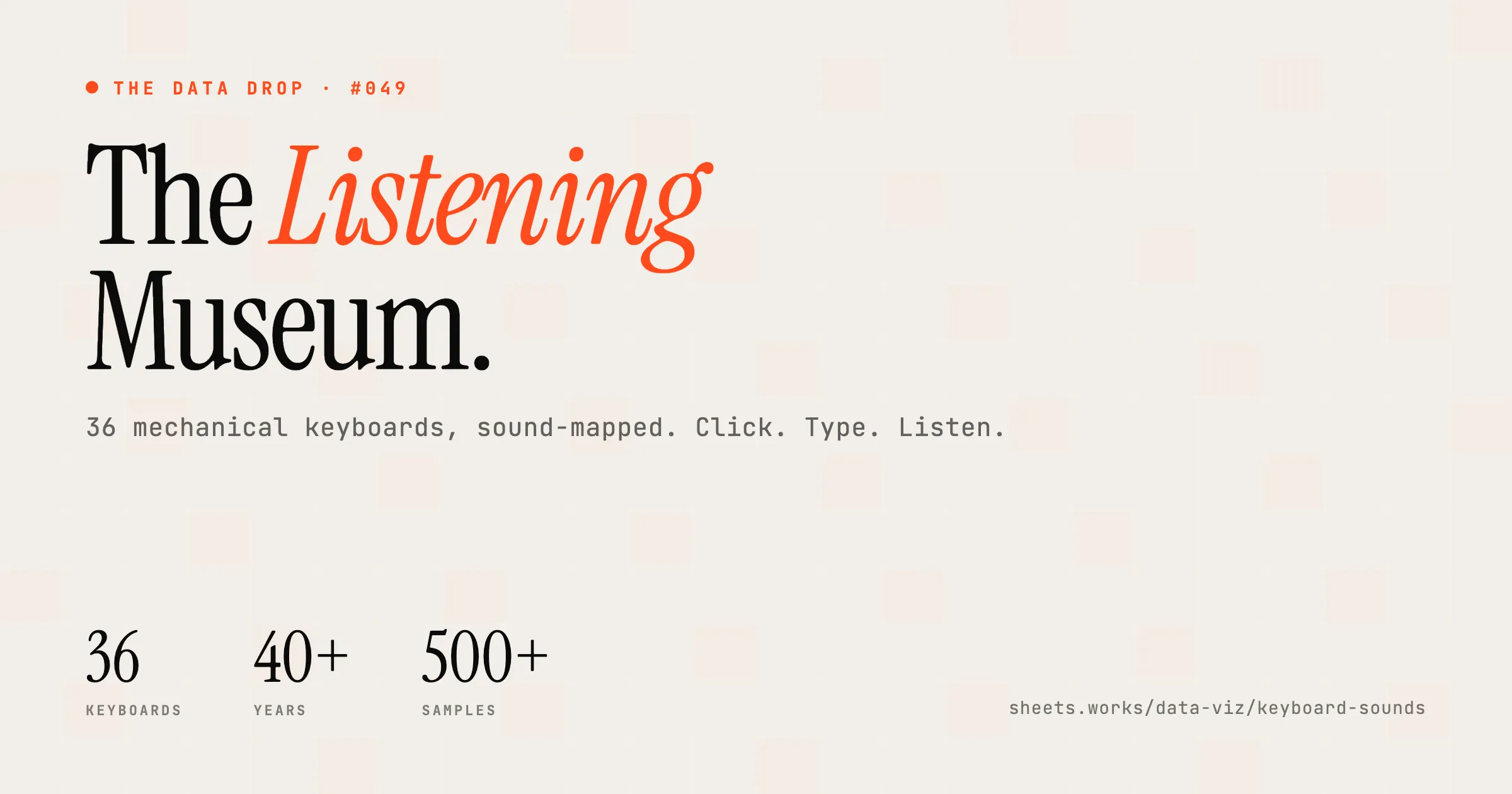
Thirty-six mechanical keyboards and switches laid out as cards. Click one, then type on your own keyboard — every key you press comes back in that board’s voice. Free, no account, 500-odd samples spanning forty years and eight switch families.
The list runs from an IBM Model M of 1985 through Topre’s rubber domes and Cherry MX clickies to the modern customs people call thocky. Clicking a card expands it into the anatomy — housing, stem, spring, and why those add up to the sound you just heard — which is the part that turns a novelty into something you learn from. Filters cover vintage, gaming, typewriter and the custom families; there is a dice button for when you don’t know what you want.
The methodology note is the best thing on the page, and it argues against the site’s own premise. The maker didn’t record any of this: every sample comes from the open-source mechanical-keyboard community — Mechvibes, Bucklespring, Monkeytype, keyBeats, daktilo, a CC0 HHKB recording on Freesound — and the page says so up front. “We are the curator, not the field recordist.” It then goes further, citing ThereminGoat’s argument that sound tests are inherently limited: microphone, room, host board, keycap set, codec and your own speakers all colour what you hear. You are never hearing the keyboard. You are hearing one recording of one build through one chain.
Which forces a correction to how this got surfaced, including here. It is not a way to audition a switch before buying — the site says flatly, treat this as a listening museum, not a buying guide, and warns that loudness differences between paired entries are recording variance, not anything about the switch. What it is instead is a demonstration of that very point. Several switches appear twice as “alt build” entries: the same switch, a different host board and mic chain. Played back to back, you can hear how much of what people call a switch’s character is actually plate, case, room and microphone.
Two details reward the pedantic. The Unicomp Classic shares its recording with the IBM Model M, because Unicomp still builds them on the original IBM tooling — a footnote that is also a small piece of manufacturing history. And some entries deliberately share audio, flagged rather than hidden.
No account, no purchase, no affiliate rail down the side. Just a page that lets you hear forty years of a thing through the board already under your fingers, and is scrupulously honest about what that is and isn’t worth.