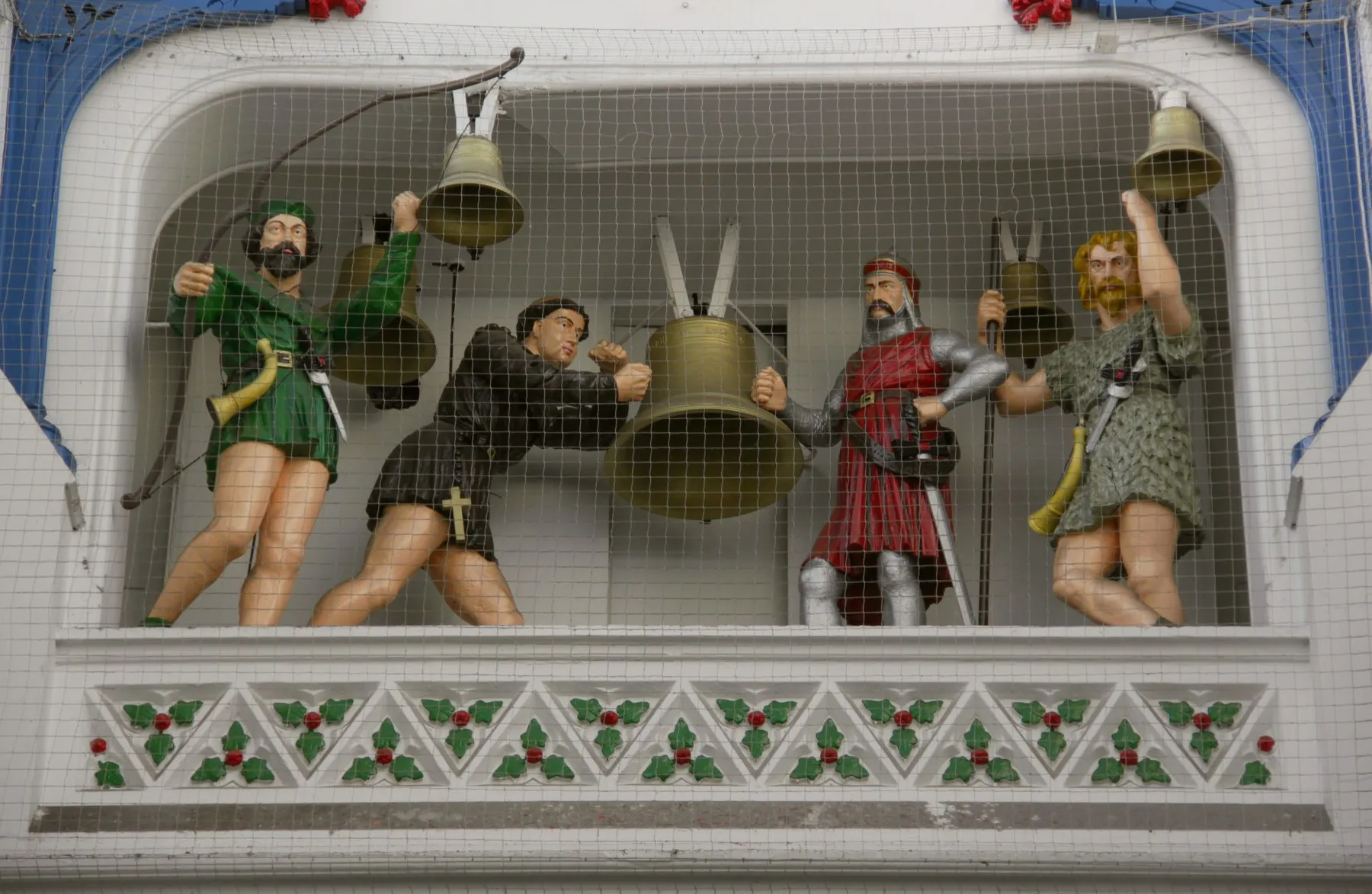
Robin Hood, Friar Tuck, Richard the Lionheart and Gurth the Swineherd mid-strike in Thornton’s Arcade, Leeds. Photo by Storye book, via Wikimedia Commons, CC BY-SA 4.0.

Four wooden Victorians swing a fist at a bell in a Leeds shopping arcade, on the hour and on the quarter, and never once touch it. The bells that ring are hidden behind them — the figures are just very convincing actors.
Thornton’s Arcade runs off Briggate in Leeds city centre, a narrow, glass-roofed Gothic Revival passage built in 1877–78 for the pub owner and music-hall proprietor Charles Thornton, on the site of the old Talbot Inn yard. It was Leeds’s first shopping arcade — seven more followed by 1900 — and it’s Grade II listed (Historic England list entry 1255837). The whole building is barely 4.5 metres wide, so the pointed arches and dragon-shaped roof brackets read more like a chapel than a shopping street. Above one entrance arch, set high in the glazed roof, is a clock with four life-sized figures.
The clock is the reason to come. William Potts & Sons, the Leeds clockmakers, built the mechanism in 1877 (the arcade itself had its public opening the following May); the four figures — carved and painted in wood by the Leeds sculptor John Wormald Appleyard — are Robin Hood, Friar Tuck, Richard the Lionheart and Gurth the Swineherd, all drawn from Walter Scott’s 1819 novel Ivanhoe. Richard and Friar Tuck raise an arm on the hour; Robin Hood and Gurth on the quarter. None of them is actually striking anything. They’re what horologists call faux jacquemarts — true jacquemarts, a tradition going back to 1383 in Dijon, really do swing a hammer into the bell. Here the figures just mime the blow while five bells, cast by John Taylor & Co of Loughborough — still the world’s largest working bell foundry — ring inside the mechanism, out of sight behind the netting. It’s theatre performed directly on top of the machine doing the actual work, both halves visible at once if you know to look for the seam.
The novel matters more than set dressing here: Scott’s Ivanhoe is largely credited with fusing Robin Hood into Richard the Lionheart’s reign in the popular imagination — the outlaw-and-returning-king pairing that’s now the default version of the legend started as one novelist’s plotting. Appleyard, whose day job was gravestones and church monuments, carved the era’s most famous piece of medieval fan casting. Thornton, for his part, already trusted the arcade’s architect, George Smith, who’d designed his other venture, the City Varieties Music Hall, in 1865 — still open, and the Guinness World Record holder for longest continuously operating music hall.
The clock still keeps time and the figures still perform. The arcade’s facades and the clock mechanism were restored in 1990–92 and again in 2010, and recent visitor reports describe it striking reliably enough that the standard advice is to time a visit for the top of the hour. What you won’t get is an unobstructed view: a fine wire mesh now sits permanently across the alcove, between the figures and every photograph anyone takes of them. The arcade itself is a working shopping passage — open whenever its shops are, no ticket, no barrier beyond that netting — so the whole performance costs exactly the time it takes to stop and look up.