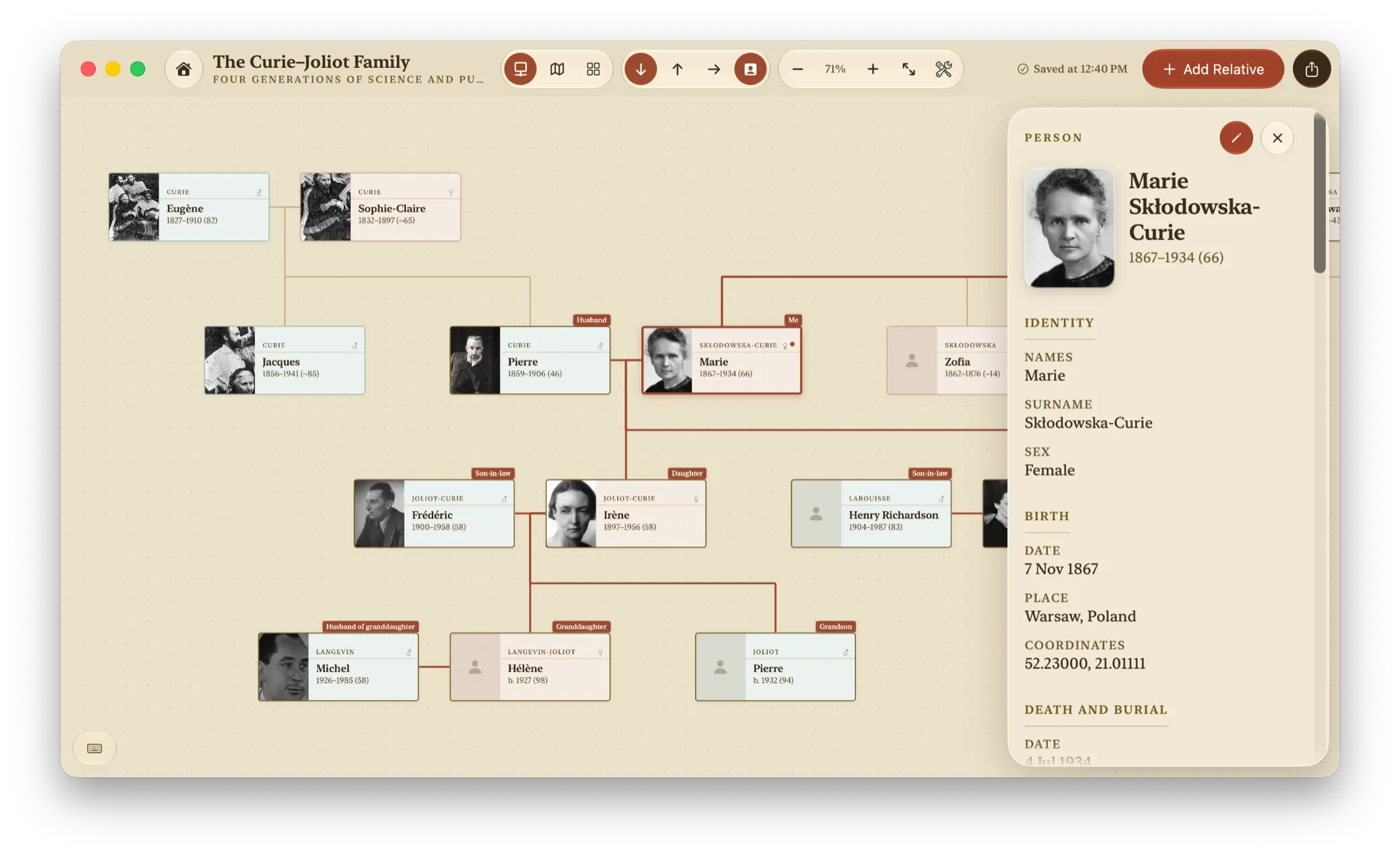
A family tree that lives as plain files in a folder on your Mac, not a subscription’s database — with kinship terms English doesn’t have words for.
Swarm is a native Mac app for building, viewing and exporting a family tree, made by a developer who posts on Hacker News as samoilev. The origin, from the Show HN post: he and his wife went deep into their own genealogy and wanted the data to live on their own Macs, not inside a subscription service. Nothing did that, so he wrote one in Swift, with no third-party packages.
Its commercial rivals — MacFamilyTree, Ancestry, MyHeritage — lock a tree into a proprietary database or a cloud subscription with DNA upsells attached. Swarm’s answer is the oldest trick available: GEDCOM 5.5.1, the plain-text genealogy format every serious tool, Gramps and Ancestry included, can read. A Swarm tree is a folder in Finder; export it and it opens elsewhere with the notes, source records and custom tags other programs attached that Swarm itself doesn’t model, and it keeps the untouched original as original-import.ged beside your edits.
What earns real attention is the kinship engine: ask how two people in a tree relate and it names the exact term — half-sibling, second cousin once removed, or a Russian in-law distinction English skips entirely, like свёкор (husband’s father) against тесть (wife’s father), or деверь against шурин for two different kinds of brother-in-law. Place lookup runs against a bundled, bilingual GeoNames index of 476,958 places, with no network call; the tree itself renders as a Buchheim–Jünger–Leipert diagram, an ancestor fan chart, or a map of birth, death and burial places. Six annotated example trees — Curies, Darwins, Kennedys, Romanovs, Roosevelts, Tudors, each with portraits and citations — ship so you can explore before touching a real family.
The unglamorous parts get equal care: merging someone else’s tree into yours finds likely matches itself, backs up first, and rolls back completely on failure. Every save is checksummed and swapped in only once verified, the last 50 revisions are kept, and anything deleted sits in a 30-day trash.
The rough edges are disclosed, not hidden. The build isn’t signed with an Apple Developer ID, so first launch needs a trip through System Settings to approve it, and it runs on macOS 15 or later only — no Windows, no Linux. There’s no online record search or DNA matching; the README calls that deliberate, the price of keeping a tree off someone else’s servers, though one Show HN commenter asked for exactly that and got no reply. The developer was just as candid about the merge feature: asked how it handles two large trees, he said it works in internal testing, but he has yet to find a real person with two trees messy enough to test it properly.