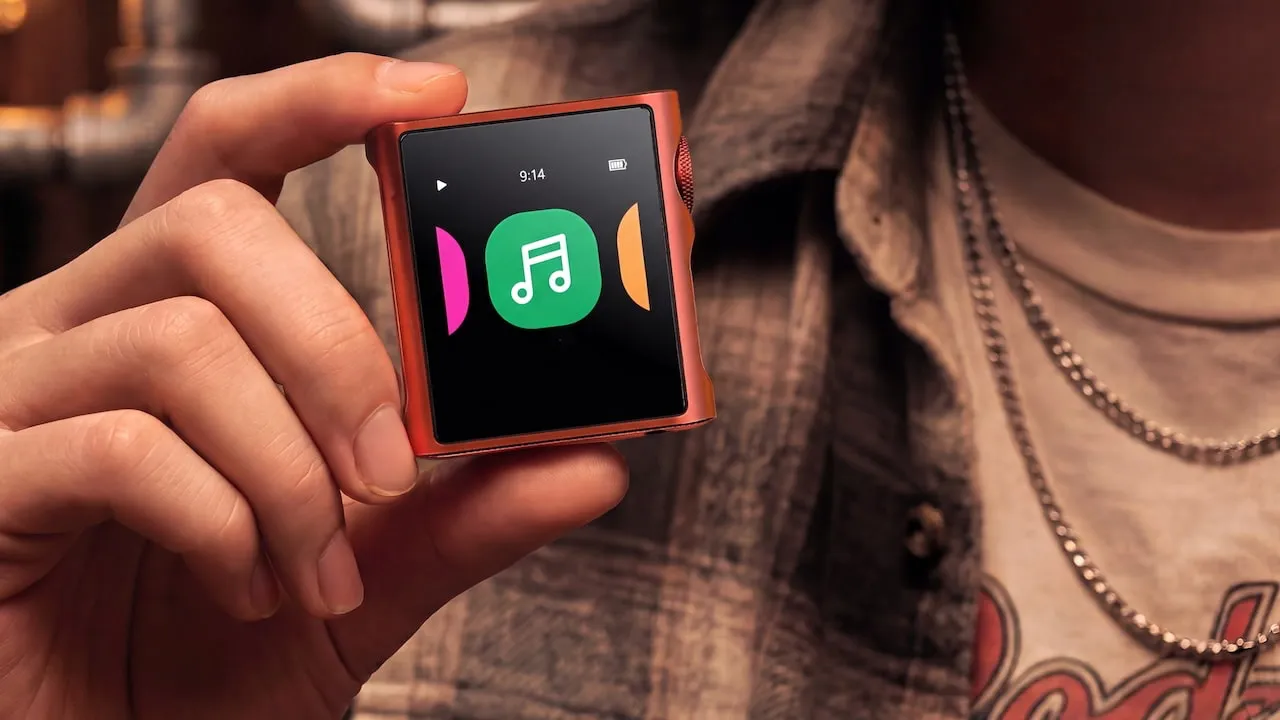
43.8 × 45 × 13.8mm. It is roughly the size of the thing it is obviously descended from.
A $129 hi-res player the size of a matchbox: dual Cirrus Logic CS43131 DACs, one 3.5mm jack, a microSD slot, and no Wi-Fi anywhere in it. It cannot stream — not because Shanling forgot, but because there is no radio and no app store to put a streaming client in.
The M0 Pura is the fourth generation of Shanling’s smallest player, and the pitch has stayed the same across all four: 35.8g, a 1.54-inch 240×240 touchscreen, a volume wheel, and Shanling’s own MTouch OS running on an Ingenic chip rather than a cut-down Android. There is no Wi-Fi. There is no app store. Music arrives on a microSD card — the only storage the device has, and it does not come with one — or over USB, or over Bluetooth. That is the whole surface area. Shanling sells it in black-and-orange, orange, and berry purple for $129, which is roughly what a month of a family streaming plan costs over a year and a half.
We reviewed Zenteek in May — a Mac player written “for the experience of owning your music rather than streaming it.” The M0 Pura is the same argument with a battery in it. Both start from the assumption that you have files, that the files are yours, and that the software’s job is to get out of the way between them and a DAC. The difference is that Zenteek makes a choice about how to treat your collection while sitting on a machine that can still open Spotify in another window. The M0 Pura removes the other window.
The audio hardware is real, not decorative. Two Cirrus Logic CS43131 DACs drive a fully balanced signal path: 100mW into 32Ω single-ended (121dB SNR, 0.0004% THD+N), 250mW balanced (128dB SNR, 0.4Ω/0.8Ω output impedance — low enough for sensitive IEMs). It plays PCM to 32-bit/384kHz and native DSD128, and its format list is the omnivorous kind — DSD, DXD, APE, FLAC, ALAC, WAV, AIFF, DTS, MP3, WMA, AAC, OGG, M4A, AC3, plus CUE sheets and M3U playlists. Battery is 650mAh rated at 9.5 hours; Headfonics measured about 8h40m at real listening volume, with a ~75-minute recharge over USB-C. It will also do variable-speed playback (1×/1.25×/1.5×/2×) with A-B repeat, which makes it a serviceable podcast and audiobook player — a use the find didn’t mention.
Four things the find got slightly off, all worth knowing before you buy. The balanced output is not a second jack. There is exactly one 3.5mm port, and the 250mW figure only appears when you plug in Shanling’s proprietary 3.5mm-to-4.4mm adapter — which is sold separately, alongside the leather and clip cases. Out of the box you get 100mW and a USB-C-to-A cable. aptX is transmit-only. Shanling’s spec sheet lists Bluetooth 5.0 as LDAC/aptX/AAC/SBC when the M0 Pura is sending to headphones, but LDAC/AAC/SBC when it’s receiving — no aptX inbound. There is no MQA, anywhere in the spec sheet; if you bought into that format, this is not the player. And USB-DAC mode is capped lower than card playback — 32-bit/192kHz and DSD128 when it’s acting as your computer’s sound card, versus 384kHz off the card.
The honest limitation is the one the find celebrated, and it deserves a sharper edge. No Spotify. No Tidal, no Qobuz, no Apple Music, no on-device library sync of any kind: you rip the CDs, or you buy the files, or you have nothing to listen to. The screen is 240×240 — fine for album art and a track title, useless for anything else — and browsing a large collection through it is a chore that Shanling half-admits by shipping a companion phone app (Eddict Player, free, iOS and Android) whose SyncLink mode moves library browsing to your phone’s screen. Which leads to the honest asterisk on “deliberately can’t stream”: Shanling’s own marketing points out that in Bluetooth-receiver mode the M0 Pura “transforms into a Bluetooth DAC/AMP for use with any smartphone and their music streaming services.” The device can’t stream. It will very happily play your streams. The purity is in the hardware, not in the enforcement — and if that distinction doesn’t matter to you, the thing you actually want is a dongle DAC, which costs less and does that one job.
Also on Amazon ↗ Affiliate
Affiliate link — we may earn a commission from qualifying Amazon purchases at no extra cost to you.