The obvious question about a desk toy that watches your coding session is what it tells the internet about you. The answer is in the firmware: a state word, a model name, a timestamp.
A plugin on your machine watches your coding agent and publishes one of three states — thinking, generating, done — to a 240×240 screen on an ESP8266. The orb answers in colour: slow cream while the model reasons, faster glacier blue while it writes, a green flash when the turn ends.
What crosses the wire is { model, state, ts }. No prompt, no code, no message text, published to rubato/<deviceId>/state over TLS on 8883. The broker is neither yours nor public: the maker’s EMQX Cloud Serverless instance, hostname hardcoded in rubato.ino, Shenzhen region, CA pinned in firmware so an impersonated broker gets rejected. Your credentials are a device ID and token printed on a card in the box. The Claude Code plugin keeps nothing on disk but that config — it tails your transcript locally to catch the first output chunk, and only the flag leaves.
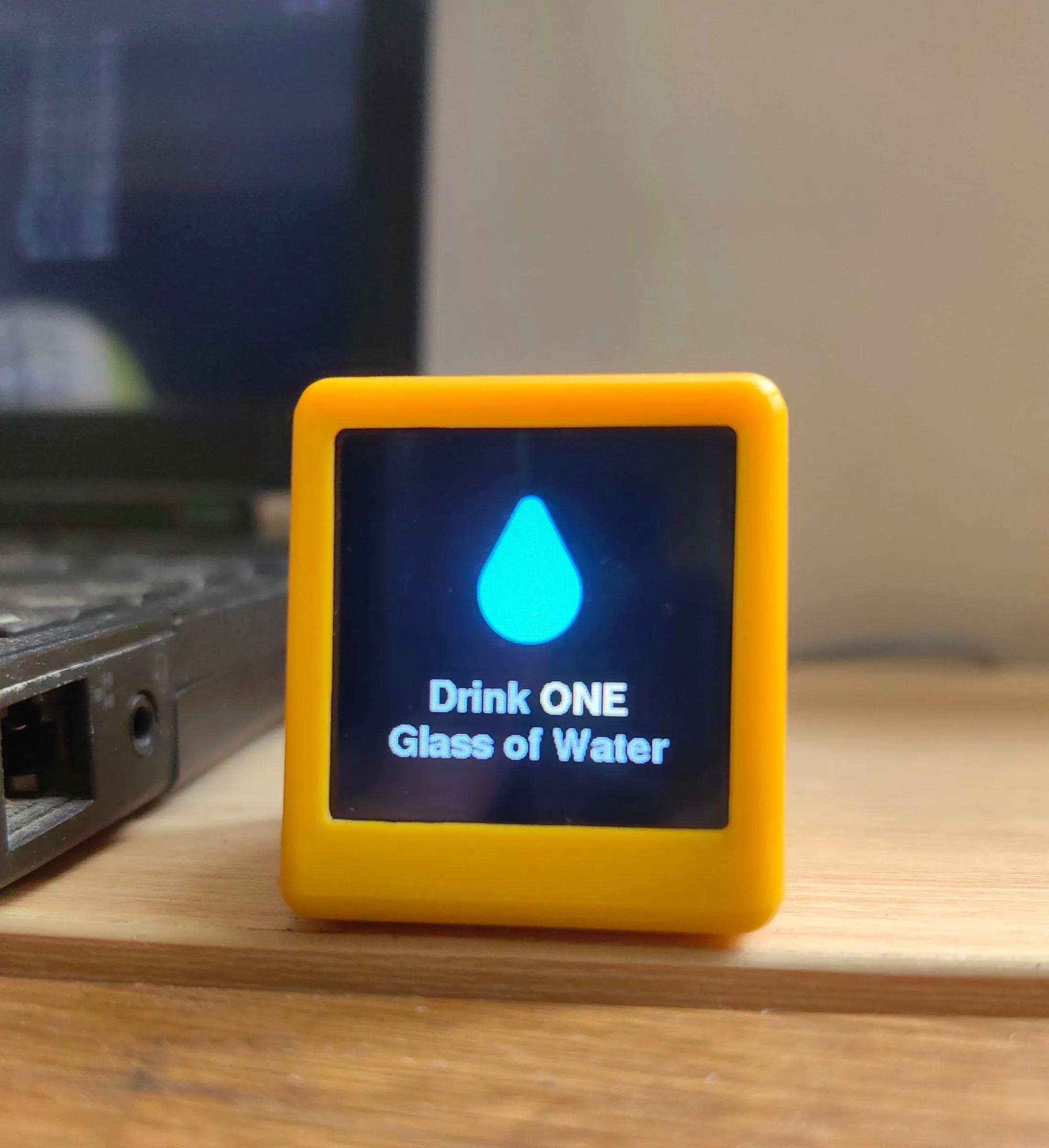
The break screens are the reason it exists, and where the pitch outruns the firmware. Six of them, each with a daily quota compiled in: water four times, bathroom, eye rest, neck stretch and kegels twice each, standing desk once. They arrive full-screen with a flat icon and two bold lines — Drink ONE / Glass of Water, Do TEN / Slow Kegels — at most one per task, never within thirty minutes of the last. The catch: a break only arms when the incoming message carries an estSec estimate, and only the DeepSeek Harness plugin sends one. On Claude Code, Codex, Cursor, OpenCode or OpenClaw you get the orb and no breaks. Nor is there an off switch — no toggle in the web settings, no serial command, and no sign of the working-hours window the listing mentions.
You can actually buy one: $59 on Tindie, assembled and tested, ten in stock as of writing, tracked from Shanghai — no battery, no account, no subscription. Two corrections to the listing: the retro-Macintosh silhouette is real, the beige is not — it ships in glossy school-bus yellow — and both the store and the repo README still call the Claude Code plugin “planned” when it shipped, hooks and all.
GPL-3.0 makes the build-your-own path genuine. The firmware is one 2,400-line .ino; the enclosure STLs, schematics and BOM sit in chuxin520922’s SmallDesktopDisplay. Unplugged from any agent it is a clock with Open-Meteo weather — which is what it was, as Misaka’s 2021 desk display, before it learned to watch you work.