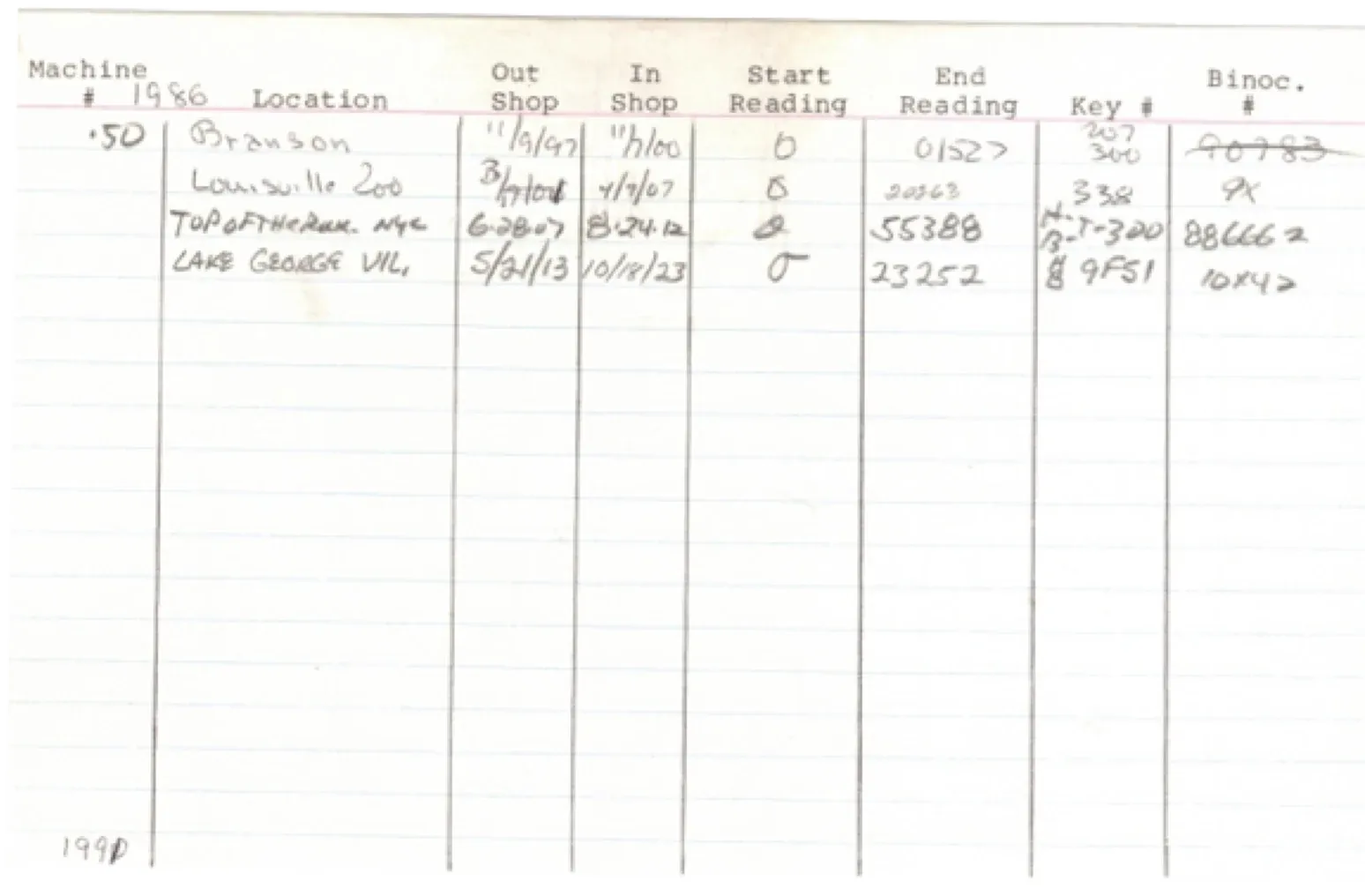
Tower Optical has kept an index card on every viewer it ever placed: where the machine went out, when it came back to the bench, and what the counter read when it did. Four of those machines are now for sale, and the card comes with them.
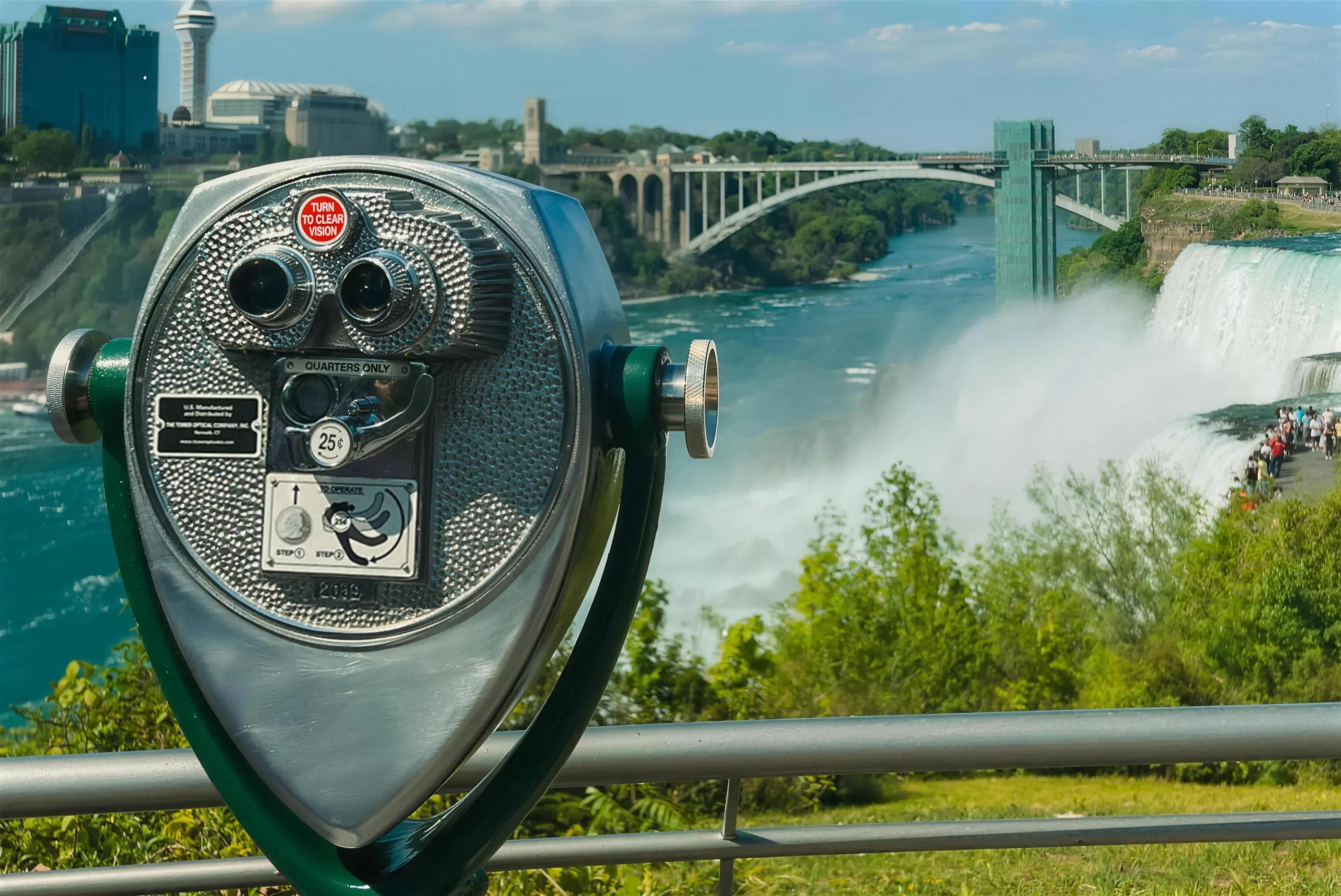
These are the cast-iron viewers from the overlook rail — a chrome-plated bronze head on a cast iron yoke, pedestal and step-up, 300 pounds, 63 inches tall, with 10×42 prism optics, manual focus, and 318 feet of field at a thousand yards. The coin mechanism has no batteries and no power source: it takes a quarter or a half-dollar, holds about two thousand of them, and works because you turn the handle. Tower Optical has built them in Norwalk, Connecticut since 1933, placed them at 400-odd destinations, and kept nearly all of them on the company books for their entire working lives. Very few have ever been sold.
Which is what makes the paperwork the actual object here. Every viewer carries a tamper-proof recording meter, and every return to the Norwalk bench is one handwritten line: location, out, in, start reading, end reading, key number, binocular number. Machine № 1986’s card runs Empire State Building → Branson → Louisville Zoo → Top of the Rock → Lake George Village, and the Rockefeller Center line ends at 55,388 — a count of people who put in a quarter and looked.
Release № 1 is four machines and three are still available, priced individually rather than flat. № 507, built around 1950, worked seventy-five years across Niagara Falls, Battery Park and the North Carolina Zoo ($10,499). № 1028, built 1960, ran Garrett Mountain, the Memphis Zoo, the Cape May ferry, the Lookout Mountain Incline and Niagara ($10,499). The one worth the trip is № 1939 — built in 1989 and posted at Crazy Horse Memorial until 2001, pointed at the mountain while the carving came out of it — and it is the cheapest at $9,499. The Empire State Building machine, № 1986, is the one that has already gone, at $12,499.
Each is refurbished in Norwalk, ships palletized and freight-included to the lower 48, and carries a lifetime warranty honored by the same shop that has serviced the fleet since 1933. You choose the configuration before it leaves: free-use with a flat faceplate, the original working quarter mechanism, or the mechanism left in place but not required — which is the one to pick, because the coin slot is half of why the thing is charming. The reason any of this is on offer is that new placements are going tap-to-pay, and rather than warehouse the coin-era machines, the company is letting them retire somewhere they’ll be looked after.
Be clear about what this is. It costs more than a used car, weighs 300 pounds, stands over five feet tall, and wants to be anchored to a deck — white-glove installation is available nationwide and quoted separately, for good reason. Almost nobody reading this will buy one. But the provenance report is not a certificate invented for the sale; it is a transcription in ink of shop records that were kept because the company needed them, and the original card ships in the box. A machine that can tell you it stood at Crazy Horse from 1989 to 2001 is a rare kind of object: one that documented its own life without being asked to.