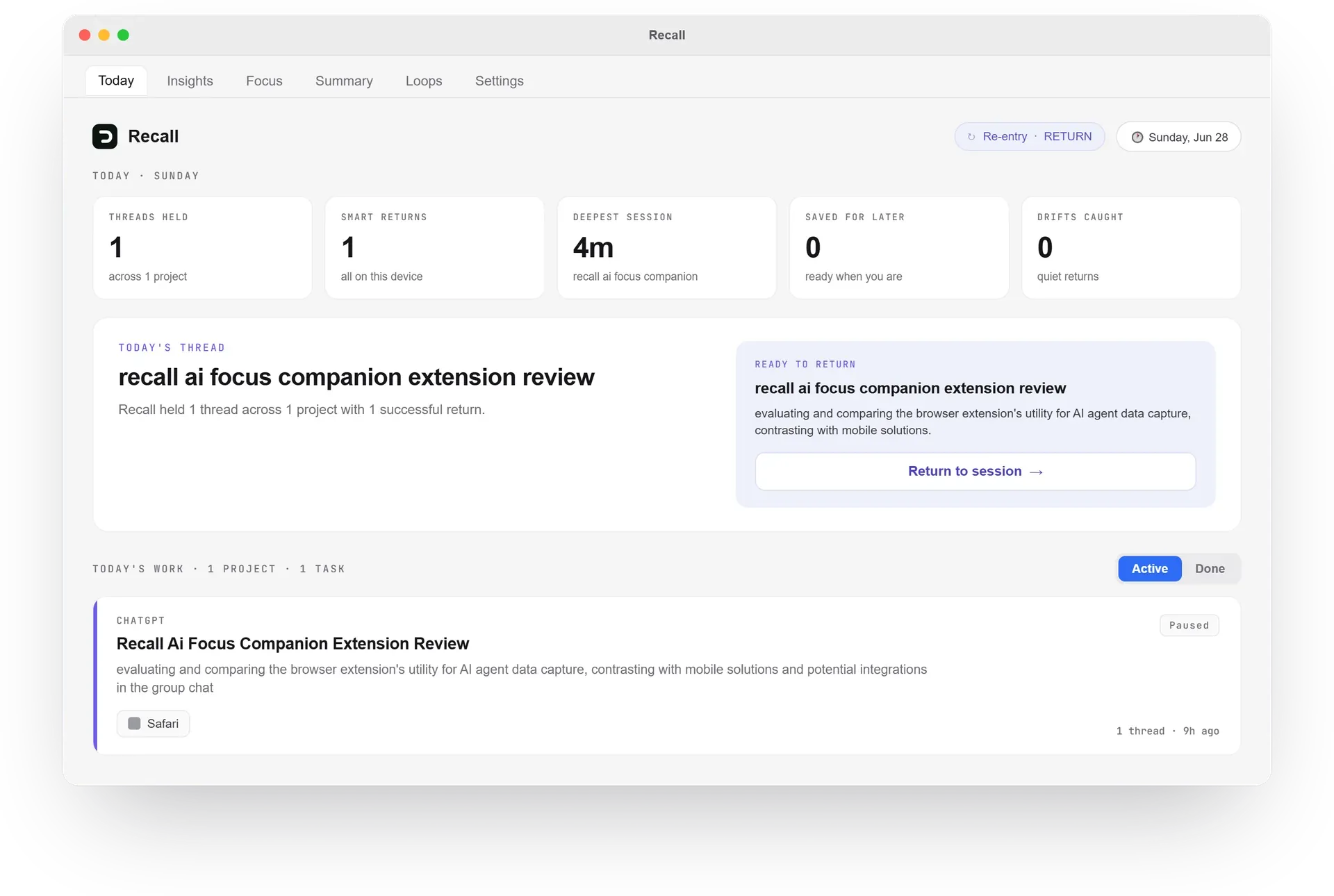
The Today view: the day grouped into threads, with one-tap “Return to session” cards that reopen where you left off.
Recall is a local-first Mac menu-bar app that watches how you move between apps, windows, and tabs and quietly threads that activity into named sessions — so when a task gets interrupted, getting back to exactly where you were is a single tap instead of ten minutes of reconstructing your own context.
Everyone has paid the tax: a meeting or a Slack ping pulls you off a task, and twenty minutes later you’re standing in a pile of half-remembered tabs trying to rebuild the state of mind you had before. Recall’s premise is that your Mac already knows the shape of that state — which app you were in, which document, which browser tabs, in what order — and can hand it back to you. It runs in the menu bar, takes structured snapshots of window and tab titles and your switching patterns, and groups the day into “threads” without any manual tagging. A Smart Return card then reopens the cluster you pick.
Crucially, it does this by noticing structure, not by reading content. Recall captures app and window titles and switch events — not screenshots, not keystrokes, not the text of your messages or emails. That distinction is worth being precise about: the app surfaces that you were in Slack with unread threads as a context signal, but it does not read the messages themselves. Everything is stored on-device, with no cloud sync of your work content; the one nuance is that some optional AI features can run against a local model or a cloud provider if you supply your own API key, so “fully on-device” holds for the base experience but not automatically for every add-on.
The nicer touches are in how it frames attention rather than just timers. Its Focus Modes are named after actual states — Locked in, Scattered, Reactive, Re-entry, Overloaded — which reads less like a productivity gadget and more like something built by people who know what a broken workday actually feels like. A “memory for AI agents” feature is listed as coming, which would expose your captured context to AI tools; that’s a genuinely useful-sounding direction and also one worth watching, given the whole pitch rests on the data staying yours.
Two corrections to how it’s often described, including in our own first capture. First, this is not a one-time purchase: the real model is a subscription — $20/month, or $9/month billed annually — with a 7-day trial that needs no card. There is a pay-once option, but only through a time-limited third-party AppSumo “lifetime” deal (from around $49), which is a promotion, not the app’s business model; don’t count on it being there. Second, it’s Apple Silicon only — Intel Macs are excluded — and the app still wears a “Beta” badge despite being paid. None of that sinks the idea, which is a good one, but you should walk in knowing you’re subscribing to a still-maturing tool, not buying a finished one outright.
If your work is a constant negotiation between too many open contexts, Recall is aimed squarely at the most expensive part of that — the cost of coming back. It’s a bet worth a trial precisely because it asks nothing of you to work: you don’t log anything, you just interrupt yourself like always, and it remembers the way back.