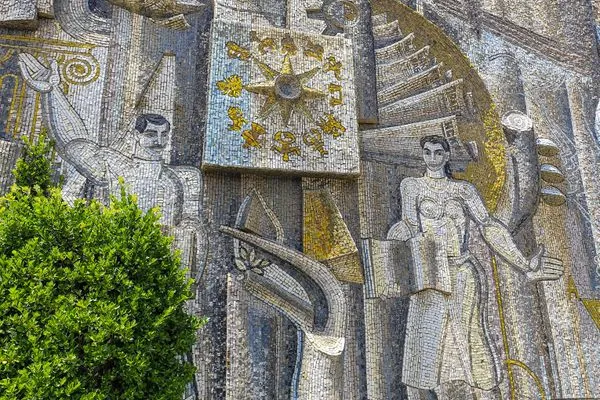
Two carved pages spread wide across a Baku printing house’s whole facade, running a history of writing from Egyptian hieroglyphs to a Mayan calendar — including the same political slogan the building spent decades setting in type.
Mətbuat prospekti — Press Avenue, in Baku’s Yasamal district — takes its name from the building on it: the Azerbaijan Publishing House, called the Kommunist Publishing House for most of the Soviet period. It doesn’t announce itself with a sign. It unfolds like a book: two vast pages raised in stone and mosaic across the whole front wall, carved with a survey of how humans have recorded language — Egyptian hieroglyphs at one edge, a Mayan calendar at the other, Chinese, Georgian, Armenian and Arabic script sharing the space between.
Above the figures run the mastheads of the Soviet press — Iskra, the country’s first socialist newspaper, and Pravda — and across the wall itself, picked out in yellow tile in Azerbaijani and Russian, sits the twentieth century’s most reproduced political slogan: workers of the world, unite. The building spent decades printing exactly that line above its own newspapers’ mastheads; here it’s set in tile instead of ink.
The mosaic is titled, simply, Mətbuat — Press — and dates to 1970, made by Oqtay Şıxəliyev and Hacıbala Rəcəbov, two of Soviet Baku’s monumental muralists. Rəcəbov’s other local work includes a 1980 Olympics mosaic at the Azerbaijan University of Architecture and Construction’s sports hall, worth seeking out on the same trip.
The building is still occupied and, by its own online reviews, still divides opinion: visitors call the mosaic outstanding, tenants complain the lift is ancient and nothing inside has been renovated in decades. Both are probably true, and the second may explain the first — Soviet-era mosaics have been stripped, clad over or demolished across Baku, and this one has lasted, at least in part, because nobody has gotten around to touching the building underneath it.
What to know: the relief runs along the side of the building and is visible from the pavement at any hour, free, with nothing to book. It’s a working building — admire the wall, keep to the pavement, and there’s no reason to go inside.