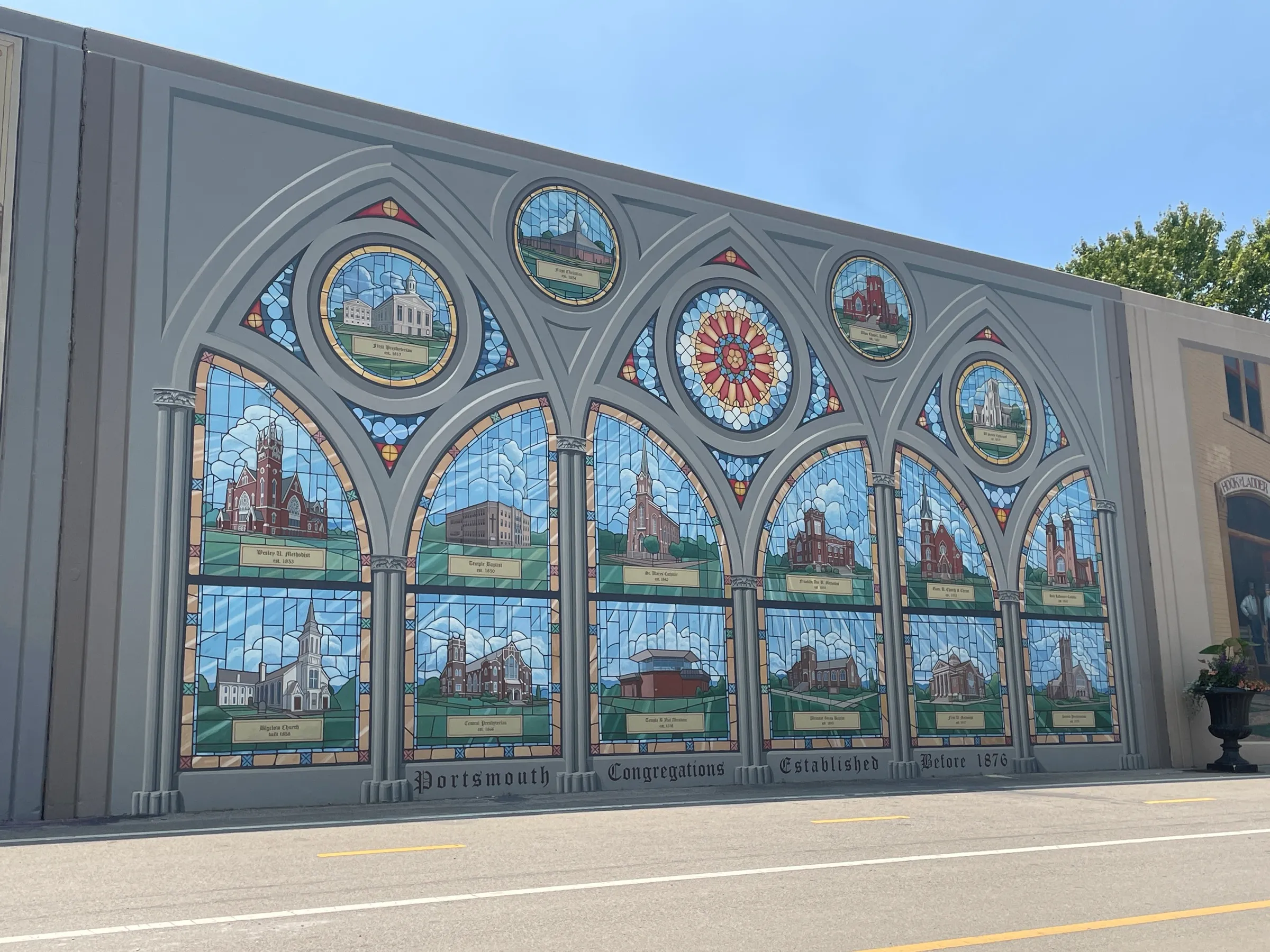
The 1937 flood took the town, so Portsmouth built a twenty-foot concrete wall between itself and the Ohio River. Fifty-six years later it started painting the wall with everything the river had nearly erased.
The flooding was not an event, it was a pattern: 1884, 1913, and then 1937, which broke the place. The floodwall went up afterwards and did its job, at the cost of putting a blank grey barrier where the river view used to be — the price every protected river town pays, and one that Portsmouth’s Boneyfiddle district paid on its main street.
In 1993 Portsmouth Murals Inc., an all-volunteer nonprofit funded by grants and local giving, commissioned Robert Dafford of Lafayette, Louisiana to paint it. Dafford is a career muralist with over 350 large-scale works behind him, and the Portsmouth commission is the one he has never finished: it is still an active project thirty-three years later, and he paints it in season, May through September. The count now stands at over sixty panels along 2,090 feet — a hair under half a mile — covering more than 42,000 square feet of wall.
What it covers is the whole span, not a highlight reel. It opens with the Adena and Hopewell cultures who built earthworks in the valley millennia before the town existed, and works forward through settlement, river commerce, the Underground Railroad, ordinary working life, and the people the place produced, Roy Rogers among them. The panels are painted in Dafford’s trompe-l’œil register, so one stretch resolves into a grey Gothic facade with arched stained-glass windows, each pane holding a different local church — a cathedral rendered on a flood barrier, which is either a joke about permanence or the most sincere thing on the wall.
It costs nothing and it is always open. Front Street in the Boneyfiddle historic district, roughly 429 Front St; Portsmouth Murals Inc. publishes a Portsmouth Murals app for iOS and Android that walks the wall panel by panel and tells you what you are looking at, which matters more than it sounds — unlabelled, half a mile of history reads as decoration.
The nice inversion is that the wall works better for the second thing than the first. It has held the river back for nearly ninety years, and in that time it has also become the only reason most visitors drive to Portsmouth at all.