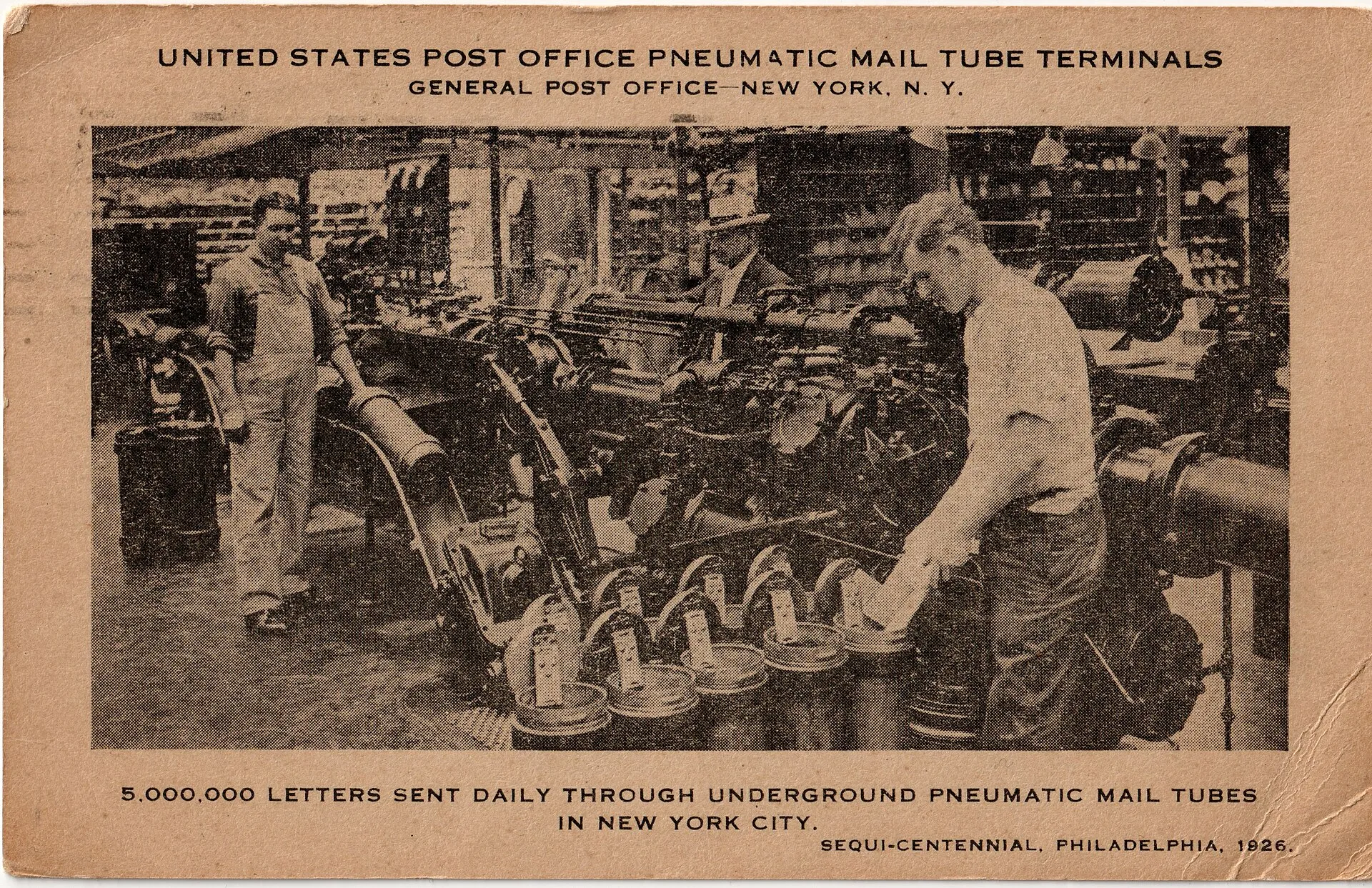
From 1897 to 1953, a third of New York’s mail travelled under Manhattan in 25-pound steel cylinders fired through pipes at 35 miles an hour. The system worked. It was killed by trucks.
Philadelphia went first, in 1893, at the urging of Postmaster General John Wanamaker — a department store magnate who had already installed the technology to move receipts around his own shop floor. New York followed on 7 October 1897, and the inaugural dispatch is the sort of thing that only happens when engineers are allowed to plan a ceremony. Senator Chauncey Depew loaded the first canister with a Bible, opened at Job 9:25 — Now my days are swifter than a post — the Constitution, and McKinley’s inaugural address. The return canister came back full of violets. Some time later, off the record, the operators put a live black cat in one and sent it across town. It arrived.
The specifications are the pleasure here. Twenty-seven miles of tube connecting twenty-three post offices, from lower Manhattan to Manhattanville and East Harlem. Steel cylinders weighing twenty-five pounds, in two sizes — 21 inches by 7, or 24 by 8 — each holding six hundred letters. Thirty-five miles an hour. The General Post Office to Grand Central in four minutes; to Harlem in twenty. A spur under the East River put Brooklyn four minutes from Manhattan, which the bridge above it could not manage at any hour of any day.
Now the correction, and it is sitting on the postcard above. That 1926 souvenir from the Philadelphia Sesquicentennial announces 5,000,000 letters sent daily through the New York tubes. The real peak figure was 95,000 letters a day — about thirty per cent of all mail moving in the city. Ninety-five thousand letters shot under Manhattan in steel is a genuinely astonishing number, and the Post Office still felt the need to multiply it by fifty for a souvenir stand. The lie is more revealing than the truth: somebody had decided the tubes were the future, and the future needs round numbers.
They were not the future. The system died in 1953 not because it broke but because the arithmetic turned: mail volumes outgrew what a 7-inch pipe could swallow, trucks got cheaper and went everywhere the tubes did not, and a government study concluded the whole network was practically obsolete. The Postmaster General cancelled the contract on cost.
The pipes are still down there. Which means that when Senator Ted Stevens described the internet as a series of tubes in 2006 and the entire web laughed at him — he was born in 1923, in a country where that was the fast way to send a letter.