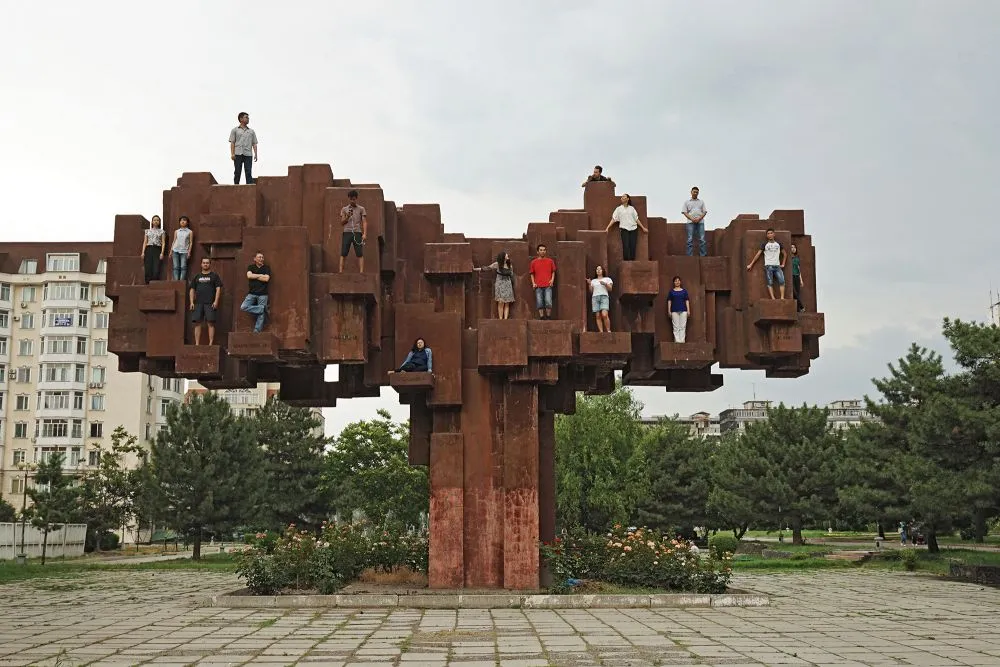
Brad Downey, “The Fathers of the Nation,” Bishkek, 2016. Photo from the artist’s project page, © Brad Downey.
For years the pedestals on this stone tree in Bishkek have held nothing but the names of the bronze figures that used to stand on them. In 2016 the artist Brad Downey put people back up there: writers, doctors, geologists and an opera singer, chosen to match the professions of the figures that were gone.
The monument is called Эл куту (El Kutu), “the people’s treasure”. It stands on Youth Alley in central Bishkek, near the Philharmonic: a rust-red tree of stacked stone blocks with a canopy that juts out over the paving. Turgunbai Sadykov spent 25 years modelling the 29 figures meant to fill it. They included the 11th-century poet Jusup Balasagyn, the scholar Mahmud Kashgari, Kurmanjan Datka (the 19th-century “Queen of the South”), the bard Toktogul and the ballerina Büübüsara Beyshenalieva. In 1995 he paid for it himself and gave it to the city for the thousandth anniversary of the Manas epic. One of the 29 was the sitting president, Askar Akayev, and his block still reads “Academician Akaev A.”
The bronzes didn’t last. A few years after the opening, while the road beside Youth Alley was being repaired, five figures were taken down one evening and never seen again. They were most likely sold for scrap, and nobody was caught. Then vandals sawed komuzes and hats off the figures that were left. So Sadykov took the rest down himself and stored them in his workshop until the city paid for a restoration. In 2018 he put the cost of recasting the missing five at 3 million som. The money still hasn’t come. The names, lettered into the stone, stayed where they were.
That is what Downey, an American artist based in Berlin, found in 2016. His project page calls the work “The Fathers of the Nation”. With a local research team he worked out who had been portrayed, then found Bishkek professionals in the same lines of work: three writers, three doctors, two geologists, a poet, a filmmaker, a politician, a composer and an opera singer. Several of them were women, which fits a monument that honoured Kurmanjan Datka better than his title does.
Then they climbed up. In Downey’s photographs people stand on the top blocks and sit on ledges above their predecessors’ names; one sits in the niche over “Sartbaeva K.” A cherry picker lifts others into place while passers-by stop to watch. Downey’s page doesn’t say how long they stayed up. The work survives as those photographs.
In July 2026 repair work began at the monument’s base, according to a Bishkek blogger quoted by for.kg. Nobody has said whether Sadykov’s figures will ever go back up. Until then, the monument is free to see from the pavement, with its empty blocks and the names still on them.