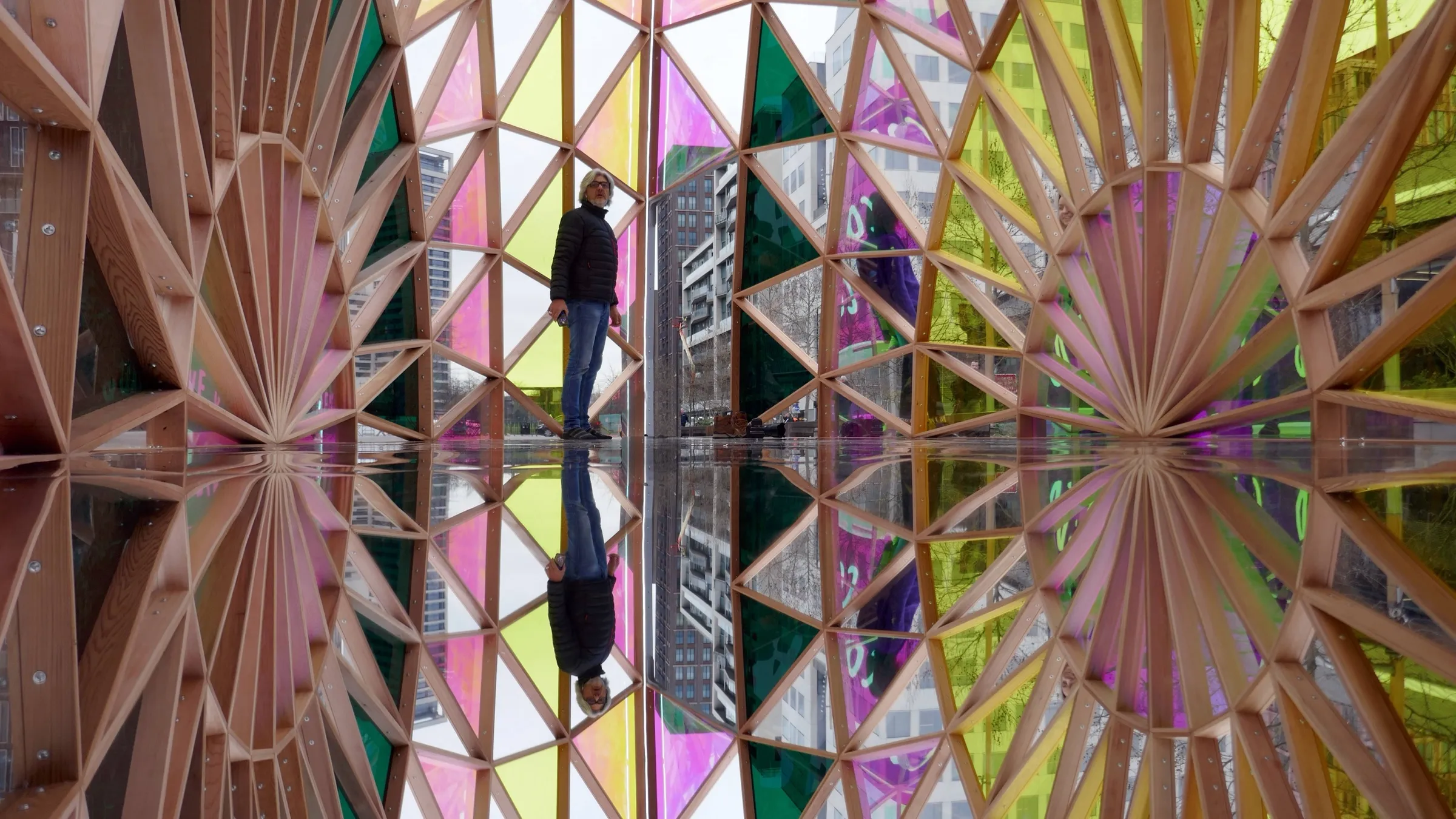
Inside Palm Temple, the two half-domes facing each other across the mirrored floor. Photo: Luke Jerram.
It reads as a pavilion until the bell goes. Then it reads as a clock, and the thing it is counting is not time.
Two halves of a spiralling cedar lamella dome stand facing each other outside the University of Bristol’s School of Chemistry — parallel, not joined, so the shape resolves as two enormous palms brought together in prayer. The triangular panels are dichroic, which means they are not coloured so much as sorting colour: what you see depends on where the light is coming from and where you are standing, so the same panel is magenta from one step and acid green from the next. The floor is mirrored, which doubles the dome, and hands you back the sky, the weather and yourself.
It was not built for Bristol. Sky Arts in Italy commissioned it for a television programme marking the 600th anniversary of Brunelleschi’s dome over Florence Cathedral, and it was first shown in London in January 2020 — a lamella dome as a small, portable, wildly coloured answer to the largest masonry dome ever built. It came to the university the following year and is now on permanent public display, free and unstaffed, outdoors and lit from within after dark.
The part that changes the visit is hanging in the apex. Jerram’s Extinction Bell tolls once, at random intervals, between 150 and 200 times a day. Each toll stands for one species estimated to be lost worldwide in 24 hours, a figure taken from a 2007 UN Environment Programme estimate. The randomness is the design decision that matters: a bell on a schedule becomes furniture within ten minutes, and this one cannot, because you never know when the next one is coming. It has been rung at Bristol Zoo Gardens, at King’s Cross, at the National Museum of Scotland, and it does the same thing everywhere — makes audible something that is happening constantly and silently somewhere else.
Be honest about what that combination does to the place. This is genuinely beautiful, and it is not restful. You go for a kaleidoscope and get an alarm, at intervals you cannot predict, and the two do not resolve into each other. That tension is plainly the point, and it is why Palm Temple is worth a detour that a prettier pavilion would not earn. Go on a bright day with weather moving through; the dichroic panels need light to do anything at all, and grey flattens them.