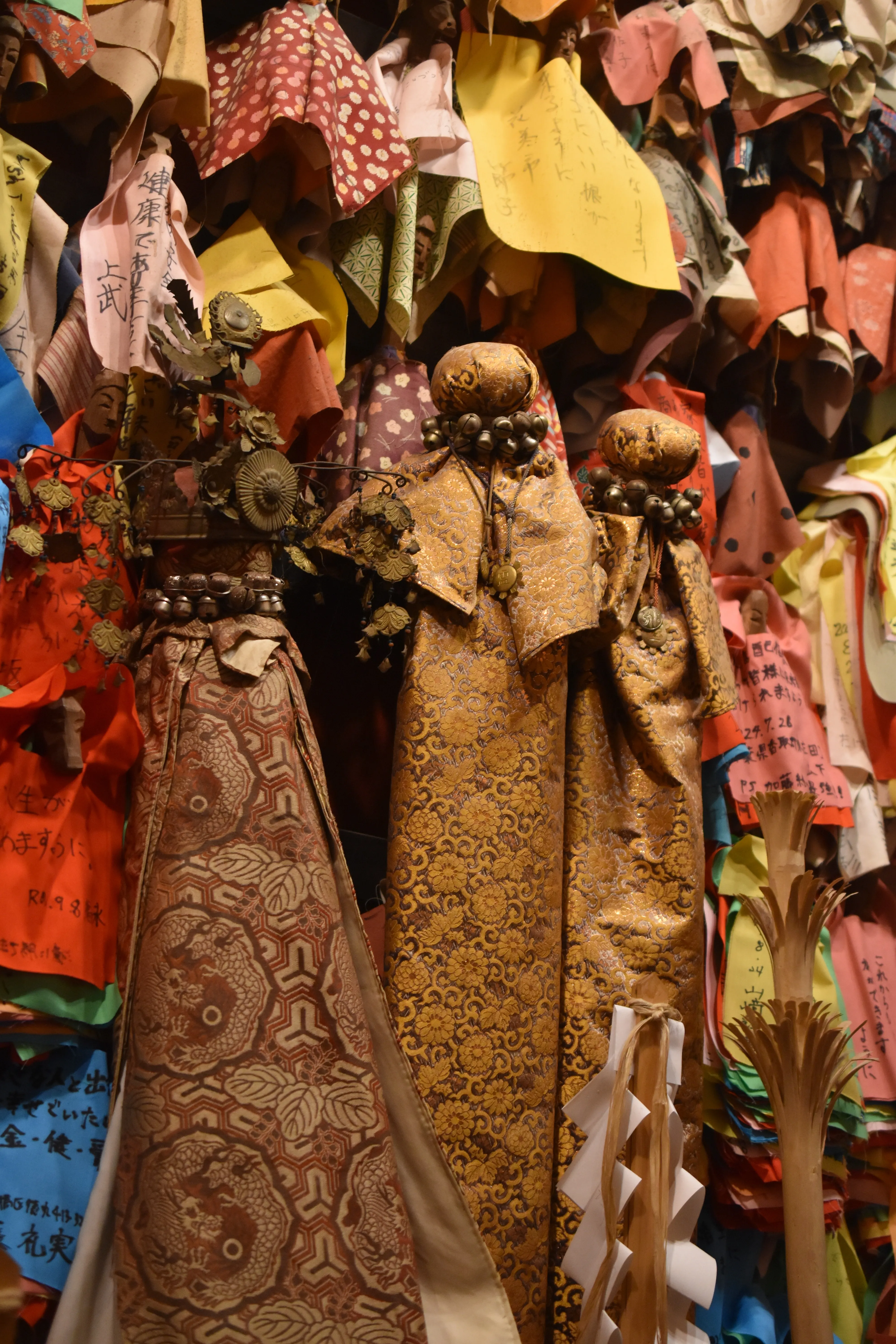
A farmer beheaded his daughter’s horse; she rode its severed head into the sky and became a household god of silk and horses. A thousand small effigies of her hang in one room in Tono, each wrapped in a stranger’s handwritten wish.
Denshoen is an open-air folk museum outside Tono, in the mountain-ringed interior of Iwate Prefecture, built around a preserved 1750s magariya farmhouse. One pavilion, called Oshirado, holds roughly a thousand effigies of Oshira-sama — a household deity of horses, silkworms, and farming, worshipped mostly in secret across rural Tohoku — hung wall to wall around an old mulberry tree at the room’s center.
The effigies aren’t carved figures so much as foot-long mulberry sticks, one end shaped or painted into a face — a woman’s, or a horse’s — dressed rather than carved into a body. Each year a family or shrine adds a fresh layer of cloth, called osendaku, over the last, so what’s on the wall today is decades of fabric stacked over a bare stick core. Visitors can buy a cloth for around 100 yen, write a wish on it, and tie it onto whichever effigy catches their eye, which is why the room reads as a wall of color rather than a shelf of statues.
The legend behind it comes from Kunio Yanagita’s 1910 Tono Monogatari, built from stories told by Tono native Sasaki Kizen. A farmer’s daughter fell in love with the family horse and married it in secret. Her father, enraged, killed the horse and cut off its head. The daughter climbed onto the severed head and rose into the sky, becoming a god. She later visited her father in a dream and told him to feed mulberry leaves to silkworms — which is how Tono became a center of sericulture, and why the deity governs looms as much as stables.
The curse warning in circulation isn’t Atlas Obscura’s invention. Families that keep an Oshira-sama observe specific taboos — no offerings of meat or eggs — and folklore records document households blaming a neglected or improperly tended effigy for a father’s eye disease or a run of bad luck. What actually happens at Denshoen’s version is harder to pin down: most communities that keep Oshira-sama decline to describe their rituals to outsiders, so this pavilion is the rare public, participatory version of a deity usually kept private.
Getting there costs a day: about four hours from Tokyo by shinkansen to Shin-Hanamaki, then a slow local line to Tono, then a bus or taxi to Denshoen itself. Admission runs around 330 yen, hours are roughly 9 to 5 in season and shorter in winter, and Denshoen provides English signage and pamphlets, so the language barrier is smaller than the trip suggests. What you get for the trouble is one room, thick with a thousand strangers’ wishes in a language you probably can’t read, wrapped around a legend that ends in a beheading and a loom.