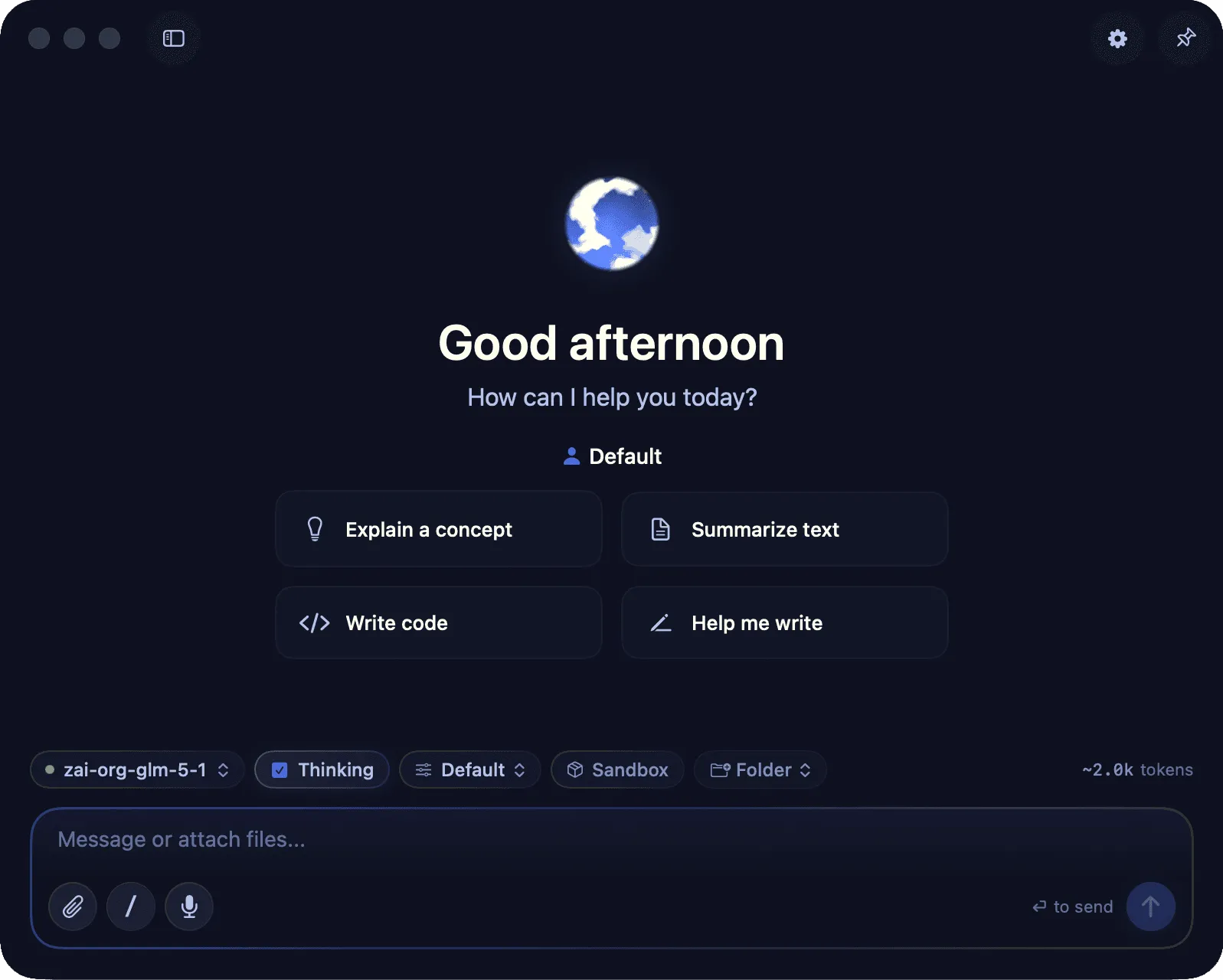
Local by default: a chat that runs on your own machine, no account, no internet required.
Osaurus is a free, MIT-licensed Mac app that runs local LLMs natively on Apple Silicon — built directly on Apple’s MLX rather than wrapping a cross-platform engine — and layers on an agent runtime the usual local tools skip: persistent memory, native app tools, and background schedules. Its standout is the part the find led with: when you opt into a cloud model, an on-device filter scrubs names, emails, and secrets out of the request before it leaves the Mac.
What Osaurus actually is takes a second to place, because it’s two things at once. Underneath is a native local-inference runtime — Swift and SwiftNIO, no Electron — that runs models like Gemma, Qwen, Llama, and GPT-OSS on Apple Silicon and exposes them through OpenAI-compatible endpoints. On top sits what its makers call a harness: a control layer that routes between local and cloud models behind one interface, with shared memory and tools. It comes from Dinoki Labs — founders Terence Pae (ex-Tesla, Netflix) and Sam Yoo — and grew, per TechCrunch’s May 2026 write-up, out of Dinoki, a Clippy-style desktop AI companion, once the team decided a private, own-your-tokens assistant was the more interesting product. So the find’s “novelty companion origin” framing is real, not folklore. It is MIT-licensed and free, with no subscription or usage caps.
The find pitched it as running “natively in Swift on Apple Silicon rather than through Python bindings like Ollama or LM Studio,” and the spirit is right but the detail needs correcting: Ollama and LM Studio aren’t Python bindings — both wrap the cross-platform C++ engine llama.cpp. The genuine difference is that Osaurus is built directly on MLX, Apple’s own on-device ML framework, and ships a curated library of MLX-optimized quantizations tuned for M-series chips. And it isn’t strictly either/or — Osaurus can also connect to Ollama and LM Studio as local backends, or to OpenAI, Anthropic, Gemini, and others in the cloud. What it adds over a plain model server is the agent layer those lack: a three-tier memory (identity, pinned facts, per-session episodes, consolidated by salience), 20-plus native tool plugins spanning Mail, Calendar, Browser, Git, Filesystem, Vision, and spreadsheet/deck formats, and background schedules plus folder watchers that trigger agents on file changes.
The privacy filter is the detail that earns the write-up, and it holds up on inspection. When a request is bound for a cloud model, Osaurus runs it first through an on-device PII detector — OpenAI’s open privacy-filter model (about 1.5B parameters, run locally via MLX) backed by regex for structured secrets — and rewrites names, emails, phone numbers, addresses, account numbers, SSNs, credit-card numbers, and API keys or tokens into stable placeholders like [PERSON_1] before the request leaves the machine; replies come back with the placeholders restored. It’s fail-closed: if a post-scrub scan still spots leakage, the send is blocked rather than sent anyway. That’s a real, specific mechanism, not marketing — worth stating plainly because the find could have been overselling it, and it isn’t.
The honest limits are the ones you’d expect of a young, local-first tool. It is Apple Silicon only — no Intel Macs, no Windows or Linux — and local models cost unified memory: small quantized models run comfortably on a modest Mac but trail frontier cloud models on hard reasoning, while the strongest local models want a lot of RAM. The project is moving fast (it was on 0.21.5 the day before this review, with 400-plus releases behind it), so expect churn and rough edges more than a settled 1.0. And the privacy filter, real as it is, is a mitigation rather than a guarantee — a 1.5B detector can miss context-dependent PII, and it only matters at all when you opt into the cloud; run everything locally and nothing leaves the Mac to filter in the first place. For a Mac user who wants local models with an actual agent around them, and a considered answer to the “but I sometimes need the cloud” problem, it’s an unusually complete take on the idea.