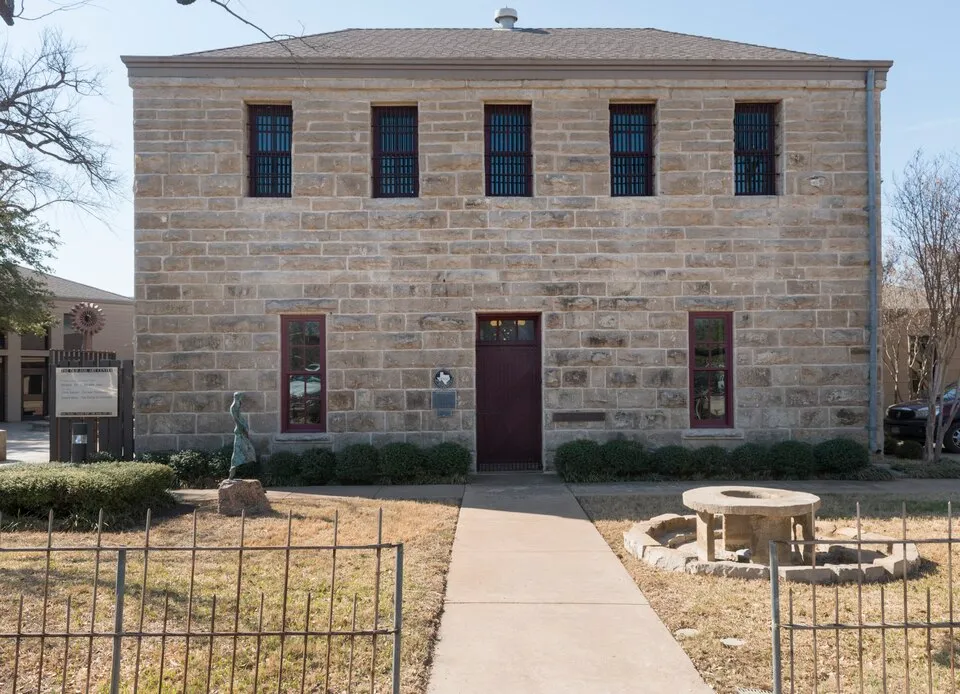
The Old Jail Art Center, Albany, Texas. Photo by Carol M. Highsmith, Library of Congress — public domain.
A limestone jail built in Albany, Texas in 1878 was one heartbeat from demolition in 1940 when a local playwright bought it for $25. Its cells now hang Picasso, Renoir, and Modigliani alongside the prisoner graffiti and mason’s marks the building was never stripped of.
Shackelford County’s first jail cost the county over $9,000 to build in 1877–78 — enough to outrage the taxpayers who footed it — and held prisoners for barely fifty years before a newer jail opened a block away in 1929. The old building sat empty for over a decade, condemned to come down, until Robert E. Nail Jr., a Princeton-educated Albany native better known locally for founding the Fort Griffin Fandangle (the outdoor historical pageant that is still, by act of the Texas legislature, one of the state’s four official plays), bought it for $25 in 1940 and the lot under it for $325 a few months later. He used the old jail as his writing studio until his death in 1968.
His nephew Reilly Nail inherited the building and, in 1980, combined his own twentieth-century art collection with that of his cousin, artist Bill Bomar, plus both of their mothers’ Asian collections, to found a public museum inside it. That founding donation is why a former jail’s holdings now run past 2,200 works and include Picasso, Renoir, Paul Klee, Alexander Calder, Goya, Rembrandt, and a 1918 Modigliani, Girl with Braids, that Bomar bought while living in New York — alongside Han-to-Tang-dynasty Chinese tomb figures, a pre-Columbian collection, and an outdoor sculpture courtyard.
The jail was never gutted to make room for any of it. The limestone blocks upstairs still carry the initials Scottish stonemasons McGuire and Emery cut into their work, plus an X and a triangle used by masons who couldn’t write their names — marks left so the county couldn’t shortchange them, and the reason the building is nicknamed the alphabet jail. In the same cells, prisoner graffiti survives from the jail’s working decades, including that of John Hayden, held eighteen months in 1923 on an assault charge before being acquitted — his name still scratched into the same wall a Klee now hangs near.
It is, by design, a modest operation: eleven-to-five, Tuesday through Saturday, closed Sundays, Mondays, and major holidays, in a Shackelford County town of about 2,000 people three hours west of Fort Worth. Admission has always been free. Nothing about the setting oversells the collection inside it — which, for a building nobody expected to survive 1940, is most of the point.