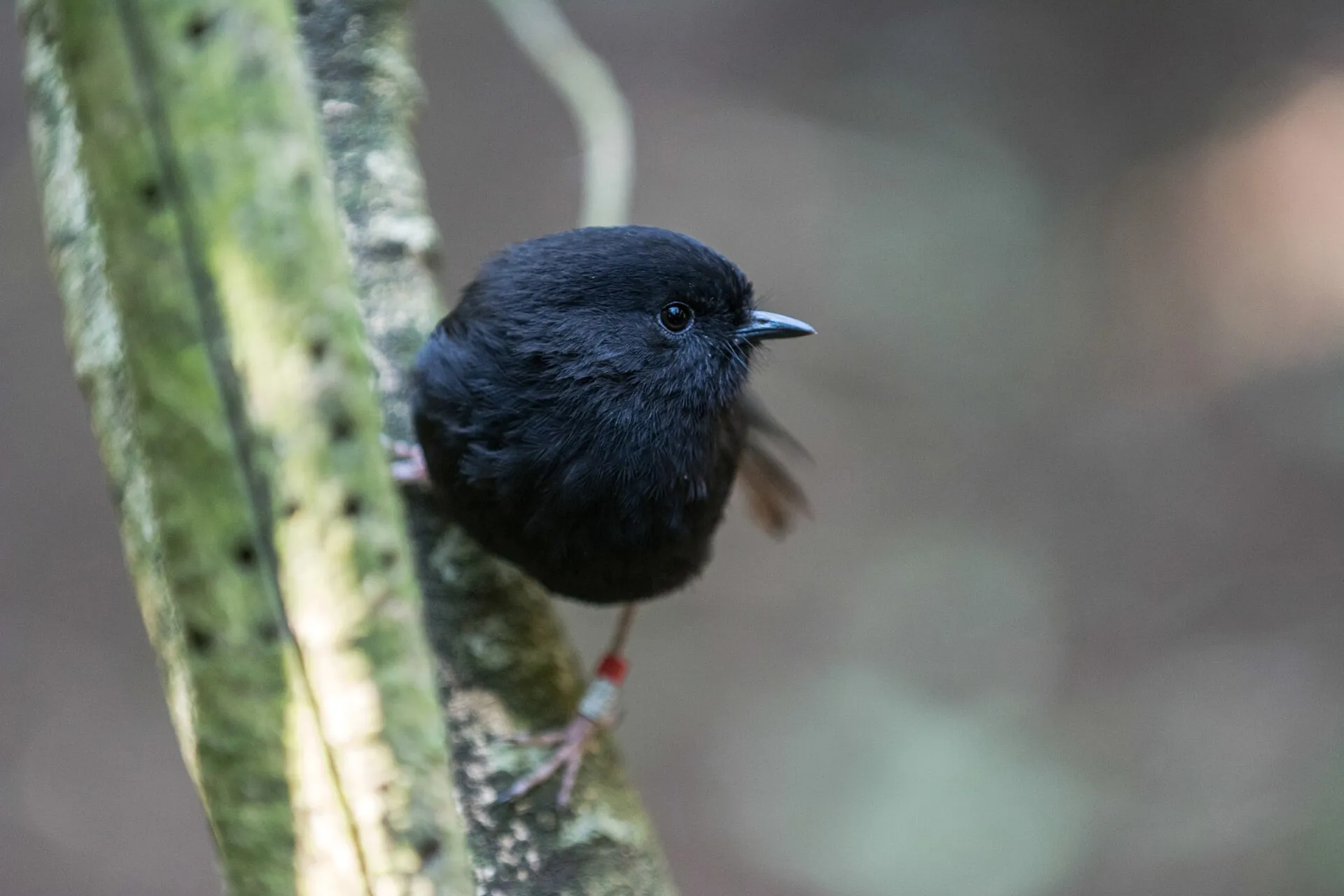
A banded black robin, photographed 20 October 2013. Photo by Leon Berard, via Wikimedia Commons — CC BY-SA 3.0.
.jpeg)
In 1980 there were five Chatham Island black robins left in the world, and one female among them who could still lay a fertile egg. There are roughly 350 now. All of them are hers.
The black robin — Petroica traversi, karure — evolved on the Chatham Islands, 800 kilometres east of the New Zealand mainland, with no mammals to be afraid of. It nests low, mates for life, and raises two chicks a year. Cats and rats came ashore with European settlement and the arithmetic ran the only way it could. By the 1970s the entire species was one seven-bird population clinging to Little Mangere, a rock stack whose forest was collapsing.
In 1976 those seven were carried to Mangere Island, where 120,000 trees had been planted to give them somewhere to live. Two died. By 1980 there were five, in a single breeding pair and three others: Old Blue and Old Yellow, and no other female laying fertile eggs.
The technique that saved them was Don Merton’s, and it worked by exploiting a fact about robins: take the first clutch and the female lays another. So the eggs were lifted and given to other birds to raise. Chatham Island warblers could incubate them and feed the chicks for a few days, then failed to get them to fledging. Chatham Island tomtits succeeded — and succeeded too well. Chicks raised start to finish by tomtits grew up believing they were tomtits, and courted tomtits, which goes nowhere. The fix was timing: hatch under a tomtit, then move the chick back into a black robin nest before it works out what it is.
Old Blue was born in 1970 and died in 1983 or 1984, so thirteen or fourteen years against a black robin’s usual four or five — she was, at the point everything depended on her, already twice as old as her species normally gets. She raised eleven chicks. Everything alive now runs back through her and Old Yellow.
That is also the honest limitation, and the Department of Conservation states it plainly. A species rebuilt from one female has almost no genetic variation left, which makes it unusually exposed to a single disease arriving on a single boot. The population has climbed steadily — around 250 in 2013, 300 in 2021, roughly 350 today across Mangere and Rangatira — but it lives on two predator-free islands and is not going to be allowed anywhere else soon.
Maria Popova’s telling is the one that surfaced this, and it is worth reading for the sentence about tenacious tenderness. Two of its numbers have drifted, though: the tree count is 120,000 rather than twenty thousand, and the 250 figure is thirteen years old. There are a hundred more of them now than that.