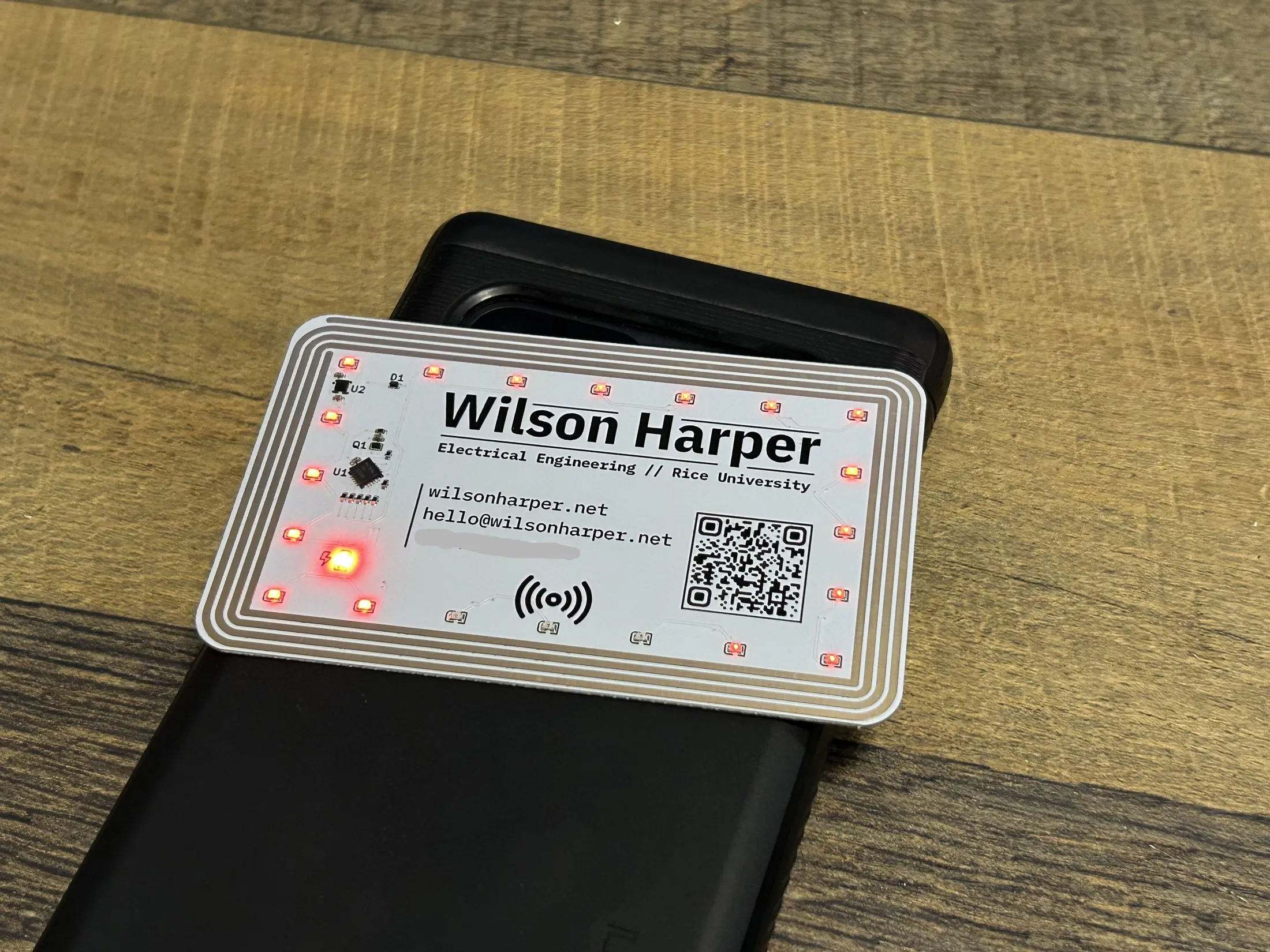
A business card with no battery that lights twenty-one LEDs off the phone reading it — and a write-up that shows you every decision, including the one that ignores the datasheet on purpose.
Your phone emits a magnetic field several times a second; a tag absorbs it and replies by varying how much it absorbs, so the phone reads its own power dips as data. Almost every tag spends that harvested energy on its own circuitry and stops there. A few chips — the NXP NTAG I2C Plus, the ST ST25DV-KC — will route surplus DC out to something else. This card is what happens when you take that pin seriously.
The LEDs are Charlieplexed, which is the trick where tri-state logic lets x pins drive x(x−1) LEDs. The first schematic used an ATtiny412: five GPIOs, twelve LEDs. Harper swapped it for the ATtiny816 — seventeen GPIOs in a 3 mm × 3 mm QFN — for the pin count, and because he needed JLCPCB to assemble the boards lead-free. Six GPIOs now drive twenty Charlieplexed LEDs, plus one plain indicator. That is where the twenty-one comes from.
The best paragraph in the write-up is the one where he disobeys the datasheet correctly. The NTAG’s documentation caps VOUT at 220 nF, because a larger capacitor drags the rail down into an oscillating loop that never finishes booting. He wanted 10 µF. So a resistor limits inrush to a few milliamps while the capacitor charges, a P-channel MOSFET keeps it out of circuit, and after 120 ms the microcontroller pulls the gate low and the capacitor joins as a smoothing reservoir.
The antenna is the other pleasure. It needed roughly 2.75 µH to resonate at 13.56 MHz against the NTAG’s internal 50 pF, and he tuned turn count, trace width and spacing until it landed slightly under — deliberately, because a capacitor can pull a resonant frequency down but nothing pulls it back up. KiCad has no coil tool and none of the plugins would draw a rectangular spiral, so he wrote a script and put it in the repo. The LED traces stop just short of closing a loop at the top of the card: a complete loop would couple with the field and generate eddy currents that kill the thing outright.
It is not a product and never claims to be. Thirty cards exist, credit-card size and thickness with an ENIG finish, programmed over UPDI through three pads on the back at breadboard spacing — with a TVS diode across UPDI and ground, because business cards live in static-y wallets. The board, the BOM and the antenna script are all on GitHub.